
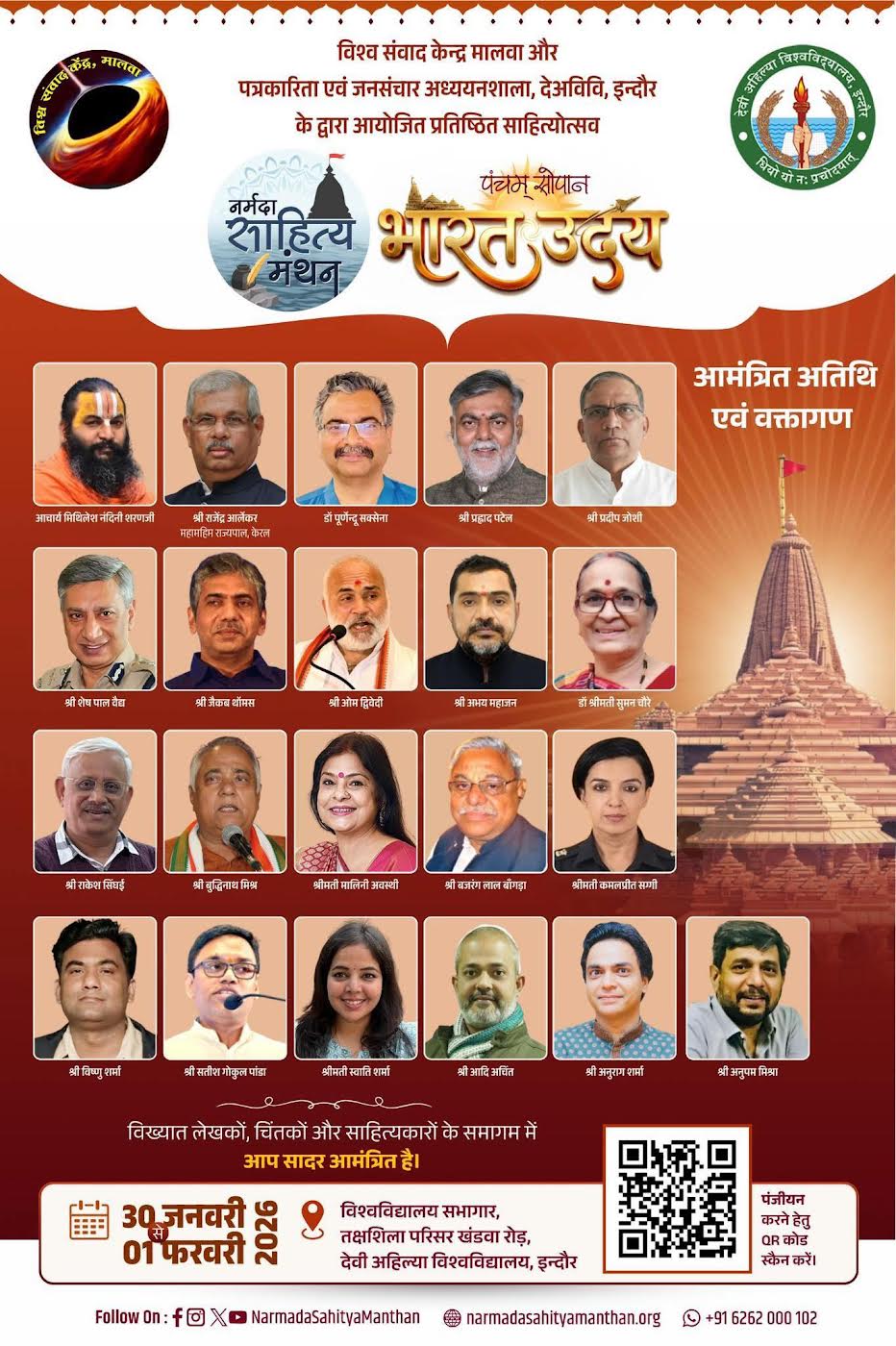
Delhi : A fresh chapter has been added to the series of literary events organized under the umbrella of nationalist thought. Following Lokmanthan, Narmada Sahitya Manthan, and Shabdotasav, the Raipur Sahitya Utsav has now firmly established its presence on the ideological front. These festivals have evolved beyond mere literary gatherings-they have become pillars strengthening the nation’s cultural and ideological consciousness. Until recently, people often said that India needed something like the Jaipur Literature Festival or Jashn-e-Rekhta. That discussion now feels outdated. The platforms rooted in nationalist thought have grown so influential that even left-leaning writers and intellectuals are experiencing FOMO (Fear of Missing Out). Their visible anxiety about the Raipur event—“Why aren’t our people being included?”—speaks volumes. Once, this very group controlled the literary establishment, sidelining senior figures like Prof. Ramdarash Mishra and Nirmal Verma. Awards depended more on cliquism than creativity. Rajendra Yadav himself admitted to securing an award for a writer’s daughter’s wedding. Prizes were distributed like welfare schemes rather than on merit.
Changing Times and Shifting Alliances
Times are changing. Both literature and its readers are transforming. Old monopolies are crumbling, and new nationalist strongholds are rising. Many writers are ready to abandon the sinking leftist boat and board the ship of nationalist thought. The success of Shabdotasav hadn’t even settled when Raipur Sahitya Utsav stole the spotlight. Now, the fifth edition of Narmada Sahitya Manthan is set to arrive in Indore from January 30 to February 1, 2026. These festivals are proof of the continuity and expansion of nationalist thought.
Raipur Sahitya Utsav 2026: Celebrating Chhattisgarh’s Silver Jubilee and Amrit Kaal
The Raipur Sahitya Utsav 2026 took place from January 23 to 25 at Purkhauti Muktangan in Nava Raipur, Chhattisgarh’s capital. Themed “From the Beginning to the Timeless” (आदि से अनादि तक), this three-day event was organized to mark Chhattisgarh’s silver jubilee year and the Amrit Kaal of the Republic. Under Chief Minister Vishnu Dev Sai’s leadership, the state government initiative successfully elevated Chhattisgarh’s literary heritage to national prominence. More than 120 renowned litterateurs participated, engaging in deep discussions across 42 sessions on contemporary social, cultural, and political issues.
Inauguration: Honoring Chhattisgarh’s Literary Legacy
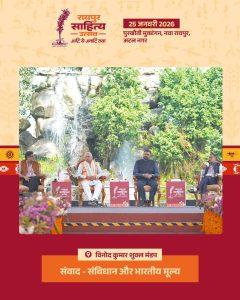
The festival opened on January 23 at the Vinod Kumar Shukla Mandap. Rajya Sabha Deputy Chairman Harivansh and Chief Minister Vishnu Dev Sai lit the ceremonial lamp as chief guests. Deputy Chief Minister Arun Sao, Dr. Kumud Sharma (Vice-Chancellor, Mahatma Gandhi International Hindi University, Wardha), actor Manoj Joshi, and other dignitaries were present. Paying tribute to the late great Chhattisgarhi writer Vinod Kumar Shukla, Harivansh highlighted the ancient tradition of Chhattisgarhi literature. He referenced Kabir’s connections to Kashi and Kawardha, and quoted Maithili Sharan Gupt to underscore literature’s role in guiding society. “A single book and a single writer possess the power to change the world,” he said, emphasizing literature’s contribution to India’s economic progress, self-reliance, and the vision of a developed India by 2047.
Chief Minister Vishnu Dev Sai described Chhattisgarh as Lord Shri Ram’s maternal homeland, declaring that this sacred land had transformed into a grand literary Kumbh. Comparing the freedom struggle to the churning of the ocean, he stressed the responsibility to preserve the memories of luminaries like Makhanlal Chaturvedi, Madhavrao Sapre, Pandit Lochan Prasad Pandey, Padumlal Punnalal Bakshi, and Gajanan Madhav Muktibodh. Quoting Atal Bihari Vajpayee’s poetry, he noted that poetry teaches resistance against injustice. Deputy Chief Minister Arun Sao called it a major step in strengthening Chhattisgarh’s literary identity.
Book Releases and Diverse Sessions
During the inauguration, J. Nandkumar’s coffee table book (on 25 years of Chhattisgarh), Prof. Anshu Joshi’s Lal Deewaren, Safed Jhooth, and Rajiv Ranjan Prasad’s Tera Raj Nahi Aayega Re were launched.
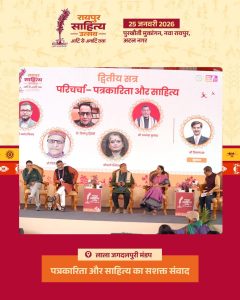
The festival featured 42 sessions—including 5 parallel, 4 group, and 3 dialogue formats. The final day covered topics like journalism and literature, travel blogging, Natyashastra, society and cinema, the Constitution and Indian values, and the interplay between governance and literature. A staging of the play Chanakya, folk dances, folk songs, Chhattisgarhi cultural performances, and a poets’ meet enchanted audiences. At Surendra Dubey Mandap, a grand painting exhibition showcased Chhattisgarh’s cultural heritage—featuring works like Chhattisgarh Mahtari (Sonal Sharma), Bastar Bazar (Awadh Kanwar), Rajim Kumbh (Divya Chandra), and scenes from Ramgarh hills as major attractions. Painting and cartoon workshops guided young participants.
A True Celebration of Roots and Traditions
Rather than Indo-Chinese stalls, the food focused on traditional Chhattisgarhi dishes like kodo rice, chapda chutney, farra, jimikand pickle, and khatti kadhi. Traditional sarees, tribal jewelry such as hasuli and bajuband, brought local customs to life. The confluence of four generations, litterateurs from north, south, northeast, and west, along with local artists’ performances, made it a genuine people’s festival.
Closing Ceremony: Words That Endure
At the valedictory, Governor Ramen Deka affirmed that literature’s importance remains undiminished even in the digital age. Citing Vande Mataram, he stressed the power of words and appealed to extend such festivals to villages and small towns. Finance Minister O.P. Choudhary and theatre personality Sachchidanand Joshi praised the event. Director Chandraprakash Dwivedi lauded the time discipline and attention to detail, suggesting similar events in places like Bastar.
Why Raipur Outshone Others
In many ways, Raipur Sahitya Utsav proved more impactful than Jaipur Literature Festival. First, it was fully centered on nationalist thought, prioritizing ideological clarity and cultural pride—unlike Jaipur, which often dilutes focus in a mix of diverse views. Second, its vibrant inclusion of local folk traditions, tribal culture, and Chhattisgarhi cuisine kept it deeply rooted—while Jaipur leans toward global-urban flavors. Third, it offered genuine public participation and a platform for young creators, which is rarer elsewhere.
Government’s Commitment to Culture
Over the past two years, the Sai government has treated literature and culture as a social responsibility. By emphasizing public involvement, local languages, and youth, the festival succeeded remarkably. The core organizing team—Chief Minister’s media advisor Pankaj Jha, R. Krishna Das, and Shashank Sharma—made it truly memorable.
More Than an Event-A Celebration of Chhattisgarh’s Soul
Raipur Sahitya Utsav 2026 was not just an event; it was a festival of Chhattisgarh’s soul. It will secure the state’s place on India’s literary map and inspire future generations. This stream of nationalist thought is now unstoppable.
