
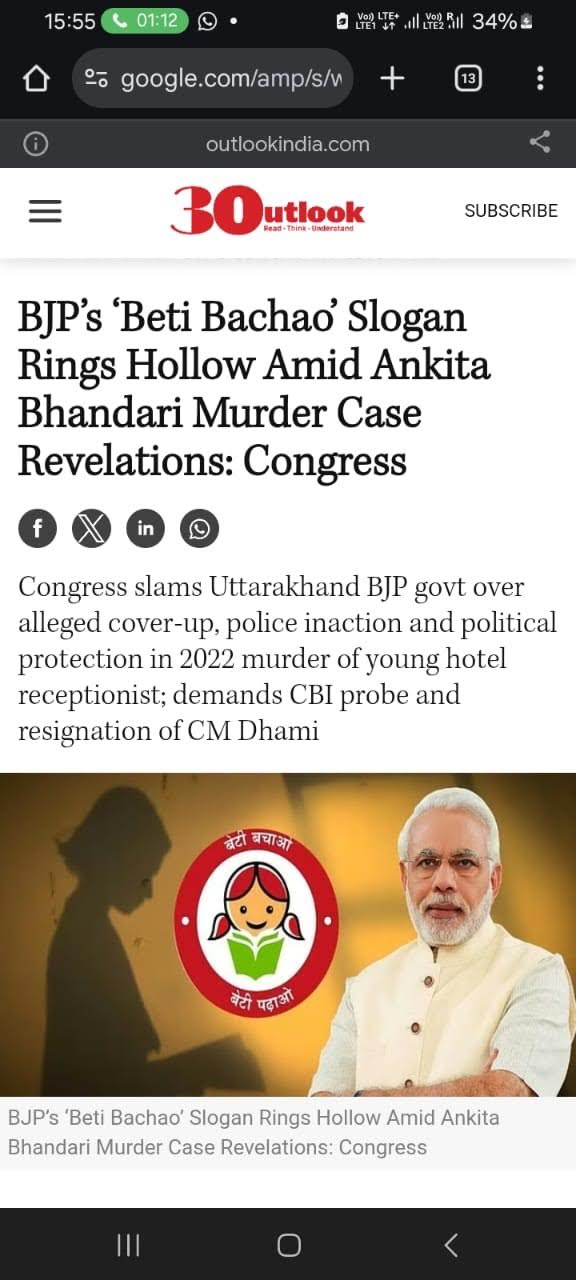
The Unsettling Similarity
Readers scrolling through news feeds recently encountered an unusual sight: two independent outlets carrying the exact same headline, word for word, on the Ankita Bhandari case. The duplication wasn’t a paraphrase or a shared theme—it was identical language, identical framing, identical moral conclusion.
In professional journalism, headlines are not incidental. They are the clearest expression of editorial judgement. When two independent newsrooms arrive at the same headline—verbatim—it raises a straightforward public-interest question:
Was this independently edited reporting, or was it sourced from somewhere else?
The Attribution Gap
If a story is carried from a wire service or shared news feed, journalistic norms are clear: attribute the source transparently. Doing so protects readers, clarifies accountability, and preserves editorial integrity.
Yet in this instance, no clear attribution was visible—neither in the headline nor in obvious story metadata. For readers, that absence matters. Without disclosure, audiences cannot tell whether:
the headline reflects original editorial judgement, a shared wire copy, or a political statement reproduced wholesale. Transparency is not optional in sensitive cases; it is foundational.

When Framing Becomes a Verdict
The shared headline did more than report a statement—it delivered a conclusion. By declaring that a flagship slogan “rings hollow,” the framing moved from describing a political claim to endorsing its moral weight.
This matters because the Ankita Bhandari case is not merely a political talking point. It is an active site of public grief, legal process, and institutional responsibility. Journalism’s role here is to interrogate claims, not to amplify them as verdicts—especially when those claims originate from one political actor.
Independent Media, Identical Voice?
Independence in journalism is not only about ownership or funding; it is also about editorial distance. Different newsrooms are expected to:
ask different questions,
foreground different facts,
and apply their own editorial reasoning.
When that diversity collapses into headline uniformity, readers are justified in asking whether narrative convergence is replacing independent judgement. MediaScan does not allege collusion. But patterns matter—and identical headlines across independent platforms are a pattern worth examining.
What’s Missing-and Why It Counts
Equally telling is what the coverage did not foreground:
no clearly presented official response alongside the political claim,
no primary legal documents or court references to anchor the narrative,
no expert voices to distinguish allegation from adjudication.
The result is a story that risks politicising a crime rather than illuminating it.
Why Readers Should Care
Repetition creates perception. When the same headline appears across outlets, it can feel like confirmation-even when it is not. Over time, this blurs the line between reported fact and repeated framing.
For a public already navigating mistrust and information overload, journalism must work harder, not less, to show how stories are sourced, edited, and framed.
The Questions That Remain
MediaScan leaves readers with questions-not accusations:
Was this a wire story, and if so, why wasn’t that made explicit?
How did two independent editorial desks arrive at identical wording?
Why was a political claim framed as a moral verdict in the headline?
What safeguards exist to prevent narrative herding in sensitive cases?
These are questions journalism should welcome. Accountability strengthens credibility; silence erodes it.
A Call for Clarity
Ankita Bhandari deserves justice. Her family deserves dignity. And readers deserve clarity about how narratives are formed—especially when they appear, word for word, across independent newsrooms.
Journalism’s power lies not in speaking with one voice, but in earning trust through transparency. MediaScan exists to ask these questions so the public can read with open eyes. Media Scan Watching the media, so the public can judge for itself.