
Vinod Kumar Shukla
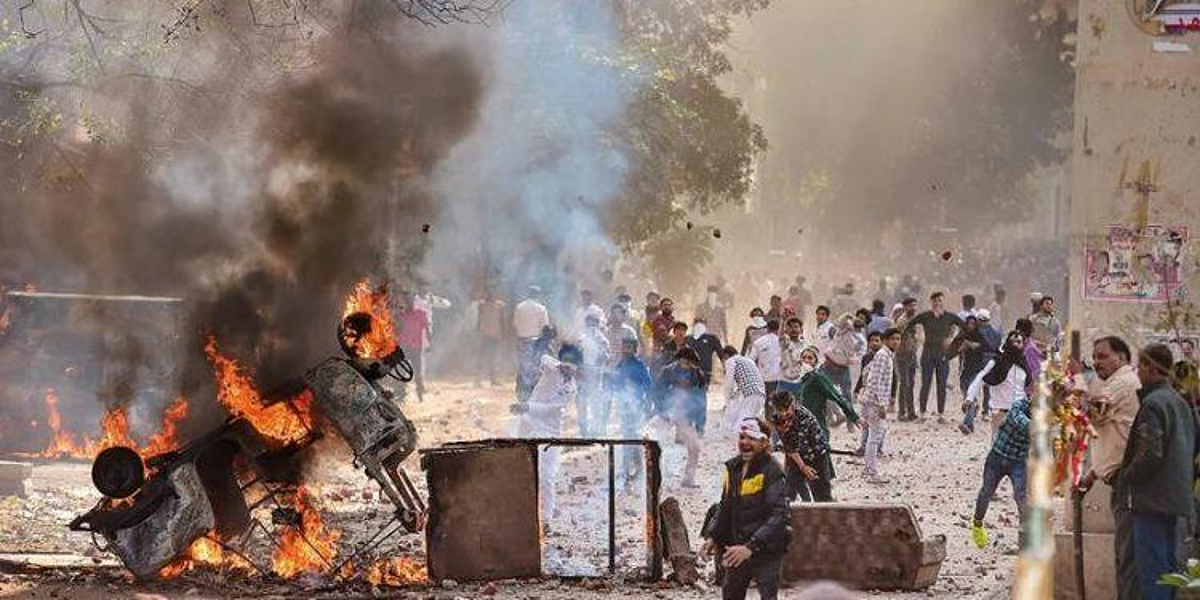
Delhi : The Delhi riots have completed six years on February 23, 2026 but instead of victims getting justice, attempts are being made to turn the terror accused a revolutionary when an ‘anthology’ was released in praise of Umar Khalid – who is in jail for inciting violence and orchestrating riots in Delhi in which 52 people were killed including a policeman called Ratan Lal, an IB officers Ankit Sharma and several others. Interestingly no one is repeating the maxim ‘Justice delayed is justice denied’ for the riot victims, on the contrary a concerted global campaign is unleashed to influence the Indian courts when his bail along with six other accused was being heard and even after the bail was rejected.
New York city mayor Zohran Mamdani too was stepped in with his Muslim victimhood card narrative in support of Khalid with his hand written message that he is in his thoughts. Khalid’s parents have all the way gone to the city to meet him to build up a campaign for his release by unduly trying to influence the court. Five other accused in the case were granted bail while Khalid and Sharjeel Imam were denied not only from the High Court but also from the Supreme Court. But before the case was heard in the Apex Court, all kinds of arguments that why he should be given bail were put forth at every possible platforms like he being a Muslim minority, a student of an institute to the repute of JNU, his PHD thesis being the world class, his very arrest is a political incarceration, his personal liberty is jeopardised by the arrest, his partner stopped eating Chinese food her favourite after his arrest, the reputation of India would get a beating if he is denied bail, human rights violation and Constitution of India will be in danger if he is denied bail and is in danger after he is denied the same to list a few.
But the Apex Court was very clear in its observation and addressed one after another, when it said while denying the bail, “In the application of such law [UAPA], the Court does not proceed on identity, ideology, belief, or association. It proceeds on role, material, and the statutory threshold governing the exercise of jurisdiction. Criminal law does not mandate identical outcomes merely because allegations arise from the same transaction.”
The Apex Court ruled while denying bail to Khalid and Imam that both of them were ‘masterminds’ and the material on record made out a ‘prima facie case’ against them under the Unlawful Activities (Prevention) Act (UAPA). The SC underscored the expansive statutory definition of a ‘terrorist act’ as Section 15 of the UAPA provides an exceptionally broad definition of terrorism. It goes beyond specifying weapons such as explosives, firearms, or poisons and includes acts committed through ‘any other means.’
Those who are arguing for Khalid outside the court are questioning this very provision by calling it arbitrary. They have philosophical arguments for supporting him but interestingly they did not read the judgment. The Supreme Court ruled that “the Constitution guarantees personal liberty, but it does not conceive liberty as an isolated or absolute entitlement, detached from the security of the society in which it operates. The sovereignty, integrity, and security of the nation, as well as the preservation of public order, are not abstract concerns rather they are constitutional values which Parliament is entitled to protect through law.”
Here some other facts also need to be highlighted that a police constable on duty Ratan Lal was killed, an IB officer Ankit Sharma was stabbed and killed and an IPS officer Amit Sharma was mob attacked with Muslim women working as shields to the mob who were allegedly instigated by these accused. But the poor JNU student Khalid and others, who openly claims India being in the illegal occupation of Jammu and Kashmir and Imam wanted to cut north east from the rest of India from Chicken’s Neck collecting 5 lakh Muslims, were able to afford the best lawyers in the country including Kapil Sibal, Abhishek Manu Singhvi, Salman Khurshid, Siddharth Luthra, Siddhartha Dave, Siddharth Aggarwal and Advocate Gautam Khazanchi and their team of lawyers.
The action of likes of Khalid and Imam has been an attack on these set constitutional norms which court outlined in its ruling when it said, “Those alleged to have conceived, directed, or steered unlawful activity or terrorist activity stand on a different legal footing from those whose alleged involvement is confined to facilitation or participation at a different level. To disregard such distinctions would itself result in arbitrariness. The present decision reflects this constitutional method. It applies the law as it stands, recognising that individual liberty must be protected, but that it must also withstand the legitimate demands of national security and collective safety. This balance is not a matter of preference rather it is a matter of constitutional duty.”
The propagandists in support of these outlaws did not spare even the court and target it by using various adjectives with a caveat that they respect the court verdict and have nothing against the courts. But they do exactly the opposite as when the matter is sub-judice, the ecosystem has come up with a book on him called “Umar Khalid and His World: An Anthology” which is not ready to even acknowledge their crime. Their protest against CAA which in itself was a propaganda and divorced from the fact as it has got nothing to do with citizenship of Indian Muslims. People studying in premier institutions were unable to understand this is not true rather protesting against CAA suited their communal ideology by hiding behind communist ideology. The book serves as a tribute to those jailed or targeted for speaking out against injustice which in itself is half-truth.
They find fault with the judiciary which is accused of getting manipulated to undermine justice but also with the current government by calling it a theatre of the absurd. It talks about historical revisionism and genocide being the most favourite word that they use the way it suits them. The ecosystem talks about the continued five-year incarceration of anti-CAA protesters but the riots that they orchestrated don’t figure in their talks. When a so-called protest kills 52 people, it is simply giving a bad name to protest and good name to terrorism.
The perennial question remains unanswered: Why do JNU students are always at the epicentre of every major movement, from anti-CAA and farmer protests to internal campus disputes and even on the issue of Palestine? But they are called “foot soldiers of the Constitution” however a significant contradiction remains. Where in the constitution is its foot soldier allowed to incite violence or orchestrate riots?