
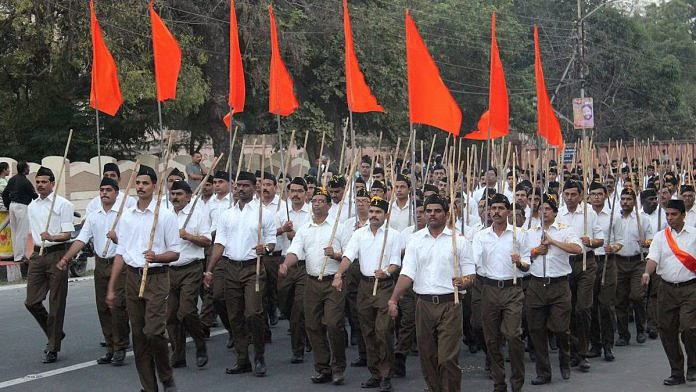
Key points from the address by Param PujyaSarsanghchalak Dr. Mohan Bhagwat Ji:
• Transformation through Conduct: We can only change another person’s thoughts through a Mitra Bhav (feeling of friendship) and our own conduct. Swayamsevaks of the RashtriyaSwayamsevak Sangh (RSS) follow this very method to bring about transformation everywhere in society, including among the youth.
• Scope of Sangh: The Sangh only conducts Shakhas; it does nothing else. It is the Swayamsevak of the Sangh who doeseverything.
• Hindutva vs. Secularism: Hindutva is a value system, whereas secularism is a state system. In the context of Bharat, ‘secularism’ is an irrelevant word.
• Dharma vs. Religion: Dharma and ‘religion’ are not synonymous terms.
• Rituals and Dharma: If someone does not go to a temple, it does not mean he/she is Adharmic(irreligious). Karmakand (Rituals) and Puja-Path (worship) alone are not Dharma. However, rituals and worship are not without purpose either.
• Meaning of Secularism: Secularism means being Panth-nirpeksh (non-sectarian), not indifferent to Dharma (Dharma-nirpeksh).
• Four Pillars of Dharma: Dharma has four pillars: Truth (Satya), Compassion (Karuna), Purity (Shuchita), and Penance (Tapas). Bharat has continuously walked on these path, which is why it is progressing.
• Cleanliness Begins at Home: The subject of cleanliness must start with oneself. Cleaning one’s own home and the street in front of it, even doing just this much, will start showing changes. One should start by not throwing garbage in public places oneself and insisting the same from friends; this will create an atmosphere of cleanliness.
• Sanskrit Language Promotion: Sanskrit Bharatiis working for the promotion of Sanskrit. They conduct workshops for Sanskrit conversation where the practice of speaking Sanskrit is carried out. The number of Sanskrit speakers is gradually increasing. Muttur village in Karnataka has become a fully Sanskrit-speaking village. The insistence on Sanskrit must remain.
• Knowledge and Wisdom: One should have all kinds of knowledge, but it must be accompanied by Vivek (wisdom).
• Traditional Values: Promoting traditional values is not being regressive or conservative.
• Youth Potential: Our youth are capable of great achievements. If our youth imbibe Rashtra-bhakti (patriotism) and Sanskriti-bhakti(devotion to culture), they will ensure the welfare of the entire world using modern technology.
• Healthcare Access: Primary and secondary healthcare should be available at the village level and, at the maximum, at the district level.
• Global Conflicts: Whatever is happening in Russia, Ukraine, and Israel makes one thing clear—Jiski Lathi Uski Bhains (Might is Right). These nations go around preaching peace to the world, yet they are now engaging in warthemselves.
• Sovereignty and UN Seat: We must achieve all forms of sovereignty. There is no need for us (Bharat) to say, “Give us a seat in the Security Council”; rather, they should say that Bharat must be given a seat.
• Neighbourhood Policy: Our neighbouring countries are, in a way, our own. It is our responsibility to establish person-to-person relationships. The government should also create facilities for this. The vision should be that we have to connect them—such a perspective is needed. Current foreign policy does not need correction, rather alertness and speed.
• Hindus in Bangladesh: When will the plight of Hindus in Bangladesh end? The Hindu minorities in Bangladesh will have to stay united. Hindus around the world must help them while remaining within their limits. We are also doing the same.
• Education in Madrasas: Madrasas should also provide national and modern education.
• Openness of Sangh: Anyone can come and see the work of the Sangh. If you find there that the Sangh is anti-Muslim, then fine; but if that is not the case, then change your perception. I would just say that this is no longer a matter of explaining—come and see. Many people have come to see and, after seeing, have accepted that the Sangh is not anti-Muslim.
• Ayodhya and Mathura/Kashi: As far as the question of the Ram Temple in Ayodhya is concerned, the temple was built there after the court’s verdict. Now, constructing anything in the name of Babri Masjid is a political conspiracy to keep the conflict alive.
• Muslim Integration: Muslims must understand and say that while they differ in terms of sect/Mazhab or mode of worship, they are part of the larger thought system based on common ancestors and Sanskriti.
• Religious Conversion: If the castes that did not change their religion until now are changing it now, then our society itself is to blame. We must go to them; do not neglect them. Participate in their joys and sorrows. When we become Samaras (harmonious) with them, those who are converting will not do so, and those who have already done so will return.
• Constitution and Hindutva: The Preamble of the Constitution briefly describes Hindutva itself. It does not explicitly contain the word ‘Hindu,’ but there is liberty, justice, and freedom for all forms of worship. Dr. Ambedkar Saheb said that I have not taken all this from abroad; I have taken it from Tathagata Buddha. Bandhu-bhav(fraternity) is Dharma, he said in his speech. A Constitution based on Dharma is the specialty of a Hindu Rashtra (Hindu Nation). Although the word ‘Hindu’ was not used, by nature, everyone in the Constituent Assembly was of that opinion. Now, does the sun rising in the east also require constitutional approval? Hindusthan is a Hindu Rashtra. This is the truth.
• Caste System: We had castes earlier too, but there was no discrimination. This caste discrimination came due to time, place, and circumstances, and the time for it to go has arrived. We have a national identity since time immemorial; that is Hindu, and that is Bharatiya.
• Women and Sangh: The Sangh does not operate based on Manusmriti. We have our own constitution. We are not anti-women. We organise the entire society. Through our own methods, we have involved women in many activities. The Rashtra Sevika Samiti carries out the work of Vyakti Nirman (character building) for them.
• Weakness of Hindu Society: The biggest deficiency of Hindu society is only one—it is not connected in the way it should be. Whereas Hindu society possesses intellect, knowledge, valour, and everything else.
• Manipur Situation: During my recent visit to Manipur, I spoke to youth from all sects, groups, and factions. The situation is improving there. It will take some time to heal the wounds they have undergone. For this, continuous dialogue must be maintained. The roots of those living in all the north-eastern states are connected to Bharat.
• Population Policy: Increasing population is not a burden; rather, a policy should be made with a long-term vision to manage the population.
• Live-in Relationships: Responsibility must be taken; this is not a matter of physical satisfaction alone.
• Ideal Family Planning: Based on the recommendations of doctors and population experts, it can be said that marriage between the age of 19 and 25 and having three children at the right time is healthy for a couple.
• Respect for Freedom Fighters: If any section of society makes any effort to bring respect to the country’s freedom fighters and great personalities, the Sangh will provide its cooperation and support. There have been thousands and lakhs of such great personalities who have not received the appropriate name, recognition, and respect.
• Corruption: Despite having all kinds of facilities and resources, some people indulge in corruption. It is clear that corruption happens not due to a person’s lack (poverty) but due to their moral decline.
• Relationship with BJP: We have always remained distant from the leadership of the BJP; this has been the case since the days of the Jana Sangh. Our connection remains with the Swayamsevaks of the Sangh. Narendra Bhai and Amit Bhai are Swayamsevaks of our Sangh, and we have close relations with them. A few days ago in Andaman, Amit Bhai was sitting near me. There is no such thing as distance or closeness.
• Goal of the Sangh: The Sangh and its Swayamsevaks are working continuously only to organise the entire Hindu society. We will keep working for this alone. We will continue doing this until it happens. We work with the belief that we will achieve this goal in this very life. If it does not happen, we will take another birth and do the same work. Our thinking is very clear that we have set out to organise the entire Hindu society, not to create a separate society within the society.
• Forgotten Glory: We have forgotten our glorious history. We must know the glory established by our ancestors.
• Bharat’s Role: Bharat has to perform the task of continuously giving Dharma to the world.
• No Desire for Power: The Sangh does not want power, nor does it want to compete with anyone. The Sangh has only one goal — Tera VaibhavAmar Rahe Maa, Hum Din Char Rahein Na Rahein (May your glory remain immortal, O Mother, whether we live for a few days or not).