
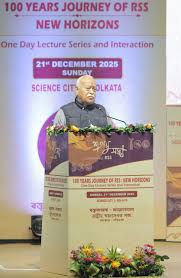
Date: December 21, 2025, Second Session
Salient points of the address by Poojya SarsanghchalakDr. Mohan Bhagwat ji
• Ideas can compete, but it is important that everyone’s hearts remain united. In America, Abraham Lincoln strengthened the bond of unity by appointing his opponent as the Secretary of Defence.
• The Sangh work is a pure and sattvic (virtuous) endeavour founded on friendship.
• You will truly understand the Sangh only when you come to the Sangh Shakha in person, see it, and understand it for yourself.
• Sangh has been functioning with a spirit of collectiveness since the day of its establishment.
• The work of the Sangh is divine work. Our effort is to become worthy of it. The affection of society has always been with us, and that is why the Sangh has progressed.
• As the RSS grew, some folks started getting uneasy. Pushback ramped up based on clashing ideas. No group in world history has faced such fierce, drawn-out opposition as the RSS. There have been attacks on its Swayamsevaks, even killings, yet the Sangh does not hold any bitterness towards its opponents, because they too are part of the same society.
• Sangh moved forward with simplicity, away from fame, with discipline and courteous language. It moved forward not through struggle, but through coordination and harmony.
• The Sangh is economically self-reliant. They account for every single penny and do not take anything from outside. The Swayamsevaks manage everything themselves. Because the Sangh is self-reliant, therefore it is self-respecting as well.
• We remained vigilant in an environment of opposition. Now, in an environment of favourability, we must rapidly expand our work. Strengthening the quality of our Swayamsevaks is the agenda for the years beyond thecentenary year.
• It is not about creating good people in society; rather, there are already a large number of good people in society. A large number of people are quietly serving society, spending their own money without seeking fame. We call this the Sajjan Shakti (noble force) of society. Sangh will help this noble force of society by connecting them, working together in a spirit of mutual cooperation, building a network among them, ensuring coordination with each other, and bringing complementarity into their work.
• The time has come to bring about a change in behaviour across society, based on a nationwide cadre of workers. The swayamsevaks should first bring about a change in their own conduct by adopting five key points; we have already begun this in the centenary year of the Sangh.
o Social Harmony (Samajik Samarasata): Ensure equal access for all Hindus to temples, water sources, and cremation grounds, eliminating caste-based discrimination.
o Family Awakening (Kutumb Prabodhan): Hold weekly family gatherings for shared meals, bhajans, dialogue, and discussions on traditions without criticism.
o Environmental Protection: Maintain clean homes and streets, save water, avoid single-use plastics, and plant trees on rooftops.
o Self-Awareness and Swadeshi (Swabodh): Prioritise indigenous goods, language, attire, and food for self-reliance and cultural identity.
o Civic Duties (Nagarik Kartavya): Read andimbibe the Constitution of India particularly its Preamble, Fundamental Duties, Directive Principles, and Rights to families and children.
• Bharat, Hindusthan and Hindu are all synonymous terms.
• The Sangh considers entire society as its own. On the basis of this sense of belonging, we all should be one. It is not necessary that everyone must come to the SanghShakha. Coming is certainly good, because there is no other system or mechanism that imparts training in selfless attitude and authenticity quite like the Sangh Shakha.
• The Sangh doesn’t work to take credit in its own name.