
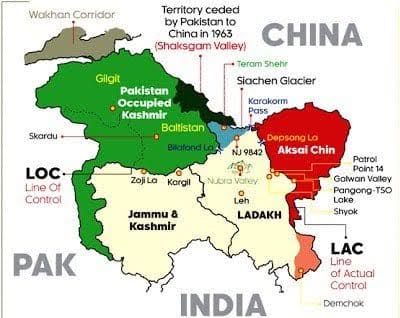
Delhi : 22 February holds a special place in India’s history as POJK Resolution Day. On this day in 1994, the Indian Parliament unanimously passed a historic resolution declaring that Jammu and Kashmir is an integral and indivisible part of India—it has been, and it will remain so. The resolution demanded that Pakistan immediately vacate the territories it has illegally occupied and expressed firm determination to oppose any separatist or divisive attempt by all necessary means.
This resolution is not merely a political document; it is a living symbol of the nation’s unity, sovereignty, and territorial integrity. It reminds us that India’s borders are inviolable and no external force can fragment them.
The 1947 Invasion and the Background of Accession
In 1947, immediately after the accession of the princely state of Jammu and Kashmir to India, Pakistani forces launched a large-scale armed invasion in October. Maharaja Hari Singh signed the Instrument of Accession on 26 October, following which the Indian Army liberated key areas including the Srinagar Valley. However, due to the ceasefire resolution of the United Nations Security Council, further military advance was halted. As a result, significant territories such as Mirpur and Poonch in the Jammu division, Muzaffarabad in the Kashmir division, and Gilgit-Baltistan remained under Pakistan’s illegal occupation. This occupation continues to this day and remains the deepest wound on India’s territorial integrity.
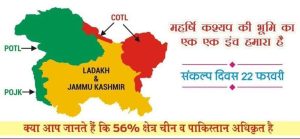
Current Classification and Geographical Status of Occupied Territories
Today, these illegally occupied areas are officially classified into three major parts:
Pakistan Occupied Jammu & Kashmir (POJK) – Primarily the Mirpur and Muzaffarabad regions, with an area of approximately 13,297 sq km.
Pakistan Occupied Ladakh (POTL) – Gilgit-Baltistan region, approximately 67,791 sq km.
China Occupied Ladakh (COTL) – Aksai Chin, Shaksgam Valley, and other parts, totaling 42,735 sq km.
Out of the original 2,22,236 sq km area of the Jammu and Kashmir princely state, nearly 54.4% of the land (about 1,21,000 sq km) remains under illegal control of Pakistan and China. On 31 October 2019, the Government of India released a new official map clearly depicting these territories as integral parts of India—a revolutionary departure from the earlier ambiguous lines. The central government now officially uses the term “Pakistan Occupied Jammu & Kashmir” (POJK), reinforcing the region’s rightful identity.
The Massacres of 1947–48: Atrocities on the Hindu-Sikh Community
During the invasion, the Hindu and Sikh communities in POJK areas faced unprecedented brutality. In the Muzaffarabad massacre, thousands of innocent people were killed and over 1,600 women and girls were abducted. In Mirpur, more than 20,000 Hindus and Sikhs were slaughtered, and thousands of women were sold in markets across Pakistan, Afghanistan, and Arab countries. Similar horrific massacres took place in Baramulla, Kotli, Rajouri, Bhimber, and the Ali Beg Gurudwara camp. In Rajouri, on the day of Diwali, women and children chose jauhar-like sacrifice to avoid falling into enemy hands.
These events displaced millions. Today, more than 12 lakh victims of this tragedy survive-most of them resettled in Jammu, with others scattered across more than 70 cities in the rest of the country. These displaced people are India’s foremost stakeholders, still reliving the pain of partition. Delhi’s Mirpur Balidan Bhawan stands as a living memorial to these tragedies.
Destruction of Cultural Heritage
Sacred sites of faith and culture in POJK were also targeted. Sharada Peeth (seat of the Goddess of Knowledge), Raghunath Temple (Mirpur), Devi Gali (Poonch), Mandhol Sun Temple, and Kirtan Garh Gurudwara (Ali Beg) have been reduced to ruins. These are direct assaults on the roots of Indian civilization and stand as evidence of attempts to erase India’s cultural heritage.Pakistan’s Current Activities and Exploitation in POJK
Today, Pakistan runs terrorist training camps in POJK and openly exploits local resources such as world-famous marble, gold, iron ore, and uranium. Gilgit-Baltistan is treated as a colony where human rights violations are routine—restrictions on protests, abductions, killings, and denial of basic facilities are common. In recent years (2025–2026), political repression, suppression of demonstrations, education crises, and economic weakening have intensified under Pakistan’s policies.
The Message of Resolution Day: The Dream of Akhand Bharat
The resolution of 22 February 1994 is India’s collective resolve against all these injustices. This day reminds us that the dream of complete liberation of Jammu & Kashmir and an undivided India remains unfulfilled. The suffering of POJK displaced persons, the sacrifice of martyrs, and the resolve of Parliament together send a firm message: “Vacate the illegally occupied territories-India will remain indivisible.”
This resolve inspires us that through public awakening and resolute policy, the day will surely come when POJK will be fully integrated into the mainstream of India.
