

The ‘Delhi Shabdotsav 2026’ held from January 2 to 4, 2026, at the Major Dhyan Chand National Stadium in New Delhi was not merely a three-day cultural and literary event. It was the clarion call for the rejuvenation of India’s cultural and ideological consciousness. Organized jointly by the Delhi Government and Suruchi Prakashan, this festival established a new benchmark in the world of literary events. Where for decades certain literary platforms have been dominated by a particular ideology, Shabdotsav presented an alternative vision centered on patriotism, devotion, unity, and Indianness. It was neither a copy of Jashn-e-Rekhta, nor of the Jaipur Literature Festival, nor of any other existing event. This was its own independent Shabdotsav—a platform with a clear direction and intent.
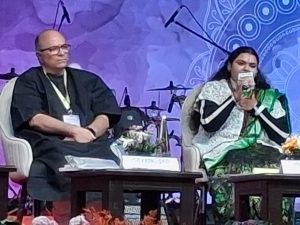
The theme of the event was ‘Bharat Abhyudaya’, symbolizing India’s journey from the Vedic era to the digital age. In the inauguration ceremony, Delhi Chief Minister Rekha Gupta said that this is the time for India’s intellectual and cultural renaissance. Culture and Tourism Minister Kapil Mishra called it a ‘surgical strike on ideological terrorism’. Over three days, more than 100 speakers participated, over 40 books were launched, and programs like folk dances, devotional music, and open mic attracted the youth. The presence of thousands of attendees proved that events based on nationalist and spiritual values can also achieve widespread acceptance.
Echoes of Patriotism and Hindutva from the Stage
The greatest feature of Shabdotsav was its clear direction. No divisive voices echoed here, no anti-national agenda was present. Children and youth were seen swaying not to songs like ‘Dum Maro Dum’, but to devotional songs of Lord Ram, Shiva, and Radha Rani. Performances by artists like Sadho Band and Hansraj Raghuvanshi filled the stadium with waves of devotion and patriotism. Folk songs and dances brought alive the grandeur of Indian culture.
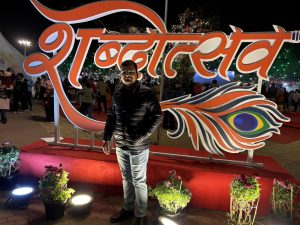
The main session on the first day was ‘Sanghe Shakti Kaliyuge’, in which RSS All India Propaganda Chief Sunil Ambekar participated. He described ‘Vande Mataram’ as a mantra during the Bengal Partition, saying that the British had banned it due to its widespread impact. He said that Dr. Hedgewar’s life was dedicated to the nation, and he founded the RSS for social reform keeping social values in mind. Ambekar explained the three processes of joining the RSS: Shakha, Ideology, and Work. He emphasized that RSS branches continue relentlessly no matter how adverse the times. In the context of Hindutva, he said that binding India in the thread of unity is Hindutva itself. Sunil ji clarified that the RSS has no desire to be called the largest organization; rather, it wants to dissolve into society and establish harmony. He said that Panch Parivartan works towards social reform, which can be realized by coordinating with all castes in society.
Deep discussions on judicial and cultural issues took place in other sessions. In the ‘Objection My Lord’ session, senior advocates Vishnu Shankar Jain, Vikramjeet Banerjee, Aman Lekhi, and Siddharth Luthra participated. Vishnu Shankar Jain spoke on issues like Mathura Janmabhoomi and Gyanvapi, calling the addition of ‘secularism’ to the Constitution during the Emergency the biggest deceit. Aman Lekhi described Hindutva as a vast ideology. Vikramjeet Banerjee advocated for Uniform Civil Code.
In the ‘Generation Z: Charioteers of Developed India’ session, personalities like Chandraprakash Dwivedi, Vishal Chaurasia, Bhasha Sambhali, and Abhilipsa Panda participated. Dwivedi ji gave examples of ancient young heroes like Prahlad and Dhruv. Vishal Chaurasia called Adi Shankaracharya the first entrepreneur. Abhilipsa Panda emphasized devotion and goal-setting.
In the closing session, Uttarakhand Chief Minister Pushkar Singh Dhami was the chief guest. In the dialogue on the topic ‘Dharmarakshak Dhami’, he said that he remains committed day and night to the people of Devbhoomi. He mentioned laying the foundation of Dharm Dhwaja in Haridwar, which symbolizes the cultural consciousness of India and Devbhoomi. He said his government is committed to preserving divine values and divinity. He mentioned demolishing over 600 illegal structures in Uttarakhand, calling it a major action against land jihad. His government implemented the Uniform Civil Code first, in line with the Constitution, and will continue serving Devbhoomi in the future. He said Shabdotsav will become a carrier of Indian culture.
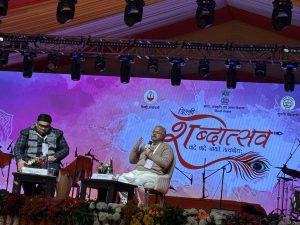
New Discourse on Qutub Minar – Call for Sanatan Heritage
An important discussion in Shabdotsav centered on the claims of former Archaeological Survey of India (ASI) Director Dharmveer Sharma. He called the Qutub Minar an ancient Vishnu observatory. Citing evidence like the rectangular foundation, 27 windows, the shadow during southern solstice, and sixth-century verses, he said these are proofs from architecture. Symbols of Hindu deities still present, like the image of Lord Ganesha found during repairs.
Following these claims, saints from Kashi demanded that the Qutub Minar be handed over to Sanatanis and a grand Vishnu temple be built there. Peethadheeshwar of Patalpuri Math, Balak Devacharya Ji Maharaj, said that during Muslim rule, temples and monasteries were demolished to build mosques, but even today signs of Hindu deities are present. He appealed to the government to respect Sanatan sentiments. This discourse reflects the ideological depth of Shabdotsav, where myths of history were broken and a new narrative was voiced boldly.
Youth Enthusiasm and Future Challenges
Great participation of youth was seen in Shabdotsav. The open mic provided them a platform to hone their expressions. Students from 40 universities in Delhi-NCR showed enthusiasm. This event proves that even in the age of social media, youth want to connect with their roots, provided they get a positive and nationalist platform.
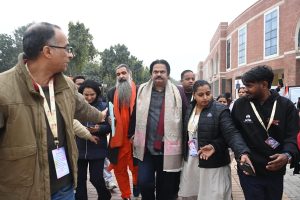
Some critics may call it unplanned, but the very first event was proof of its success. If this event continues without obstacles for five years, it will set an example for other literary festivals.
A New Beginning, A Strong Alternative
Shabdotsav is not just an event, but a direction. It proves that festivals of literature and culture can be celebrated with patriotism and devotion, without any divisive tones. In the coming years, it will become an inspiration and competitive standard for other events. Thanks to God that it is not a copy of anyone, but a platform with its own independent identity. If the chosen path is right, the destination will surely be reached. Shabdotsav has emerged as a symbol of Bharat Abhyudaya—the beginning of an ideological transformation.
