
Aman D. Vashishtha, Executive Director, Bharatiya Neeti Samvad Kendra
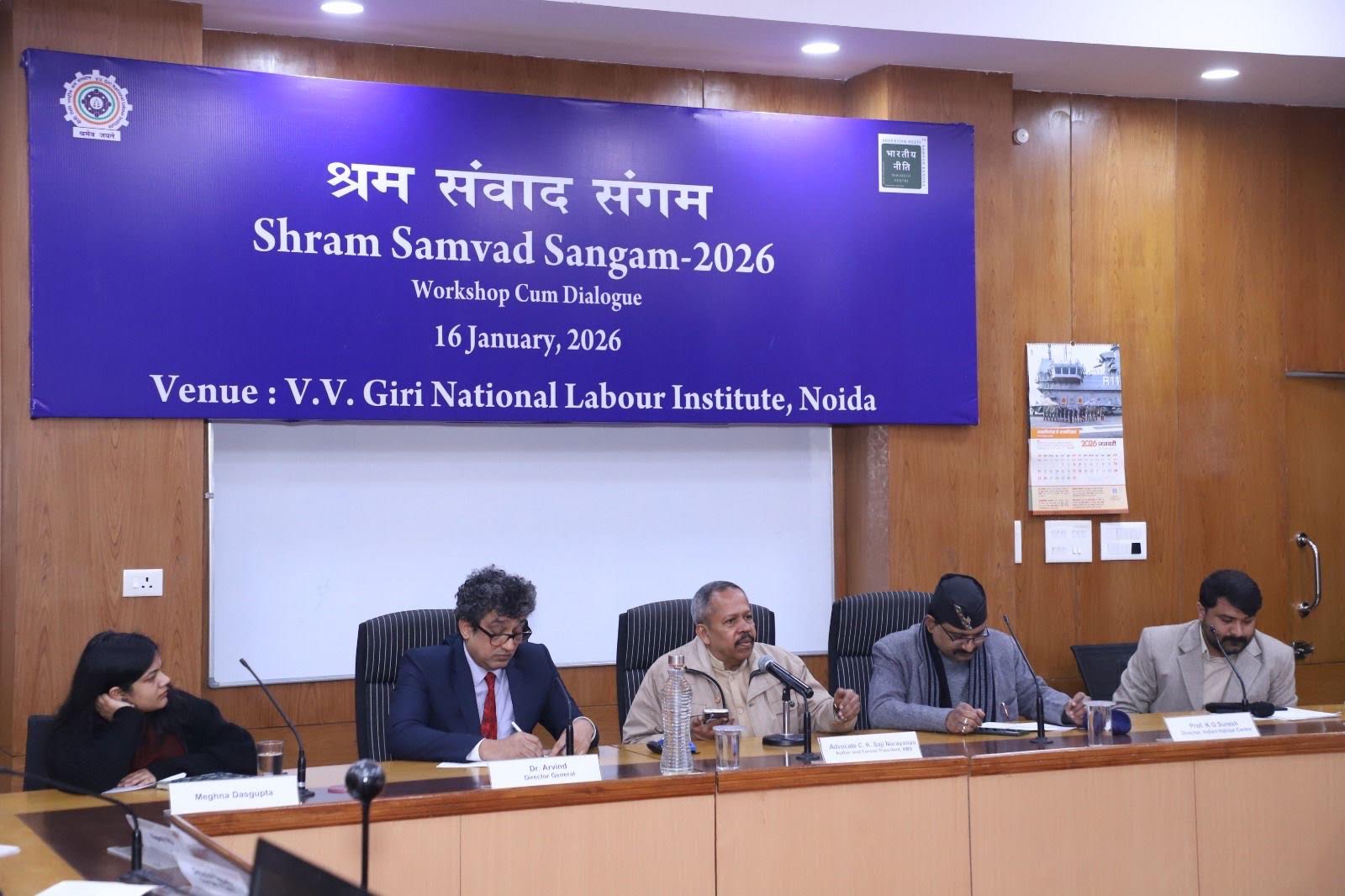
Noida: In the Bharatiya Bodh parampara, the word shram (labour) has never been confined merely to physical exertion. It has always been a marker of dignity, self-respect, and social harmony. As understood within Bharat’s civilizational consciousness, labour is not merely an economic activity but a yajna – a conscious and sacred act through which society sustains and nourishes itself. In the Rig Veda recognises human labour as the force that organizes creation into an ordered cosmos, while the Bhagavad Gitaplaces karma – purposeful action rooted in duty – at the very centre of human life. From this perspective, labour cannot be separated from ethics (Bharatiya Drusti), community, and social harmony. Yet, in the modern era, policy discourse has gradually distanced itself from this civilizational inheritance. Today, conversations around labour are largely confined to compliance frameworks, registration mechanisms, dashboards, and statistical indicators. Welfare has replaced dignity; administration has displaced trust. The worker, with lived experience and social identity, is increasingly reduced from a human being to a unit of data. It is precisely within this widening gap between civilization and administration that the deeper significance of Shram Samvad Sangam–2026 must be understood. Held at the V. V. Giri National Labour Institute, Noida, and organised in collaboration with the Bharatiya Neeti Samvad Kendra, the Sangam was not merely a technical discussion on labour codes. It was a deliberate intellectual pause – an attempt to reconnect labour governance with its Bharatiya roots, while simultaneously engaging honestly with the realities of a digital and aspirational Bharat. Guided by Shri C. K. Saji Narayanan, former National President of the Bharatiya Mazdoor Sangh; Dr. Arvind, Director General, V. V. Giri National Labour Institute; and Prof. K. G. Suresh, Director, Bharat Habitat Centre, New Delhi, the dialogue drew inspiration from Bharat’s largest labour movement’s ethical tradition – one that prioritises dignity, dialogue, and national responsibility over conflict-driven industrial antagonism. The presence of public intellectuals such as Prof. Sanjeev Kumar, Debashish Satpathy (NBCC), Prof. Monika Suri, Dr. Bommuluri Bhavana Rao, Arun Chauhan, and Dr. Deepender Chahar further strengthened this shared understanding.
From Law to the People: The True Measure of Reform: The consolidation of 29 labour laws into four labour codes by the Government of Bharat is undeniably an ambitious and forward-looking reform. Digital platforms developed for registration, social security, and compliance reflect a serious intent at the policy level. However, the lived reality remains that reforms are not tested on paper but in life. Repeatedly, the Sangam underscored that labour reforms become meaningful only when their impact reaches the spaces where workers actually live – workplaces, neighbourhoods, families, and their anxieties about the future. In Bharatn political thought, the legitimacy of governance is established only when it reaches Antyodaya – the last person in society. This is not a philosophical abstraction but a practical standard of governance. Labour being placed in the Concurrent List itself acknowledges that both the Centre and the States bear equal responsibility for ground-level outcomes. Yet, in the current landscape, efforts appear fragmented. Research occurs in isolation, regulations are drafted separately, industries implement selectively, workers bear the consequences, and civil society struggles to stitch together a fractured system. What is most conspicuously absent is coordination and dialogue. The core sentiment emerging from the Sangam was clear: Bharat does not need another centralised scheme, but a culture of working together. A culture where partnership matters more than hierarchy, trust more than control, and human understanding more than procedural rigidity. Only when institutions begin working for each other rather than merely alongside each other will labour reforms truly touch lives.
Shram-Setu @2047: A Bridge Between Governance and Lived Experience: The most significant idea to emerge from Shram Samvad Sangam – 2026 was Shram-Setu @2047, articulated by BNSK–Bharat. This is neither a government notification nor a new package of schemes. It is a way of thinking – one that reconnects governance with the lived experiences of human beings. Its essence flows from a deeply Bharatiya insight: communities undergo real and lasting transformation only when change begins and then grows from within, rather than being imposed from outside. Experiences shared at the Sangam brought this belief to life. Particularly illustrative was the Silchar model in Assam, implemented under the guidance of Visva-Bharati University Professor Biplab Lohochowdhury, where communities revitalised canals, constructed bridges, sustained agriculture, and established schools for children without waiting for continuous administrative intervention. This was not an example of aid or subsidy, but an expression of collective self-confidence and human agency. Shram-Setu @2047 recognises this human energy and provides it with a structure that is both decentralised and interconnected. It envisions labour facilitation centres as Shram Shakti Kendra at the district, block, and panchayat levels where workers are not treated as files but as individuals; neighbourhood assemblies in urban settlements where concerns of informal labour, migration, housing, and gig workers can be discussed directly; Gram Sabhas and Palli Sabhas in rural/Trabal areas so that labour rights become a living part of local democratic traditions rather than remaining on paper; a two-way dialogue system where workers, administrators, and policymakers listen to one another; community-led welfare and grievance redressal mechanisms grounded in trust and supported by legal and digital assistance; and an integrated convergence of central, state, and local efforts to ensure reforms truly reach the last mile. At its heart, this is a model of trust between the State and society – where the State creates pathways, society walks alongside, and communities lead. Shram-Setu @2047 is not about a deadline; it is about a human journey in which labour regains dignity and governance moves closer to life.
Technology Guided by Ethical Purpose: Shram Samvad Sangam–2026 categorically rejected the artificial binary often created between technology and humanity in contemporary discourse. In the Bharatiya civilizational worldview, technology has never been a source of fear; its fundamental expectation has always been that tools remain guided by wisdom, ethics, and human purpose. In this spirit, the Sangam highlighted that artificial intelligence and digital labour governance, when used responsibly, can enable faster and more transparent grievance redressal, expand social security coverage, and ensure more precise and equitable distribution of benefits. At the same time, the dialogue issued a clear warning: technology devoid of ethical direction does not empower – it creates new forms of exploitation. In this context, the need for a Human-Centric Robotics & AI Model (Humanotic Model) was emphasised – one in which automation and algorithms do not replace human judgment but serve as its assistants. In this framework, technology does not displace the worker; it strengthens their safety, dignity, and capability. Within Bharatiya thought, the yantra must always remain subordinate to the mantra – technology must be guided by moral intent and human responsibility. The ultimate purpose of governance is not efficiency alone, but the protection and expansion of human dignity. When technology operates within this ethical architecture, it becomes an instrument of progress; otherwise, it risks harming the very society it was meant to serve.
Leadership, Vision, and Continuity
Shram-Setu @2047 naturally aligns with the broader vision of Hon’ble Prime Minister Shri Narendra Modi, wherein labour reforms are not merely legislative or administrative exercises but foundational to building a developed Bharat through dignity, skill, and self-reliance. Within this discourse, the guidance of eminent thinkers and public intellectuals such as Shri Mukul Kanitkar, National Executive Member of the RSS, and Shri Vivek Dadhakar, National Organiser of the Bharatiya Janata Party (BJP), further reinforced the shared understanding that reforms become sustainable and effective only when they are culturally rooted, socially accepted, and institutionally continuous.
Reclaiming the Dignity of Vishwakarma
A civilization that venerates Vishwakarma cannot allow its workers to remain invisible. Construction workers, sanitation workers, gig workers, factory labourers, and artisans are not merely beneficiaries of schemes-they are active agents of nation-building. At its core, Shram Samvad Sangam–2026 was a call to restore the dignity of labour – its ethical honour – to the centre of public consciousness. As Bharat moves towards 2047, the fundamental question is not how fast we progress, but in which direction and with what values. Shram-Setu @2047 builds a living bridge between policy and people, tradition and technology, the nation and society. It is not a momentary innovation, but a profound reminder – of a historical memory that Bharat once governed with empathy, responsibility, and shared purpose, and that it can do so once again.