
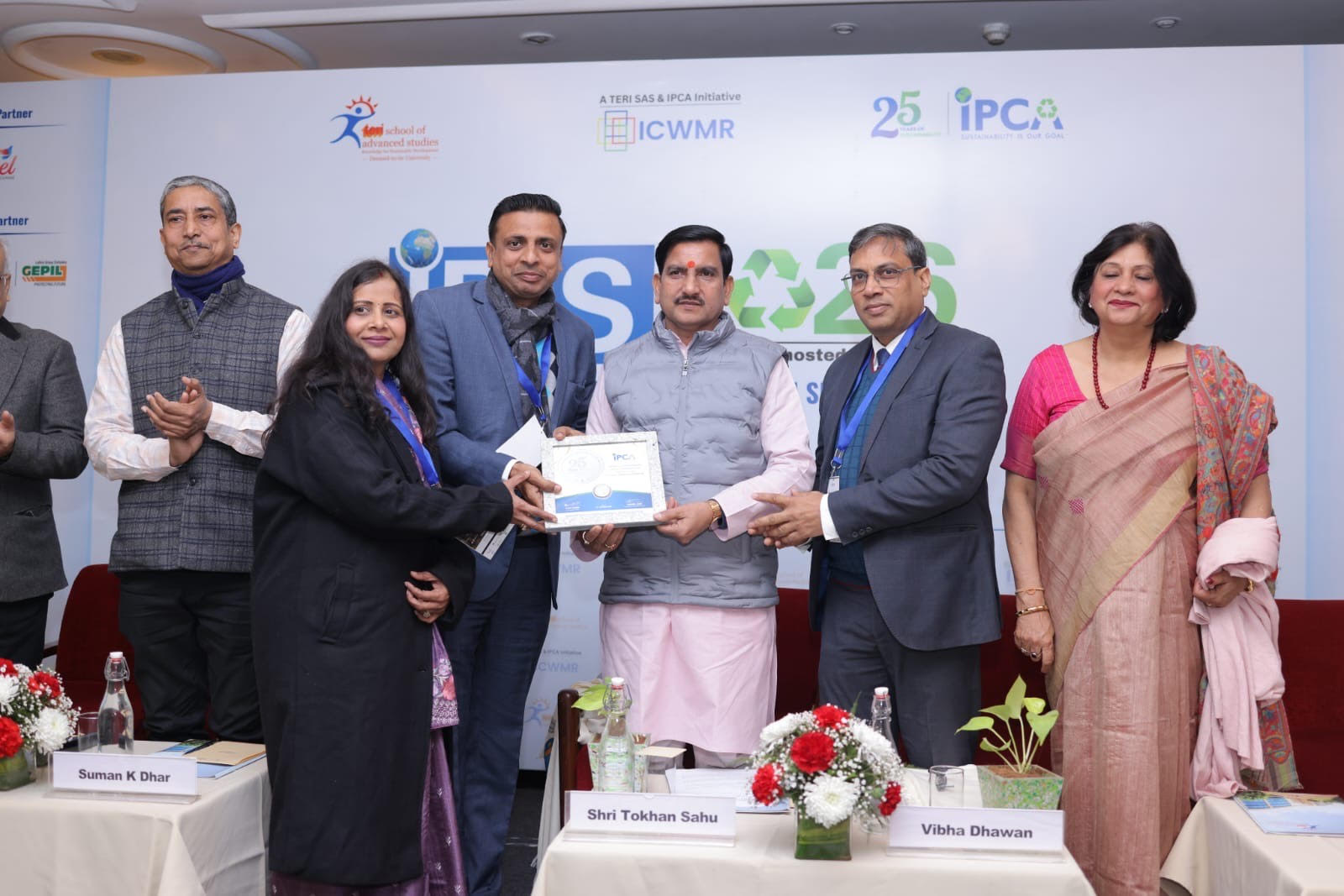
New Delhi: The IPCA Centre for Waste Management and Research (ICWMR) at TERI SAS kicked off the International Recycling Incubation Summit (IRIS) 2026 at the India Habitat Centre today. The two-day event is focused on ‘Integrating sustainable waste supply chain logistics and low-carbon pathways for a circular economy’. It brings together over 300 participants from various sectors, including government, business, academia, media, and community groups, to accelerate India’s shift towards more efficient resource use.
During the opening ceremony, the mood was optimistic and action-oriented. Presiding as Chief Guest, Shri Tokhan Sahu, Minister of State, Ministry of Housing and Urban Affairs, emphasised the government’s determination to incorporate sustainability into urban planning. “Our journey from a Clean India to a Circular India is essential,” he said, emphasising that cities should not just be places where things are consumed but also areas where resources are reused and regenerated. He said that Swachh Bharat Mission started by our Hon’ble PM in the year 2014 is not just a mission but a revolution towards making Clean India. He mentioned that Circular Economy is the way to achieve the vision of “Viksit Bharat”. He also mentioned that the event like IRIS 2026 is the right platform to bring together the Govt. Academia, Research Institutes and NGO’s to deliberate ways to achieve Sustainable Development and making Viksit Bharat. . In his welcome address, Prof. Arun Kansal, Director, ICWMR, TERI SAS, framed the summit as a critical platform for convergence. “IRIS 2026 is designed to connect the dots between technology, policy, and community action to unlock its value. We are here to move from incubation to acceleration,” he remarked. Dr Vibha Dhawan, Chancellor, TERI SAS, highlighted that educational institutions need to play an active role in this circular transition. She noted that universities should collaborate with industry and communities to develop real solutions rather than focusing solely on theoretical knowledge. She also highlighted the importance of effective waste logistics to achieve greater resource recovery and reduce carbon footprints.
Providing a global policy perspective, Mr C.R. Mohanty from the UNCRD connected India’s efforts to the broader Sustainable Development Goals. India’s scale and innovation in circular economy models offer transformative lessons for the Global South. “Integrating low-carbon pathways into waste management is a powerful strategy for climate mitigation and building resilient economies,” he observed. He also spoke about the importance of working towards achieving SDG’s with more rigour to counter various environmental challenges.
While setting the theme address, Mr Ashish Jain, Founder Director, IPCA, highlighted “The future belongs to businesses that see waste as a strategic resource. In the circular economy, sustainability is not a cost—it is our greatest competitive advantage and our responsibility to the planet.” He mentioned that now we should responsibly and collectively work to achieve “Waste to Wealth & Health”. Prof. Suman Dhar, VC, TERI SAS, informed, “Our students are not just studying sustainability—they are designing it. The circular transition will be led by those who can blend technical skill with systemic vision, and TERI SAS is committed to empowering these changemakers.
The summit’s agenda is packed with various discussions, including:
• Industry Leaders Meet: Examining stewardship beyond compliance.
• The Circular Confluence: A high-level panel on aligning policy, practice, and innovation.
• Parallel Technical Tracks: On Advanced Recycling Technologies, Waste Logistics Optimization, Circular Supply Chain Design, and Policy Frameworks.
• Media Panel & Grassroots Impact Stories: Highlighting the role of narrative and community action.
• Collective Wisdom Panel & Valedictory: Synthesising outcomes and felicitating research excellence.
IRIS 2026 aims to finish with a clear plan for partnerships, policy suggestions, and innovative ideas that strengthen the movement from waste to valuable resources, supporting India’s goal of achieving net-zero emissions.