
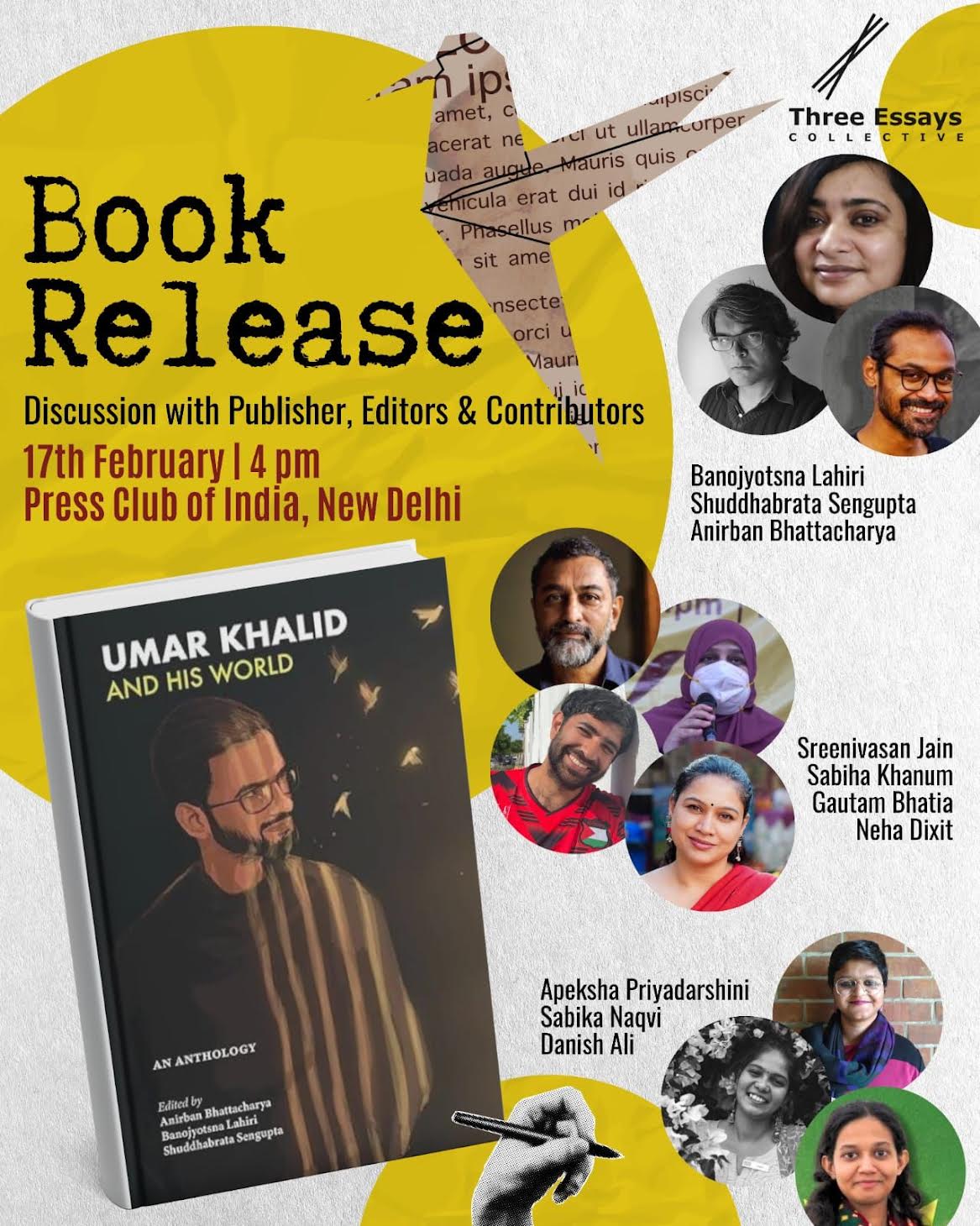
Umar Khalid, who has been imprisoned for several years on charges of conspiracy in the Delhi riots, is once again at the center of discussion. The reason is not his release, but a book written about him—‘Umar Khalid and his World’. This collection includes essays and messages from historian Romila Thapar and Ramachandra Guha, academic Anand Teltumbde, writer Mukul Kesavan, Congress MLA Jignesh Mevani, New York City Mayor Zohran Mamdani, and actors Prakash Raj and Swara Bhasker. The volume also contains several essays by Umar Khalid himself. The launch of this book yesterday at the Press Club of India has sparked a major ethical and legal debate: Should one glorify a person facing serious allegations like conspiring against the country, whom the courts have so far not deemed worthy of bail?
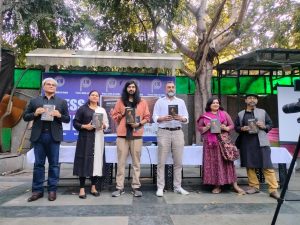
Gathering of Activists at the Press Club
- The event at the Press Club of India was attended by many journalists, writers, and activists from across the country. Among those present were Siddharth Varadarajan, Apoorvanand, Paranjoy Guha Thakurta, and several activists associated with left-wing ideology.
- The book was edited by Banojyotsna Lahiri, Shuddhabrata Sengupta, and Anirban Bhattacharya. The invitation listed names such as Srinivasan Jain, Sabiha Khanum, Gautam Bhatia, Neha Dixit, Apeksha Priyadarshini, Sabika Nakvi, and Danish Ali.
- Journalist Srinivasan Jain, who released the book, said: “Understand the chronology as it is. This chronology is not understandable to anyone—that in the morning you put your critics in jail, and in the evening you claim to be the mother of democracy….”
- The dominant tone of the program was that Umar Khalid is being targeted to suppress the ‘voice of dissent’. Speakers argued that there is no solid evidence against Khalid and that keeping him in jail for a long time without trial is a violation of human rights. But the question arises here: Is this merely ‘dissent’ or something more?
The Courts’ Stance and the Seriousness of UAPA
While on one hand activists and urban Naxal groups are calling it the ‘murder of democracy’, the stance of the country’s Supreme Court and Delhi High Court has been different.
- Judicial Observation: The courts have repeatedly rejected Umar Khalid’s bail applications. The prosecution (police) claims that Khalid orchestrated a deliberate conspiracy behind the 2020 Delhi riots.
- UAPA Provisions: Obtaining bail under the Unlawful Activities (Prevention) Act (UAPA) is extremely difficult, as it considers the prima facie seriousness of the allegations. When the Supreme Court and High Court, after examining the evidence, have not granted bail, presenting him as ‘innocent’ or a ‘hero’ on public platforms also raises questions about the understanding of the judiciary.

Controversy over ‘Glorification’: Freedom of Expression vs. National Interest
One section believes that this book and this event are an attempt to create an atmosphere in favor of an accused person. When a case is under consideration, such events can be seen as attempts to influence witnesses and the investigation process.
- The Victims’ Side: For the families who suffered loss of life and property in the Delhi riots, it may be ‘unfortunate’ to see the person accused of inciting violence being presented as a ‘symbol of resistance’.
- Role of Institutions: Holding such events at prestigious institutions like the Press Club shows how deep ideological polarization has become. The Editors Guild and the Press Club of India have long been accused of sympathizing with leftists and activists. The elected office-bearers of the Press Club of India should consider whether providing such a platform to an accused person aligns with the neutral ethos of journalism.
Double Standards of Intellectuals?
-
The same activist class talks about ‘letting the law take its course’ in cases involving people from other ideologies, but when it comes to Umar Khalid, they directly put the law and court processes in the dock.
• Does someone’s ‘intellectual background’ or ‘writing ability’ place them above the country’s laws?
Two Parallel Extremes
-
In a democracy, freedom of expression must be respected, but not at the cost of the nation’s integrity and security. Whether Umar Khalid is guilty or not will be decided only by the court. Until then, presenting any accused as a ‘martyr’ or ‘great revolutionary’ creates confusion in society.
• This book launch at the Press Club has made it clear that in India, there are now two parallel extremes of ‘truth’. One extreme is the process of law, while the other is the ideological loyalty of leftists, activists, and urban Naxal groups. Ultimately, justice will prevail only when facts and evidence are prioritized over emotions and discourse.
