A Case Study on Equity in Sexual Offense Judgments

Screenshot-2025-07-25-at-6.57.46-PM.png

Mumbai : The case of a 40-year-old female teacher granted bail in Mumbai for a sexual relationship with a 16-year-old male student, as reported by Zee News, raises critical questions about gender neutrality in legal and social responses to sexual misconduct under India’s Protection of Children from Sexual Offences (POCSO) Act. The court’s decision to grant bail, citing a “consensual relationship” after the teacher’s resignation diluted the teacher-student dynamic, prompts a deeper examination of how such cases might be handled if the genders were reversed—specifically, a 40-year-old male teacher and a 16-year-old female student. Analyzing this through the lens of gender neutrality reveals potential inconsistencies in legal application and societal perceptions that undermine equitable justice.

Under the POCSO Act, enacted in 2012 to protect children under 18 from sexual offenses, consent is irrelevant when the victim is a minor. The law is designed to be gender-neutral, focusing on the act of sexual misconduct rather than the gender of the perpetrator or victim. In this case, the female teacher was charged under POCSO for allegedly sexually assaulting the minor, luring him to luxury hotels, and providing alcohol. The court’s rationale for granting bail—partly based on the relationship being “consensual” after the teacher’s resignation and the victim’s age being over 16—suggests a leniency that may not align strictly with POCSO’s intent. If the teacher were male and the student female, the legal response might differ due to societal biases. Courts often view male perpetrators in such cases as predatory, with less consideration for claims of consent, even if the minor is over 16. The power imbalance inherent in a teacher-student relationship, regardless of gender, is a critical factor under POCSO, yet the court’s emphasis on the diluted dynamic post-resignation might not have been as readily accepted with a male teacher, where societal outrage tends to amplify perceptions of exploitation.

Socially, gender stereotypes significantly shape reactions. A female teacher engaging with a male student is often met with less public condemnation, sometimes even trivialized as a “rite of passage” for the boy, reflecting a cultural bias that males are less vulnerable or more complicit in sexual encounters. Conversely, a male teacher with a female student typically faces intense social stigma, with the narrative framing the girl as a victim and the man as a predator. This double standard undermines gender neutrality, as it diminishes the perceived harm to male victims and may influence judicial discretion. In this case, the teacher’s defense leveraged affectionate messages and the boy’s emotional attachment, which the court considered. If the genders were reversed, such evidence might be dismissed as grooming or manipulation, reflecting a societal tendency to view female minors as more vulnerable and male adults as more culpable.

Legally, the POCSO Act’s application should be consistent, but judicial interpretation can vary. The teacher’s bail conditions—₹50,000 bond, no contact with the victim, and restrictions on leaving Mumbai—indicate some accountability, but the court’s consideration of her role as a single mother and improper arrest procedures (grounds provided in Marathi, a language she didn’t understand) may have softened the outcome. A male teacher might face stricter scrutiny, with less sympathy for personal circumstances, as societal expectations often hold men to harsher standards in sexual offense cases. The complainant’s family called the bail decision a “grave injustice,” suggesting dissatisfaction with the perceived leniency, a sentiment likely to be magnified if the perpetrator were male.

Gender neutrality demands that the law and society treat all cases of sexual misconduct with equal seriousness, focusing on the power imbalance and the minor’s inability to consent. This case highlights a gap between legal intent and application, where gender biases—socially and judicially—may influence outcomes. To achieve true gender neutrality, courts must prioritize the POCSO Act’s core principle: protecting minors from exploitation, regardless of the perpetrator’s or victim’s gender. Societal attitudes must also evolve to recognize male victims’ vulnerability and female perpetrators’ accountability, ensuring justice is blind to gender stereotypes.

Reference :

‘It was consensual’: Court gives teacher, 40, bail over sexual relationship with 16-year-old boy
https://www.hindustantimes.com/india-news/it-was-consensual-court-gives-teacher-40-bail-over-sexual-relations-with-16-year-old-boy-101753321077972.html

Sexual assault of student: Court cites ‘consensual relationship’ while granting bail to school teacher in Mumbai
https://www.hindustantimes.com/cities/mumbai-news/sexual-assault-of-student-court-cites-consensual-relationship-while-granting-bail-to-school-teacher-101753298548248.html

Sexual Harassment Scandals at Jadavpur University and JNU: A Tale of Freedom, Responsibility, and Institutional Accountability

jpg.avif

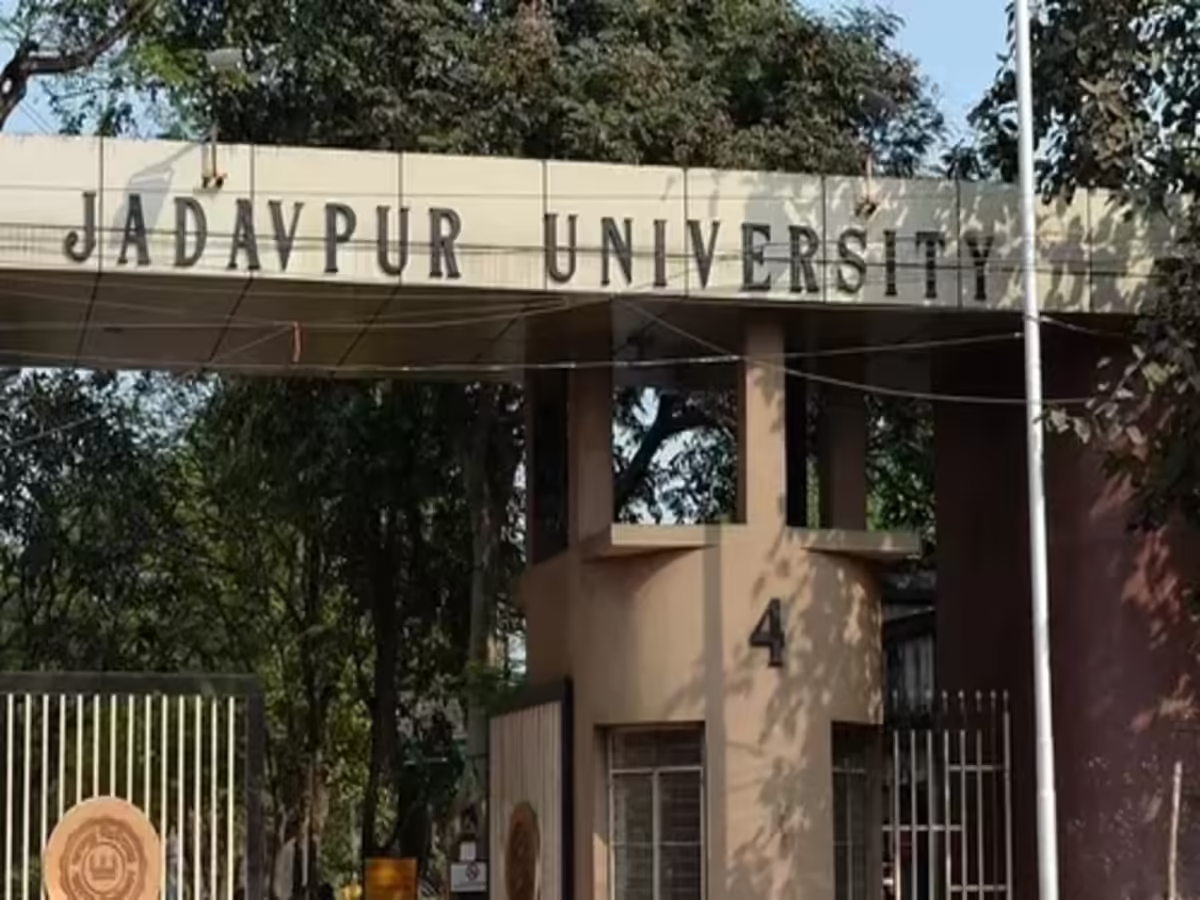
Kolkata: The discourse surrounding sexual harassment and scandals at India’s premier educational institutions, such as Jadavpur University (JU) in West Bengal and Jawaharlal Nehru University (JNU) in New Delhi, reflects a complex interplay of individual freedom, institutional responsibility, and societal expectations. These cases, often amplified by media attention, have sparked debates about the boundaries of personal liberty, the misuse of freedom, and the need for robust mechanisms to address grievances. While freedom is a cornerstone of academic environments, fostering critical thinking and self-expression, its misinterpretation as license for unchecked behavior can lead to harm, exploitation, and a culture of impunity. This article examines key incidents at JU and JNU, drawing on verified reports to present a balanced narrative, while emphasizing that true freedom lies in living on one’s own terms without infringing on the dignity of others.

Jadavpur University: A Legacy Marred by Harassment Cases

Jadavpur University, a prestigious institution known for its vibrant intellectual culture, has faced multiple allegations of sexual harassment over the years, drawing significant media scrutiny. One of the earliest reported incidents occurred in 2014, when a second-year History student alleged she was molested by a group of male students inside a boys’ hostel on August 28. The victim claimed she was dragged into the hostel, beaten, and had her phone snatched, leaving her traumatized. She filed an FIR with the Jadavpur police, identifying one engineering student and six others from the same faculty as perpetrators. The incident, reported by India Today, sparked outrage and highlighted safety concerns on campus. While the police investigation proceeded, the university faced criticism for its initial response, underscoring the need for stronger institutional mechanisms to address such cases.

In 2016, another high-profile case emerged when thirteen students from JU’s English department accused the son of a professor of sexual harassment. The allegations, first made public by an undergraduate student via a Facebook post, included claims of lewd messages, unwanted advances, and physical molestation. The university suspended the accused and formed a fact-finding committee, as reported by The Indian Express. The Arts Faculty Students’ Union demanded the accused’s suspension, the inclusion of a student representative in the probe, and that the accused’s parent not assume a leadership role in the department. The case revealed systemic issues, as the complainant alleged prior complaints in 2015 were ignored, and she faced bullying from the accused’s friend, a Presidency University student. The West Bengal Women’s Commission later found prima facie evidence of harassment, urging further action.

In 2017, a case involving an assistant professor in JU’s comparative literature department further highlighted the challenges of addressing harassment. A student alleged the professor made inappropriate remarks during a class, referencing explicit content from a text in a suggestive manner. Students boycotted his classes, citing a history of inappropriate behavior, but the lack of a formal complaint to the Internal Complaints Committee (ICC) limited institutional action. Scroll.in reported that the professor’s status as a government employee complicated efforts to replace or dismiss him, reflecting bureaucratic hurdles in addressing such cases. The incident underscored students’ distrust in the ICC, which they perceived as ineffective and prone to administrative influence.

A 2020 case involved a former JU student accusing an engineering assistant professor of coercing her into a sexual relationship with promises of marriage, only to abandon her. The Jadavpur police registered an FIR based on her complaint, which detailed a relationship spanning 2018 to March 2020. The case, covered by The Times of India, highlighted issues of power dynamics and consent, raising questions about accountability for faculty members.

More recently, in 2023, the death of an 18-year-old first-year student at JU, who allegedly jumped from a hostel balcony, prompted investigations into a possible sexual harassment angle. The Kolkata police arrested two students after discrepancies in their statements, and the incident fueled statewide protests against ragging and campus violence. The university established an internal committee to probe the matter, while Chief Minister Mamata Banerjee assured support to the victim’s family. This case, reported by Hindustan Times, underscored the intersection of harassment, ragging, and institutional negligence.

JNU: From MMS Scandal to Systemic Concerns

JNU, renowned for its progressive ethos and student activism, has also grappled with sexual harassment scandals that have tarnished its reputation as a safe campus. The 2011 MMS scandal was a pivotal moment, when a pornographic video clip involving two students surfaced on campus. The clip, shot in April 2010 at Tapti hostel, featured a female student who left the university without graduating, and a male student from the computer science department. India Today reported that the university suspended two students after a proctorial inquiry, with Delhi Police later arresting the accused, Janardan Kumar, for circulating the video as an act of revenge after a fallout with his partner. The incident raised questions about privacy, consent, and the ethics of recording intimate moments, with media framing it as a “scandal” that challenged JNU’s image as a bastion of idealism.

In 2018, JNU faced multiple harassment cases. One involved a professor from the School of Life Sciences, Atul Johri, accused by eight female students of molestation. The Delhi Police arrested him, and students marched to demand justice, as reported by Hindustan Times. Another case saw a PhD scholar accuse a School of Social Sciences professor of molestation and threats, with a case registered under IPC sections 354, 506, and 509. The JNU Students’ Union (JNUSU) criticized the ICC for delays and inaction, reflecting broader dissatisfaction with the replacement of the Gender Sensitisation Committee Against Sexual Harassment (GSCASH) with the ICC in 2017.

The dismantling of GSCASH, a body praised for its autonomy and sensitivity, was a turning point. Data obtained via RTI revealed that JNU recorded 151 sexual harassment complaints since 2017, with a peak of 63 in 2018-19. The Indian Express noted that 98% of cases were resolved, but the ICC’s lack of transparency and alleged administrative influence fueled distrust. In 2024, a second-year student at the Centre for Chinese and South-East Asian Studies alleged harassment by a professor, prompting her to leave campus. The JNUSU demanded the professor’s suspension and GSCASH’s reinstatement, citing inadequate security and ICC inaction. Another incident in October 2024 saw 47 female students file a joint complaint about harassment at a freshers’ party, alleging procedural violations by the ICC, as reported by The Hindu

The Message: Freedom with Responsibility

The cases at JU and JNU highlight a critical tension between individual freedom and the responsibility to respect others’ autonomy. Academic institutions are spaces where young adults explore their identities, often embracing progressive ideals and personal liberties. However, freedom must not devolve into licentiousness, where actions disregard consent or exploit vulnerabilities. The MMS scandal at JNU, for instance, was not merely about the act of recording but the betrayal of trust through its circulation, turning a private moment into public humiliation. Similarly, allegations at JU involving faculty and students reveal power imbalances that undermine the spirit of equality and respect.

This is not about moral policing or imposing restrictive norms but about fostering a culture where individuals live on their own terms without being used or exploited. Both men and women must recognize that true freedom lies in mutual respect and consent. The failure of institutional mechanisms, such as JU’s ICC or JNU’s post-GSCASH framework, exacerbates these issues, leaving survivors disillusioned and perpetrators emboldened. Students’ reluctance to approach ICCs, as seen in the 2017 JU case, stems from fears of victim-shaming and bureaucratic delays, pushing them toward public platforms like social media.

The struggle for freedom in academic spaces—freedom to learn, express, and grow—must include a fight for accountability. Universities must strengthen their grievance redressal systems, ensuring transparency and survivor-centric approaches. The reinstatement of bodies like GSCASH, as demanded by JNU students, could restore trust. Moreover, fostering open conversations about consent, power dynamics, and healthy relationships can prevent freedom from being misconstrued as permissiveness.

The sexual harassment cases at Jadavpur University and JNU underscore the challenges of balancing individual freedom with collective responsibility. From the 2014 JU molestation case to the 2011 JNU MMS scandal and recent protests, these incidents reveal systemic gaps in addressing harassment and ensuring campus safety. While media coverage has amplified these issues, it often sensationalizes them, overshadowing the need for constructive dialogue. Freedom is a cherished value, but it must be exercised with respect for others’ dignity. By strengthening institutional mechanisms and promoting a culture of consent, universities can ensure that freedom does not become a license for exploitation, allowing students to thrive in environments that uphold both liberty and accountability.

Reference :

Women’s panel finds merit in JU sex-abuse complaint
https://timesofindia.indiatimes.com/womens-panel-finds-merit-in-ju-sex-abuse-complaint/articleshow/57880980.cms

Jadavpur University student molested inside boys hostel
https://www.indiatoday.in/india/story/jadavpur-university-student-molested-inside-boys-hostel-206907-2014-09-02

Students at Jadavpur university boycott classes of professor accused of serial sexual harassment
https://scroll.in/article/859140/students-at-jadavpur-university-boycott-classes-of-professor-accused-of-serial-sexual-harassment

Kolkata: Former student files rape case against Jadavpur University’s engineering professor
https://timesofindia.indiatimes.com/city/kolkata/former-student-files-rape-case-against-ju-engineering-prof/articleshow/77422530.cms

Jadavpur University fresher death: 2 more students arrested by Kolkata police
https://www.hindustantimes.com/cities/kolkata-news/kolkata-police-arrest-two-more-students-in-jadavpur-university-death-case-investigation-underway-101691910318081.html
MMS scandal rocks JNU, probe on
https://www.indiatoday.in/india/north/story/mms-scandal-rocks-jnu-probe-ordered-128116-2011-02-07

JNU MMS scandal accused nabbed
https://www.hindustantimes.com/delhi/jnu-mms-scandal-accused-nabbed/story-KApXh4MqaRgYbdvQYkuPEJ.html

JU suspends prof’s son accused of sex abuse, forms panel to probe allegations
https://indianexpress.com/article/india/india-news-india/jadavpur-university-sexual-harassment-case-professors-son-suspended-investigatation-2939524/

Jadavpur University student molested inside boys hostel
https://www.indiatoday.in/india/story/jadavpur-university-student-molested-inside-boys-hostel-206907-2014-09-02

JNU teacher accused of sexual harassment and molestation, third incident in two months
https://www.hindustantimes.com/delhi-news/jnu-teacher-accused-of-sexual-harassment-and-molestation-third-incident-in-two-months/story-G857WWN2Zcz5URCa16G9GL.html

JNU rocked by another sexual harassment case
https://timesofindia.indiatimes.com/city/delhi/jnu-rocked-by-another-sexual-harassment-case/articleshow/63421400.cms

JNU received 151 sexual harassment complaints since 2017, data reveals
https://indianexpress.com/article/cities/delhi/jnu-sexual-harassment-complaints-data-reveals-9697130/

Several students, including JNUSU, join an indefinite protest called by the survivor of the March 31 incident, demand bringing back GSCASH.
https://www.newsclick.in/sexual-harassment-jnus-recent-track-record-mars-its-image-safe-campus

JNUSU alleges attempt to save culprits of sexual harassment
https://www.thehindu.com/incoming/jnusu-alleges-attempt-to-save-culprits-of-sexual-harassment/article68801060.ece

Why are Indian college students bypassing official sexual harassment committees?
https://www.thehindu.com/society/why-are-indian-college-students-bypassing-official-sexual-harassment-committees/article21296575.ece


भारतीय मज़दूर संघ ने मनाया 70 वर्षों की उपलब्धियों का भव्य समापन समारोह

Screenshot-2025-07-24-093956.png

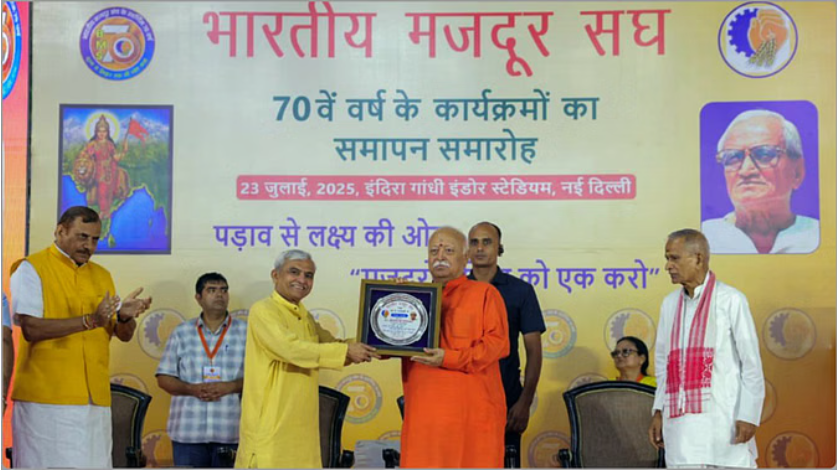
नई दिल्ली : भारतीय मज़दूर संघ (BMS) ने अपने 70 वर्ष पूर्ण होने के उपलक्ष्य में वर्षभर चले आयोजनों की श्रृंखला का भव्य समापन समारोह 23 जुलाई 2025 को नई दिल्ली के के.डी. जाधव कुश्ती हॉल, इंदिरा गांधी स्टेडियम में आयोजित किया। कार्यक्रम में मुख्य अतिथि के रूप में राष्ट्रीय स्वयंसेवक संघ के सरसंघचालक डॉ. मोहन भागवत, विशिष्ठ अतिथि के रूप में केंद्रीय मंत्री मनसुख मंडविया एवं अध्यक्षता बीएमएस अध्यक्ष हिरानमय पांडेय द्वारा की गई।

कार्यक्रम की शुरुआत इन्दु जम्वाल, अध्यक्ष दिल्ली प्रांत, बीएमएस के स्वागत भाषण से हुई। उन्होंने सभी आगंतुकों एवम् आतिथियों का हार्दिक स्वागत किया। उन्होंने कहा इसके पूर्व 1970 में दिल्ली में प्रथम अधिवेशन का आयोजन हुआ था और आज का BMS-70 कार्यक्रम आयोजित हो रहा है, यह सभी कार्यकर्ताओं के लिए गौरव का विषय है। 

अखिल भारतीय महामंत्री श्री रविन्द्र हिम्मते ने मंच से वर्षभर चले विभिन्न आयोजनों की जानकारी साझा करते हुए बताया कि किस प्रकार भारतीय मजदूर संघ ने पिछले सात दशकों में श्रमिक हितों की रक्षा करते हुए संगठनात्मक विस्तार और वैचारिक स्पष्टता बनाए रखी है। उन्होंने यह भी स्पष्ट किया कि समापन कोई अंत नहीं, बल्कि एक नया पड़ाव है — संगठन की यात्रा निरंतर चलती रहेगी।

श्री हिम्मते ने उन महान विभूतियों और कार्यकर्ताओं को श्रद्धांजलि अर्पित की, जिन्होंने संगठन को इस ऊंचाई तक पहुंचाने में अपना जीवन समर्पित किया। उन्होंने कहा, 23 जुलाई 2024 को मजदूर संघ ने अपने 70वें वर्ष में पदार्पण किया था, जिसकी शुरुआत उस ऐतिहासिक स्थल भोपाल से हुई, जहां से बीएमएस के कार्य की शुरुआत हुई थी। श्री हिम्मते ने कहा भारतीय मजदूर संघ ने अपने राष्ट्रीय, औद्योगिक और श्रमिक हित — इस त्रिसूत्रीय सिद्धांत पर कार्य करते हुए अपने 70 वर्षों के कार्यकाल को सफलतापूर्वक निभाया है। संगठन ने अपने मूल्यों में पारदर्शिता, सामूहिक निर्णय प्रणाली, तथा दलगत राजनीति से पूर्णत: दूर रहने का जो संकल्प लिया, वही इसकी दीर्घकालीन सफलता का आधार बना।

बीएमएस के राष्ट्रीय अध्यक्ष हिरणमय पांडेय ने कहा मजदूर संघ 1989 के पूर्व दूसरे स्थान पर था परन्तु उसके बाद से अब तक बीएमएस देश का शीर्ष मजदूर संगठन बना हुआ है। उन्होंने कहा हमारा संगठन युवा और महिलाओं का नेतृत्व ने केवल देश में बल्कि विदेशों में भी प्रदान कर रहा है। जी 20 के अन्तर्गत एल 20 में नेतृत्व मजदूर संघ ने किया और दुनिया को भारतीय श्रमिक विचार से अवगत कराया।उन्होंने कहा, आज बीएमएस देशभर में 28 प्रदेशों, 44 महासंघों, और 6630 संगठनों के माध्यम से सक्रिय रूप से कार्य कर रहा है। भारत तक ही सीमित नहीं, नेपाल में भी बीएमएस की उपस्थिति संगठन के अंतरराष्ट्रीय विस्तार की दिशा में एक महत्वपूर्ण संकेत है।

श्री पांडेय ने कहा, पांडेय अपने 70वें वर्ष को एक पड़ाव मानता है, न कि अंत। यह संगठन अपने 100वें वर्ष में प्रवेश कर वैश्विक मंच पर भी प्रभावशाली उपस्थिति दर्ज कराएगा, ऐसा विश्वास उसके कार्यकर्ताओं और नेतृत्व को है।

राष्ट्रीय स्वयंसेवक संघ के अखिल भारतीय कार्यकारिणी सदस्य श्री वीर भगाये जी ने भी कार्यक्रम को संबोधित किया। उन्होंने कहा यह केवल कार्यक्रम नहीं बल्कि विचारधारा एवं आंदोलन है। यह कार्यक्रम की भव्यता बता रही हैं यह अब समाज का कार्यक्रम बन चुका है। कार्यक्रम के विशिष्ट अतिथि केंद्रीय मंत्री मनसुख मंडविया ने मजदूर संघ की कार्यशैली की प्रशंसा करते हुए कहा मजदूर संघ की कार्यशाली सिखाती और प्रेरणा देती है। केंद्रीय मंत्री ने कहा बीएमएस 70 साल की लंबी कार्य अवधि में देश का सबसे बड़ा और दुनिया का महत्वपूर्ण संगठन बन चुका है। दुनिया में बीएमएस को सम्मान दिया जा रहा है। 

समारोह में राष्ट्रीय स्वयंसेवक संघ के सरसंघचालक डॉ. मोहन भागवत ने कार्यकर्ताओं का मार्गदर्शन किया। उन्होंने कहा  यह केवल उत्सव का समय नहीं, बल्कि आत्म-अवलोकन का भी अवसर है। हमें यह चिंतन करना चाहिए कि हमने अब तक क्या किया है और आगे हमें किस दिशा में बढ़ना है।

दुनिया को एक नया श्रमिक मॉडल देने की आवश्यकता है, और यह दायित्व बीएमएस को निभाना चाहिए। आज संगठन की जो प्रतिष्ठा है, वह पहली पीढ़ी के समर्पण, दूसरी पीढ़ी के विस्तार, और अब तीसरी एवं चौथी पीढ़ी की चेतना पर निर्भर है। यह भाव आगे भी बना रहना चाहिए। उन्होंने कहा, हमारे लिए मजदूरों का दुख समाज का दुख है। कोई व्यक्ति बीएमएस के पास लाभार्थी बनकर आता है और ध्येयार्थी बनकर चलता है।

कार्यक्रम में तकनीकी सशक्तिकरण की दिशा में एक बड़ी पहल के रूप में भारतीय मज़दूर संघ ने एक नवीन डिजिटल प्लेटफ़ॉर्म ‘ई-कार्यकर्ता’ ऐप की भी शुरुआत की, जो संगठन के कार्यकर्ताओं, कार्यों और संवाद को तकनीकी रूप से एकीकृत करेगा। साथ ही, बीएमएस की 70 वर्ष की यात्रा पर आधारित एक शॉर्ट फिल्म प्रदर्शित की गई। इसी अवसर पर बीएमएस की यात्रा को वर्णित करती हुई ऑर्गनाइजर वीकली पत्रिका का विशेष संस्करण को भी विमोचित किया गया।

इस भव्य कार्यक्रम में राष्ट्रीय स्तर के संघ पदाधिकारियों के साथ बीएमएस के विभिन्न प्रदेशों के अध्यक्ष, महामंत्री, फेडरेशन लीडर्स, कार्यकारिणी सदस्य, नेपाल से आए प्रतिनिधि, दिल्ली की मुख्यमंत्री श्रीमती रेखा गुप्ता अन्य मंत्री गण तथा दिल्ली-एनसीआर से हज़ारों की संख्या में कर्मचारी उपस्थित रहे। पूरे कार्यक्रम में जोश, अनुशासन और संगठन के प्रति अटूट समर्पण की झलक साफ़ दिखाई दी। समारोह का समापन राष्ट्रगान के साथ हुआ, जिसमें उपस्थित हज़ारों कार्यकर्ताओं ने श्रमिक हित, सामाजिक न्याय और आत्मनिर्भर भारत के निर्माण के लिए अपने संकल्प को दोहराया।

The Bizarre Tale of Harshvardhan Jain and His Fake Embassy in Ghaziabad

2-8.png

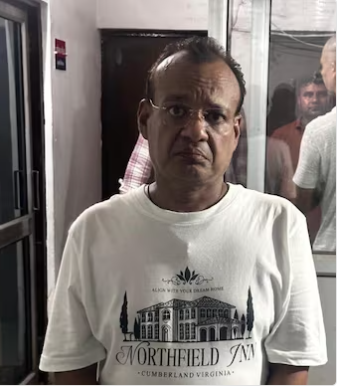
Ghaziabad: In a startling revelation that sounds like a plot from a Hollywood thriller, the Uttar Pradesh Special Task Force (STF) uncovered a fake embassy operating out of a luxurious bungalow in Ghaziabad’s Kavi Nagar on July 22, 2025. The mastermind behind this audacious scam was Harshvardhan Jain, a 47-year-old man who posed as a diplomat representing fictional and unrecognized micronations such as Westarctica, Seborga, Poulvia, and Lodonia. This elaborate con, which ran for nearly seven years, has left authorities and residents stunned, exposing a web of deception involving forged documents, luxury cars, and a carefully crafted facade of diplomatic legitimacy.

Harshvardhan Jain, a man with an ostensibly impressive background, claimed to have earned an MBA from the “College of Applied Science” in London and another from ITS College in Ghaziabad. His family background added to his veneer of credibility—his father was once a prominent industrialist with marble mines in Rajasthan. Jain leveraged this profile to portray himself as a high-flying diplomat, complete with a fleet of luxury vehicles, including an Audi and a Mercedes, adorned with fake diplomatic number plates marked “DC” (Diplomatic Corps). His rented two-storey bungalow in Kavi Nagar, labeled the “Consulate-General of the Grand Duchy of Westarctica,” flew flags of India and Westarctica, a micronation in Antarctica unrecognized by any sovereign state. The setup was so convincing that it fooled many, with Jain hosting charity events and community feasts (bhandaras) to maintain his public image.

The problem with Jain’s “embassy” was its sheer illegality. Westarctica, Seborga, Poulvia, and Lodonia are either micronations—self-proclaimed entities with no legal recognition—or entirely fictional. Operating an embassy without authorization from India’s Ministry of External Affairs (MEA) violates national sovereignty and international diplomatic norms. Jain’s operation was a sophisticated scam designed to exploit unsuspecting job seekers and businesses. He promised lucrative overseas job placements and international business deals, using forged diplomatic passports, fake MEA seals, and morphed photographs with high-profile figures like Prime Minister Narendra Modi and former President APJ Abdul Kalam to bolster his credibility. The STF raid uncovered a trove of incriminating evidence: Rs 44.7 lakh in cash, foreign currency, 12 forged diplomatic passports, 34 stamps of various countries and shell companies, 18 fake diplomatic number plates, two forged PAN cards, and fake press credentials.

Jain’s modus operandi was to create an aura of legitimacy around his fictitious diplomatic status. He used his “embassy” to issue fake diplomatic IDs and Seborga passports, charging hefty fees to victims lured by promises of foreign jobs or investments. Authorities suspect he was also involved in a hawala racket, funneling money through shell companies. His high-profile lifestyle, complete with diplomatic suits and luxury cars, made his claims believable to many. The Westarctica Instagram account even promoted Jain’s “consulate” as a legitimate operation since 2017, adding to the deception.

This wasn’t Jain’s first brush with the law. In 2011, he was booked for possessing an illegal satellite phone, a case still on record at Kavi Nagar police station. His alleged connections to controversial figures like self-styled godman Chandraswami and international arms dealer Adnan Khashoggi hint at a shady past, raising questions about the extent of his network. The STF is now investigating potential collaborators and the number of victims ensnared by Jain’s scheme.

The Ghaziabad fake embassy case underscores the audacity of white-collar crime and the vulnerabilities in public trust that scammers exploit. Jain’s ability to operate undetected for years highlights gaps in oversight, particularly in a digital age where micronations can gain superficial legitimacy online. As the investigation continues, authorities aim to unravel the full scope of this diplomatic fraud, ensuring that justice is served for those deceived by the self-styled “Baron” of Westarctica.

scroll to top