From Humble Beginnings to Global Leadership: A Saga of Resilience, Vision, and Farmer-Centric Growth
The Birth of a Farmer’s Dream
In the early 1960s, India stood at a crossroads. The nation faced a severe food crisis, with widespread hunger and dependence on foreign aid for food grains. Farmers, the backbone of the country, struggled with limited access to fertilizers, a critical input for boosting agricultural productivity. The cooperative sector, responsible for distributing 70% of fertilizers in India at the time, was grappling with supply shortages. This crisis sparked a revolutionary idea: a cooperative dedicated to producing and distributing fertilizers, owned and operated by farmers themselves. Thus, on November 3, 1967, the Indian Farmers Fertiliser Cooperative Limited (IFFCO) was born—a beacon of hope for millions of Indian farmers.
This article chronicles the remarkable journey of IFFCO, from its visionary inception to its status as the world’s largest fertilizer cooperative by turnover on GDP per capita. It explores the challenges overcome, the innovations embraced, and the controversies navigated, including the urea scam that tested its resilience. Above all, it celebrates IFFCO’s unwavering commitment to empowering farmers and fostering sustainable agriculture, making it an indispensable pillar of India’s agrarian landscape.
The Visionaries Behind IFFCO
The establishment of IFFCO was not the work of a single individual but a collective vision rooted in the ethos of cooperation. The food crisis of the early 1960s galvanized India’s farmers, policymakers, and cooperative leaders to seek long-term solutions. The idea of a farmer-owned fertilizer cooperative gained traction when the Cooperative League of the USA, through Cooperative Fertilizer International (CFI), proposed collaborating with Indian cooperatives to establish fertilizer production capacity in 1964. This proposal resonated with the Indian government and eminent cooperators who saw the potential to transform agriculture through self-reliance.

Key figures in IFFCO’s founding included cooperative leaders and government officials who championed the cause of farmer empowerment. While specific names like Mr. Paul Pothen, IFFCO’s founding managing director, stand out—recognized with the prestigious Padma Shri award for his contributions to India’s agricultural revival—the true driving force was the collective spirit of India’s farming community. The 57 founding member cooperatives laid the foundation for what would become a movement, embodying values of self-help, democracy, equality, and solidarity.
The vision was clear: to ensure a steady supply of high-quality, affordable fertilizers to Indian farmers, thereby enhancing crop yields and securing food self-sufficiency. This vision was not just about production but about uplifting the socio-economic status of farmers, making IFFCO a cooperative “of the farmers, by the farmers, and for the farmers.”
The Early Years: Laying the Foundation
IFFCO was registered as a multi-unit cooperative society on November 3, 1967, under the Multistate Cooperative Societies Act. Starting with just 57 member cooperatives, IFFCO set out to address the acute fertilizer shortage that plagued Indian agriculture. The cooperative’s early years were marked by ambitious planning and strategic partnerships. With financial and technical assistance from American cooperatives through CFI, IFFCO proposed the establishment of ammonia, urea, and NPK (nitrogen, phosphorus, potassium) plants, with initial projects slated for Kalol and Kandla in Gujarat.
The Kalol plant, commissioned in 1975, marked IFFCO’s entry into fertilizer production. Built with innovative use of indigenous materials, it set a precedent for self-reliance. The Kandla plant, also commissioned in 1975, followed suit, producing a range of fertilizers including NPK and di-ammonium phosphate (DAP). These plants were not just industrial achievements but symbols of India’s determination to achieve food security. By 1981, IFFCO expanded its footprint with the commissioning of urea plants at Phulpur and Aonla in Uttar Pradesh, further solidifying its role as a major fertilizer producer.
These early projects faced significant challenges, including limited infrastructure, technological constraints, and the need to balance cost with quality. Yet, IFFCO’s cooperative model allowed it to overcome these hurdles by fostering collaboration and leveraging collective resources. The success of these plants laid the groundwork for IFFCO’s rapid growth, transforming it from a fledgling cooperative into a cornerstone of India’s agricultural ecosystem.

Growth and Expansion: Scaling New Heights
From its modest beginnings, IFFCO grew exponentially, both in scale and impact. By 2021, the cooperative had expanded to include over 36,000 member cooperatives, reaching more than 50 million farmers across India. This growth was driven by strategic expansions, technological advancements, and a commitment to meeting the evolving needs of farmers.
Manufacturing Excellence
IFFCO’s production units became the heart of its operations. The cooperative established five major plants across India:
· Kalol, Gujarat: Commissioned in 1975 and expanded in 1997, it produces 1,100 metric tons per day (MTPD) of ammonia and 1,650 MTPD of urea.
· Kandla, Gujarat: Also commissioned in 1975, with expansions in 1981 and 1999, it produces a range of fertilizers, including NPK (520,000 MTPD), DAP (1,200,000 MTPD), and water-soluble fertilizers.
· Phulpur, Uttar Pradesh: Commissioned in 1981 and expanded in 1997, it produces 9.7 lakh metric tons of ammonia and 17 lakh metric tons of urea annually.
· Aonla, Uttar Pradesh: Commissioned in 1988 and expanded in 1996, it produces 1,740 MTPD of ammonia and 1,515 MTPD of urea.
· Paradeep, Odisha: Acquired in 2005, it has a production capacity of 1.3 million tons of urea per year.
These plants, equipped with state-of-the-art technology, achieved remarkable efficiency, with IFFCO recording an overall capacity utilization of 98% for nitrogenous fertilizers and 53% for phosphatic fertilizers in 2008-09. The cooperative’s focus on energy conservation, exemplified by the Aonla plant’s adoption of CO2 recovery technology, set new benchmarks in the industry.
Diversification and Innovation
IFFCO’s growth was not limited to fertilizer production. Recognizing the diverse needs of farmers, the cooperative diversified into sectors such as general insurance, rural telephony, commodity trading, and rural e-commerce. Key subsidiaries and initiatives include:
· IFFCO Tokio General Insurance: Launched to provide rural and agricultural insurance, including the ‘Sankat Haran Bima Yojana,’ offering free insurance with every bag of IFFCO fertilizer purchased.
· IFFCO Kisan Suvidha Limited (IKSL): Provides online solutions and information to farmers, enhancing their access to modern agricultural practices.
· IFFCO BAZAR: A rural e-commerce platform that combines technology with retail to deliver value to farmers in remote areas.
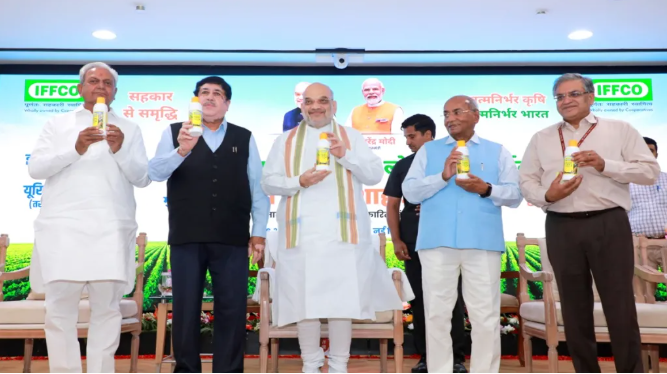
· Nano Biotechnology Research Centre: Established in 2019 in Kalol, Gujarat, it developed the world’s first Nano Urea Liquid, a revolutionary product that reduces nitrogen use by 50% while increasing yields by 8% on average.
These initiatives reflect IFFCO’s commitment to holistic farmer welfare, extending beyond fertilizers to encompass financial services, skill development, and digital empowerment.
Global Reach
IFFCO’s ambition transcended national boundaries. The cooperative established joint ventures in Oman (OMIFCO), Jordan (JIFCO), Dubai (KIT), and Senegal (ICS), enhancing global fertilizer supply chains and securing raw materials like phosphoric acid. These partnerships not only strengthened IFFCO’s position in the global market but also contributed to India’s food security by ensuring a steady supply of critical inputs.
By 2017, IFFCO was ranked 66th on the Fortune India 500 list, with a net worth of $2.6 billion as of March 2021. Its market share—19% in urea and 31% in complex fertilizers—cemented its status as India’s largest fertilizer manufacturer.
Challenges: Navigating a Complex Landscape
Despite its successes, IFFCO faced significant challenges that tested its resilience. The fertilizer industry in India is heavily dependent on imported raw materials, such as ammonia, phosphoric acid, and rock phosphate, making it vulnerable to global price fluctuations. Additionally, the overuse of urea, driven by heavy government subsidies, led to imbalanced nutrient application, raising concerns about soil health and sustainability.
IFFCO also faced environmental and social scrutiny. The World Benchmarking Alliance ranked IFFCO 222nd among 350 global food and agriculture companies, highlighting gaps in sustainability strategies, water use reduction, and commitments to prohibit child and forced labor. The cooperative was urged to set clearer targets for reducing greenhouse gas emissions and improving social inclusion.
The Urea Scam: A Dark Chapter
One of the most significant challenges in IFFCO’s history was the alleged urea scam that surfaced in 2022. The Enforcement Directorate (ED) investigated claims that IFFCO’s managing director, Udai Shanker Awasthi, and others were involved in a fertilizer scam involving kickbacks worth Rs 685 crore. The allegations centered on the generation and layering of proceeds of crime through unrelated entities, with some funds allegedly transferred to entities controlled by Awasthi and his associates. The ED attached properties worth Rs 20.96 crore as part of the probe.
The urea scam cast a shadow over IFFCO’s reputation, raising questions about transparency and governance within the cooperative. For an organization built on trust and farmer-centric values, these allegations were a significant blow. However, IFFCO’s leadership maintained that the cooperative’s operations remained unaffected, and its commitment to farmers was unwavering. The legal proceedings are ongoing, and while the scam posed a reputational risk, IFFCO’s vast network and contributions to agriculture helped it weather the storm.
The impact of the scam was mitigated by IFFCO’s strong track record and its proactive measures to address governance concerns. The cooperative continued to focus on innovation and farmer welfare, reinforcing its credibility through tangible achievements like the launch of Nano Urea and other sustainable products.
IFFCO’s Impact on Farmers: A Lifeline for Indian Agriculture
IFFCO’s significance to Indian farmers cannot be overstated. With a network of over 36,000 cooperative societies and 158 Farmers Service Centres, IFFCO reaches more than 55 million farmers, providing them with affordable fertilizers, crop advisory services, and soil testing. Its products, including urea, DAP, NPK, and innovative nano-fertilizers, have been instrumental in boosting crop yields and improving soil health.
The introduction of Nano Urea Liquid in 2021 marked a paradigm shift in fertilizer technology. Developed at IFFCO’s Nano Biotechnology Research Centre, this product delivers nitrogen with over 80% efficiency, compared to 30-40% for conventional urea. A 500 ml bottle of Nano Urea, containing 40,000 mg/L of nitrogen, is equivalent to a 45 kg bag of traditional urea, reducing costs and environmental impact while increasing yields by an average of 8%. Tested across 11,000 farmers’ fields for 94 crops, Nano Urea has been hailed as a game-changer for sustainable agriculture.
Beyond fertilizers, IFFCO’s initiatives like the Save the Soil Campaign and IFFCO Kisan Seva Trust (IKST) address broader challenges faced by farmers. The Save the Soil Campaign promotes sustainable practices, while IKST provides financial assistance to farmers affected by natural calamities. Stories like that of Mrs. Kailash Panwar, a farmer from Rohtak who achieved record yields with IFFCO’s support, underscore the cooperative’s transformative impact.
IFFCO’s diversification into insurance, microfinance, and digital platforms has further empowered farmers. IFFCO BAZAR, for instance, brings modern retail to rural India, while IFFCO Tokio General Insurance offers financial security. These initiatives have not only improved farmers’ livelihoods but also strengthened the cooperative movement in India, making IFFCO a symbol of hope and progress.
Recent Developments: Pioneering the Future
In recent years, IFFCO has continued to innovate and expand. The launch of Nano DAP in 2023, following the success of Nano Urea, further solidified its leadership in sustainable agriculture. Plans to export nano-fertilizers to 25 countries and achieve an output of 30 crore bottles reflect IFFCO’s global ambitions.
The cooperative has also embraced digital transformation through initiatives like the ‘ICT Initiatives for Farmers and Cooperatives,’ promoting e-culture in rural India. Investments in food processing, renewable energy, and skill development align with IFFCO’s vision of doubling farmer incomes by 2024, in line with the Indian government’s goals.
Despite challenges like import dependence and subsidy burdens, IFFCO’s production volume reached 9.6 million metric tons in the 2023 financial year, a 9.6% increase from the previous year. This growth underscores IFFCO’s resilience and its ability to adapt to changing market dynamics.
Conclusion: A Legacy of Empowerment
From its inception in 1967 with 57 cooperatives to its current status as a global leader with over 36,000 member cooperatives, IFFCO’s journey is a testament to the power of collective action. Its unwavering focus on farmer welfare, coupled with innovations like Nano Urea and strategic global partnerships, has made it an indispensable force in Indian agriculture. While challenges like the urea scam and environmental concerns have tested its resolve, IFFCO’s commitment to transparency, sustainability, and farmer empowerment has kept it on a path of growth.
For the fans of IFFCO—farmers, cooperators, and advocates of sustainable agriculture—the cooperative’s story is one of inspiration. It is a reminder that when farmers unite, they can overcome any challenge and build a future where agriculture thrives, and every farmer prospers. As IFFCO continues to innovate and expand, it remains true to its founding vision: to put a smile on the face of every Indian farmer.