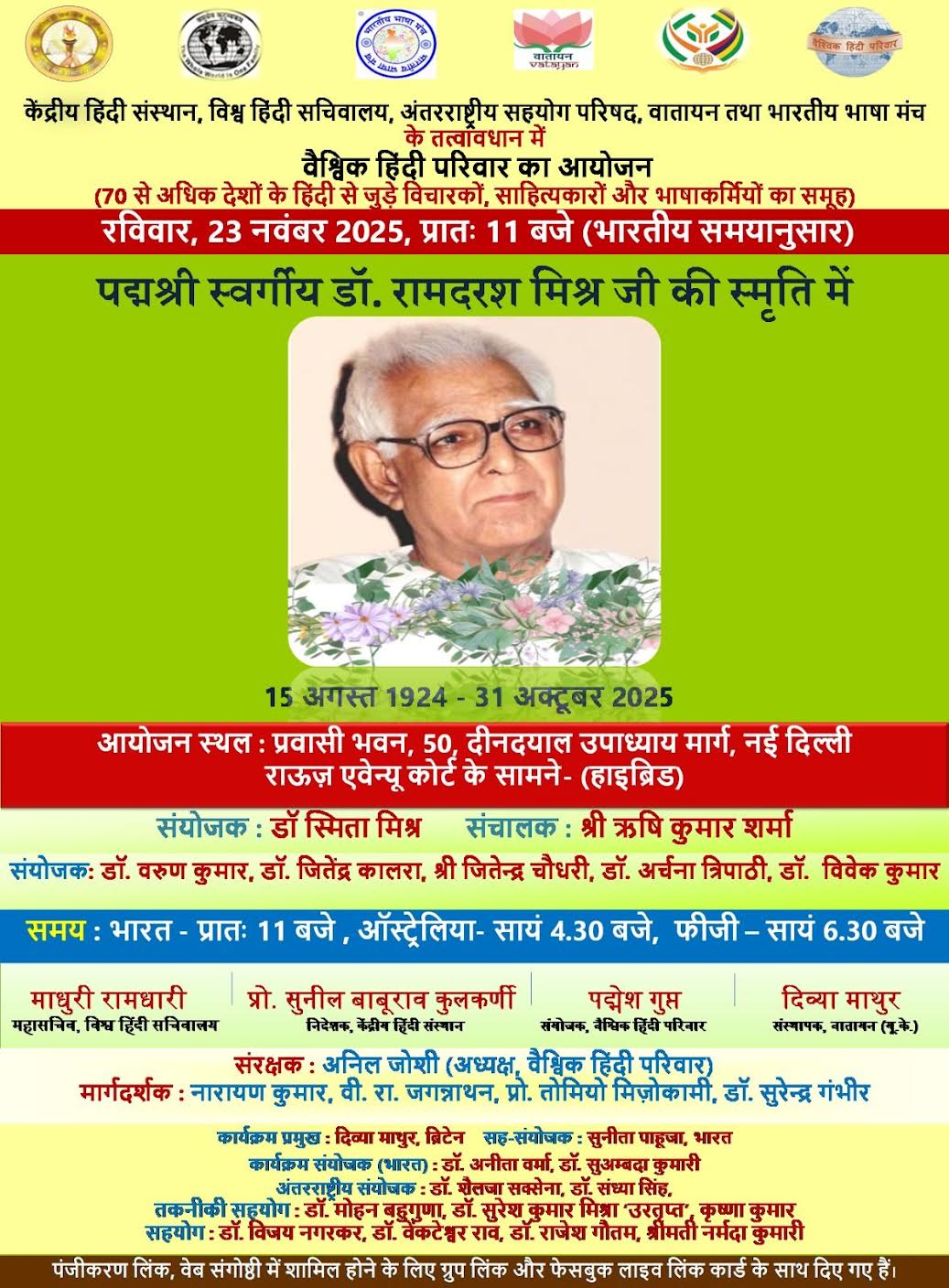
पद्मश्री स्व. डॉ रामदरश मिश्र जी की पावन स्मृति में

3-7.jpeg

केदार

दिल्ली ।पद्मश्री स्व. डॉ रामदरश मिश्र जी की पावन स्मृति में केंद्रीय हिंदी संस्थान, विश्व हिंदी सचिवालय, अंतरराष्ट्रीय सहयोग परिषद, वातायन तथा भारतीय संघ के तत्वावधान में वैश्विक हिंदी परिवार (70 से अधिक देशों के विचारकों एवं भाषाविदों का संयुक्त संस्थान) द्वारा एक आयोजन संपन्न हुआ। रविवार, 23 नवंबर 2023, प्रातः 11 बजे से दोपहर 2 बजे तक (प्रवासी भवन, समीप राउज एवन्यू कोर्ट, दीन दयाल उपाध्याय मार्ग, नई दिल्ली) चले इस कार्यक्रम में विभिन्न स्थानों से आमंत्रित विद्वानों ने रामदरश मिश्र जी के प्रति श्रद्धासुमन स्वरूप अपने-अपने संस्मरण सांझा कर अपनी बात रखी। गूगल मीट के माध्यम से भी अनेकों विद्वानों ने देश-विदेश से आनलाइन जुड़कर अपने संबोधन सांझा किये। इस अवसर पर सुप्रसिद्ध साहित्यकार एवं पूर्व मुख्यमंत्री रमेश पोखरियाल निशंक ने भी अपने संदेश में स्वर्गीय डॉ रामदरश मिश्र जी के प्रति अपने संस्मरण एवं विचार प्रकट किए।

इस अवसर पर मुझे भी संस्थान द्वारा अपने संस्मरण एवं अपनी बात रखने का अवसर मिला। मुझे आमंत्रित किए जाने तथा अवसर प्रदान करने हेतु माननीय संस्थान का सहृदय आभारी हूं। कार्यक्रम की अध्यक्षता प्रोफेसर अनिल जोशी ने की तथा कुशल संचालन हिंदी अकादमी के पूर्व उप सचिव श्री ऋषि कुमार शर्मा द्वारा किया गया। इस आयोजन में स्वर्गीय मिश्र जी की कनिष्ठ पुत्री प्रोफेसर श्रीमती स्मिता मिश्रा भी उपस्थित रहीं, जिन्होंने नम आंखों से अपने पिता के जीवन और रचनाक्रम से जुड़े संस्मरणों से सभी को अवगत कराया। ज्ञात हो कि इस अवसर पर आज ही आस्ट्रेलिया एवं फीजी में भी मिश्र जी की स्मृति में कार्यक्रम आयोजित किए जा रहे हैं।

कार्यक्रम को अपने संबोधन से जिन जिन विद्वानों ने महान साहित्यकार रामदरश जी के प्रति संबोधन स्वरूप श्रद्धासुमन अर्पित किए उनमें, सर्वश्री विजय मल्होत्रा, डॉ अमरेंद्र पांडे, डॉ श्रीमती के. गोंद, प्रोफेसर नीता त्रिपाठी, अर्चना त्रिपाठी, डॉ अल्का सिन्हा, डॉ वरुण कुमार, नरेश शांडिल्य, प्रोफेसर अनिल जोशी, डॉ स्मिता मिश्रा, प्रोफेसर दिव्या माथुर, डॉ वेदमित्र शुक्ल, डॉ संजय प्रभाकर, डॉ कुमार सुबोध, डॉ सुधा शर्मा ‘पुष्प, डॉ शशांक चंद्र शुक्ल, मनोज कुमार सिन्हा, डॉ अनिरुद्ध सुधांशु, आदित्य नाथ तिवारी, डॉ पृथ्वी सिंह केदारखंडी, प्रियव्रत छिकारा, नीरज कुमार एवं कुलदीप सिंह सहित अन्य कई गणमान्य लोग उपस्थित रहे। अंत में दो मिनट की श्रद्धांजलि अर्पित कर कार्यक्रम संपन्न हुआ और सभी के द्वारा प्रसाद ग्रहण किया गया।

IIT Kharagpur: A Glorious Saga of Seventy-Five Years

1024px-IIT_Kharagpur_Old_Building_1951.jpg

Kolkata : On 18 August 2025, the Indian Institute of Technology (IIT) Kharagpur completed its magnificent seventy-five years. Established in 1951 as the very first IIT of independent India, it became the cornerstone of the nation’s dream of scientific and technological self-reliance. Built on the bricks of the historic Hijli Detention Camp, this institute today stands among the world’s finest technical universities. As we celebrate its Platinum Jubilee, its journey unfolds as an extraordinary blend of struggle, vision, innovation, and nation-building.

Birth: From Hijli to Kharagpur

In 1946, the committee headed by Sir Jogendra Singh recommended the creation of higher technical institutions to produce 15,000 engineering graduates annually. Exactly four years after independence, on 18 August 1951, Maulana Abul Kalam Azad laid the foundation of India’s first national institute of technology inside the Hijli Detention Camp – the same prison that once held Netaji Subhas Chandra Bose and countless other revolutionaries. The first convocation in 1956 was addressed by Jawaharlal Nehru himself, who bestowed upon it the proud title of “Indian Institute of Technology”.

In the beginning, there were only 224 students and 42 faculty members. The institute started with five departments: Civil, Mechanical, Electrical, Electronics & Communication, and Metallurgy. The first batch consisted of students who had passed only the tenth grade; they underwent two years of pre-engineering followed by a four-year B.Tech programme.

The Golden Era (1950s–1970s)

During the 1950s and 60s, IIT Kharagpur forged collaborations with almost every major foreign university that helped shape the modern IIT system. Nearly 250 foreign professors came from the Illinois Institute of Technology (USA), eight German technical universities, Soviet institutes, and through UNESCO. This was the period when the famous “Kharagpur School of Thought” emerged – rooted in practicality, discipline, and service to the nation.

In 1961, India’s first M.Tech programme was launched here. In 1959, the institute awarded the country’s first PhD (Dr. Sudhir Ghosh, Civil Engineering). By the 1970s, it had grown to 15 departments, several centres, and over 2,500 students.

A Laboratory of Firsts

Kharagpur has always maintained a tradition of being the “first”:

• India’s first 5-year integrated M.Sc. programme (1973)
• The first MBA programme in any IIT (Vinod Gupta School of Management, 1993)
• The first law school in any IIT (Rajiv Gandhi School of Intellectual Property Law, 2006)
• The first full-fledged medical college and hospital in any IIT (B.C. Roy Institute of Medical Science & Research with 200 beds)
• India’s first supercomputer under the National Supercomputing Mission (PARAM Shivay, 2019)
• India’s first floating solar power plant (2020)
• India’s cheapest and fastest COVID-19 testing kit “COVIRAP” (2020, costing only ₹600)

Global Recognition

In the QS World University Rankings 2025, IIT Kharagpur stands third in India and 222nd globally. It consistently ranks among the world’s top 50 in Engineering & Technology. In the 2024 Nature Index, it was the second-highest ranked institution in India. With over 14,000 research papers published annually, more than 300 patents filed every year, and over 150 start-ups incubated (including companies like Hydration Tech, NanoClean, and MindTree co-founders), these numbers speak for themselves.

The campus culture is legendary. Spread over 2,100 acres of lush greenery, it remains one of the largest university campuses in the world. Historic halls like Nehru Hall, Patel Hall, Azad Hall, and Lala Lajpat Rai Hall; the iconic Old Main Building of 1951 whose clock still keeps perfect time; the 2.6-kilometre-long Scholars’ Avenue; the historic Gymkhana ground where Sachin Tendulkar practised in 1999; and the Technology Students’ Gymkhana – Asia’s largest student body – all combine to create a unique cultural identity.
Spring Fest (the social & cultural fest) and Kshitij (Asia’s largest techno-management fest) attract students from across the globe every year.

Science for Society

IIT Kharagpur has never limited itself to awarding degrees; it has always given back to society:

• Coastal erosion models after the 2004 tsunami
• Reconstruction technology after the 2005 Kashmir earthquake
• Bio-reactors for cleaning the Ganga
• Low-cost sensors for farmers (Department of Agricultural & Food Engineering)
• Affordable solar lamps and water purifiers for rural India

Alumni: Shaping the World

Among its nearly 130,000 alumni are some extraordinary names:
• Sundar Pichai (CEO, Google)
• Arvind Krishna (CEO, IBM)
• Parag Agrawal (former CEO, Twitter)
• Vinod Gupta (co-founder, InfoUSA; benefactor of VGSoM)
• Ajit Balakrishnan (founder, Rediff.com)
• Duvvuri Subbarao (former Governor, Reserve Bank of India)
• Biswadeep Bhattacharya (Global Head of Beverages, PepsiCo)

These are just a few. Almost one in every ten Indian-origin CEOs in the United States is an IIT Kharagpur alumnus.

The 75th Year: A New Resolve

In its Platinum Jubilee year, IIT Kharagpur has unveiled the vision “Future Ready India @100”. To make India a developed nation by 2047, the institute has set ambitious targets:

• Net-zero carbon campus by 2030
• Centre of Excellence in Quantum Technology
• Semiconductor manufacturing research
• 500 PhDs per year in Artificial Intelligence & Machine Learning
• Incubation of 500 start-ups

On 18 August 2021, Prime Minister Narendra Modi digitally inaugurated the 75th-year celebrations and said, “The history of Kharagpur is the history of India’s self-confidence.”

The same bricks of Hijli jail that once sheltered freedom fighters are today building the ladder for India to become a global superpower. In seventy-five years, IIT Kharagpur has not merely produced engineers; it has crafted dreams – dreams that land Chandrayaan on the moon, dreams that run Google and IBM, dreams that are turning India into a $5-trillion economy.

When dusk falls on this 2,100-acre campus and the last rays of the sun touch those red bricks, it feels as if the bricks are whispering: “The dream we saw in 1951 is now becoming reality.”

When the next seventy-five years are complete, this very campus might be running space stations or Mars missions.

IIT Kharagpur is not just an institution; it is an idea – the idea of young India, of India’s technological ambition, of India’s radiant future.

वर्नाक्युलर घोषणा’: भारतीय भाषाओं में हस्ताक्षर करने वाले नागरिकों का अपमान

drop-proceedings-under-section-66a-of-it-act-mha-to-states-and-uts.jpg

दिल्ली । भारत एक बहुभाषी राष्ट्र है, जहाँ संविधान की आठवीं अनुसूची में 22 भाषाएँ दर्ज हैं। इन भाषाओं में हस्ताक्षर करना, बोलना और लिखना प्रत्येक भारतीय नागरिक का मूलभूत अधिकार और उसकी सांस्कृतिक पहचान का प्रतीक है। परंतु, स्वतंत्रता के 78 वर्षों बाद भी, भारत की आर्थिक व्यवस्था और वित्तीय संस्थाएँ एक ऐसी औपनिवेशिक मानसिकता को ढो रही हैं जो भारतीय भाषाओं को हीन और उनके उपयोगकर्ताओं को ‘अनपढ़’ मानती है। बैंक और वित्तीय संस्थाओं द्वारा हिन्दी या किसी भी भारतीय भाषा में हस्ताक्षर करने वाले नागरिकों से कराई जाने वाली ‘क्षेत्रीय भाषा की घोषणा’ (वर्नाक्युलर घोषणा) इसी निंदनीय मानसिकता का स्पष्ट प्रमाण है। यह प्रथा न केवल भाषाई भेदभाव है, बल्कि करोड़ों नागरिकों के आत्म-सम्मान पर सीधा आघात है।

*क्या है ‘क्षेत्रीय भाषा की घोषणा’?*
‘वर्नाक्युलर’ शब्द का शाब्दिक अर्थ है ‘किसी क्षेत्र की स्थानीय या क्षेत्रीय भाषा’। वित्तीय संस्थाओं, विशेषकर बैंकों, में यह घोषणा-पत्र उन ग्राहकों से भरवाया जाता है जो अंग्रेज़ी में हस्ताक्षर नहीं करते हैं, बल्कि हिन्दी, मराठी, गुजराती, तमिल, या किसी भी अन्य भारतीय भाषा (जिसे वे ‘क्षेत्रीय भाषा’ (वर्नाक्युलर लैंग्वेज) कहते हैं) में हस्ताक्षर करते हैं। इस घोषणा पर हस्ताक्षर करके ग्राहक एक तरह से यह स्वीकार करता है कि:

• वह अंग्रेज़ी नहीं जानता है।

• उसे बैंकिंग दस्तावेज़ों की सामग्री को समझने के लिए किसी तीसरे व्यक्ति की आवश्यकता है।

• कुछ मामलों में, इसे सीधे तौर पर ‘अनपढ़’ या ‘अंगूठा लगाने वाले’ व्यक्ति की श्रेणी में रखा जाता है।

यह प्रावधान मूल रूप से अंग्रेज़ी शासन के दौरान उन ग्रामीण और अनपढ़ नागरिकों के लिए बनाया गया था, जो किसी भी भाषा में पढ़ने या हस्ताक्षर करने में सक्षम नहीं थे, और उन्हें धोखाधड़ी से बचाने के लिए किसी शिक्षित गवाह की आवश्यकता होती थी। यह अत्यंत खेदजनक है कि भारतीय भाषाओं में हस्ताक्षर करने वाले साक्षर नागरिकों को भी आज उसी श्रेणी में रखा जा रहा है।

*साक्षरता और भाषा की भ्रामक पहचान*

इस घोषणा का सबसे बड़ा विरोधाभास यह है कि यह साक्षरता को अंग्रेज़ी भाषा से जोड़कर देखता है। भारत में करोड़ों नागरिक उच्च शिक्षित हैं, जिन्होंने अपनी शिक्षा भारतीय भाषाओं के माध्यम से पूरी की है और वे अपनी भाषा में लिखने-पढ़ने में पूर्णतः सक्षम हैं। एक डॉक्टर, इंजीनियर, या सरकारी अधिकारी भी, जो अपनी पहचान और सम्मान के लिए हिन्दी या तमिल में हस्ताक्षर करता है, उसे इस घोषणा के माध्यम से अप्रत्यक्ष रूप से ‘अशिक्षित’ या ‘समझ से कम’ मान लिया जाता है।

यह न केवल भाषाई रूढ़िवादिता है, बल्कि राष्ट्र के संवैधानिक मूल्यों के विपरीत है। संविधान की राजभाषा हिन्दी और अन्य क्षेत्रीय भाषाओं में हस्ताक्षर करने पर यदि बैंक किसी नागरिक से यह घोषणा करवाते हैं कि ‘मेरे सामने पढ़ा गया और मैंने समझा’, तो यह स्पष्ट करता है कि बैंकिंग और वित्तीय प्रणाली आज भी मानती है कि ज्ञान का एकमात्र पैमाना अंग्रेज़ी भाषा ही है।

*अधिकारों का हनन और गोपनीयता का उल्लंघन*

जब किसी ग्राहक को यह घोषणापत्र भरना पड़ता है, तो उसे बैंकिंग दस्तावेज़ों की गोपनीयता बनाए रखने के लिए किसी तीसरे व्यक्ति (साक्षी) पर निर्भर रहना पड़ता है। यह ग्राहक की व्यक्तिगत वित्तीय जानकारी और गोपनीयता के अधिकार का उल्लंघन है। यदि ग्राहक अपनी भाषा में दस्तावेज़ पढ़ और समझ सकता है, तो उसे किसी तीसरे व्यक्ति की क्या आवश्यकता है? यह प्रक्रिया अनावश्यक रूप से ग्राहक की वित्तीय प्रक्रिया को जटिल बनाती है और उसे एक हीन भावना से भर देती है।

*भारतीय रिज़र्व बैंक को पत्र और नियामक का हस्तक्षेप*

इस अपमानजनक प्रथा को समाप्त करने के लिए लेखक ने दिनांक 27 जून 2025 को एक विस्तृत पत्र भारतीय रिज़र्व बैंक (आरबीआई) के गवर्नर तथा वित्त मंत्रालय को भेजा था, जिसमें स्पष्ट किया गया था कि “वर्नाक्युलर डिक्लेरेशन” न केवल असंवैधानिक (अनुच्छेद 14 और 19 का उल्लंघन) है, बल्कि जिस ग्राहक को अंग्रेज़ी नहीं आती, उसी से यह घोषणापत्र अंग्रेज़ी में भरवाना एक “हद दर्जे की धोखेबाजी व जालसाजी” है।
पत्र में यह भी तर्क दिया गया था कि यह प्रावधान आरबीआई की ग्राहक अधिकार संहिता का उल्लंघन है, जिसमें ग्राहक को समझने योग्य भाषा में सूचना प्राप्त करने का अधिकार दिया गया है।

*आरबीआई की प्रतिक्रिया (दिनांक 11 अगस्त 2025):*

आरबीआई ने अपने उत्तर में स्वीकार किया कि उनके द्वारा जारी विभिन्न मास्टर निदेश और परिपत्र यह सुनिश्चित करते हैं कि:
1. उधारकर्ता के लिए सभी संसूचना स्थानीय भाषा अथवा उधारकर्ता द्वारा समझी जानी वाली भाषा में होनी चाहिए।
2. ऋणों और अग्रिमों के लिए मुख्य तथ्य विवरण (केएफसी) उधारकर्ता द्वारा समझी जाने वाली भाषा में लिखा जाएगा।
3. बैंकों को खाता खोलने के फॉर्म, पास-बुक आदि सहित ग्राहकों द्वारा उपयोग में लाई जानेवाली सभी मुद्रित सामग्री को त्रैभाषिक रूप से (संबंधित क्षेत्रीय भाषा, हिन्दी व अंग्रेज़ी) में उपलब्ध कराना चाहिए।

आरबीआई ने स्वयं द्वारा जारी किए गए इन नियमों का उल्लेख करते हुए, इस मामले की गंभीरता को स्वीकार किया और सूचित किया कि इस विषय से संबंधित ईमेल को “निरीक्षण विभाग को उचित कार्यवाही के लिए अग्रेषित किया गया है।”

आरबीआई के अपने नियम स्पष्ट रूप से यह कहते हैं कि ग्राहकों को उनकी भाषा में संसूचना मिलनी चाहिए। ऐसे में, किसी साक्षर नागरिक से उसकी अपनी भाषा में हस्ताक्षर करने पर, उसे अतिरिक्त और अपमानजनक ‘वर्नाक्युलर घोषणा’ करने के लिए बाध्य करना नियामक के ही निर्देशों का स्पष्ट उल्लंघन है। यह तथ्य कि एक नागरिक की शिकायत पर केंद्रीय बैंक ने मामले को निरीक्षण के लिए भेजा है, यह दर्शाता है कि यह औपनिवेशिक प्रथा अब नियामकीय जाँच के दायरे में आ चुकी है।

*आत्म-सम्मान की बहाली आवश्यक*

‘क्षेत्रीय भाषा की घोषणा’ केवल एक कागज़ी औपचारिकता नहीं है; यह भारतीय भाषाओं के प्रति एक संस्थागत पूर्वाग्रह है। आरबीआई द्वारा अपने ही नियमों का हवाला देने और मामले को निरीक्षण विभाग को भेजने के बाद, अब वित्तीय संस्थाओं को इस प्रथा को तुरंत समाप्त कर देना चाहिए।
बैंकिंग प्रणाली को यह स्वीकार करना होगा कि साक्षरता का अर्थ अंग्रेज़ी साक्षरता नहीं है। यदि किसी नागरिक का खाताधारक पहचान पत्र (केवाईसी) साक्षरता प्रमाणित करता है, तो उसे अपनी भाषा में हस्ताक्षर करने पर अतिरिक्त और अपमानजनक घोषणा करने के लिए बाध्य नहीं किया जाना चाहिए।
यह समय है कि भारत की वित्तीय संस्थाएँ भाषाई आत्म-सम्मान को प्राथमिकता दें और अपनी ही भाषाओं में हस्ताक्षर करने वाले देश के करोड़ों साक्षर नागरिकों को ‘अनपढ़’ की श्रेणी से बाहर निकालें। यह सुनिश्चित करना अब भारतीय रिज़र्व बैंक के निरीक्षण विभाग की ज़िम्मेदारी है, ताकि हमारा बैंकिंग तंत्र समावेशी और वास्तव में भारतीय कहलाए।

ITBP Marks 64th Raising Day with Celebrations at Udhampur, J&K

ITBP-marks-64th-Raising-Day-in-Udhampur-1024x534-1.jpg

Udhampur, Jammu & Kashmir | The Indo-Tibetan Border Police (ITBP) celebrated its 64th Raising Day with pride and grandeur at the 15 Battalion, Udhampur.

The event was graced by Shri Bandi Sanjay Kumar, Hon’ble Minister of State for Home Affairs, as the Chief Guest, along with Shri Manoj Sinha, Hon’ble Lieutenant Governor of Jammu & Kashmir, Sh. Prateek Sharma, Northern Commander, Sh. Nalin Prabhat, DG J&K, and other distinguished dignitaries.

Shri Bandi Sanjay Kumar paid solemn tribute to ITBP martyrs, took the ceremonial salute, and witnessed the grand Raising Day Parade.

In his address, the Hon’ble Minister extended greetings to all ITBP personnel and commended their exemplary service under extreme Himalayan conditions, highlighting their devotion, dedication, and professionalism in safeguarding the nation.

Shri Praveen Kumar, Director General, ITBP, welcomed the Chief Guest and dignitaries. He highlighted the Force’s significant achievements and emphasised ITBP’s contribution in:

High-altitude border security, Humanitarian assistance and disaster relief, Internal security and Naxal operations,Mountaineering excellence and rescue operations

Parade Highlights :

The parade featured participation from all major contingents of the Force, including: Women’s contingent, Ski team, Mounted column, Commandos Paratroopers, Dog squad, Brass band, Thrilling demonstrations added to the spectacle, including C-SAC drills by women Himveers, an integrated drone display, and a martial arts performance.

A total of five personnel received the President’s Police Medal for Distinguished Service, while 24 officers and personnel were awarded the Police Medal for Meritorious Service.

Best unit awards for the year were presented as follows:

43 Battalion – Best Border Battalion, 52 Battalion – Best Non-Border Battalion, 27 Battalion – Best ANO Unit, 18 Battalion – Best Clean Battalion, 25 Battalion – Best Green Battalion, 13 Battalion – Winner, Rajbhasha Chalshield Trophy (2024)

Shri Mukesh Singh, Additional Director General, ITBP, delivered the vote of thanks, expressing gratitude to the Chief Guest and reaffirming the Force’s resolve to serve the nation with unwavering dedication and professionalism.

scroll to top