
Vinod Kumar Shukla
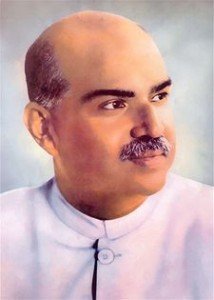
Kolkata : The 2026 Assembly election results of West Bengal are significant on at least two counts in which the Bharatiya Janata Party (BJP) has defeated Trinamool Congress (TMC) decisively. These elections have not only brought about change in the government but have also attempted to correct historical mistakes that the politics of the state had lost track with. Also, the victory of the BJP in the state completes the full circle that Shyama Prasad Mukherjee started drawing in 1951 with the formation of Bharatiya Jan Sangh (BJS) which merged with Janata Party in 1977 and was revived as the BJP in 1980.
However, the leader who fought for the cause of the people of Bengal was not only forgotten for long but was politically disowned by his own people. His mission and fight for the people of the country was demeaned as the political ideology of Hindi speaking region and by calling it with various other names. The two issues that he took up by staring at the eyes of the most powerful leader of the time and even sacrificed his life on June 23, 1953 for Jammu and Kashmir while in custody there. His death raised suspicion across the country but demands for independent inquiry was ignored by Prime Minister Jawahar Lal Nehru including the letter written by his mother being thrown in the garbage bin. The entire West Bengal chose to remain silent supposedly for his ideology allegedly being divisive.
What was his ideology? Mukherjee termed special provisions made for Jammu and Kashmir under Article 370 as the Balkanisation of India and three-nation theory of Sheikh Abdullah whose conviction for J&K was ‘Ek Desh Mein Do Vidhan, Do Pradhan aur Do Nishan Nahi Chalenge’ (A country can’t have two constitutions, two prime ministers, and two flags). To cut the story short, he fought against the entry permit for J&K which was revoked in 1959 but many other provisions remained and removing them needed a favourable number of members in Parliament.
The other issue that he had opposed and had decided to resign protesting against from the Nehru government as Union Minister for Industry and Civil Supplies for injustice with people of East Bengal scripted in the Nehru-Liaquat Agreement or Delhi Pact. Mukherjee believed the agreement left Hindus in East Pakistan at the mercy of the new Pakistaniestablishment. The pact demonstrated a weak policy of India toward Pakistan and failed to stop the influx of refugees in later days which subsequently became such an issue that it became one of the reasons for the creation of Bangladesh with Indian intervention. But the issue of infiltration could not beaddressed for vote bank politics.
Mukherjee wanted a systematic exchange of population and property between East Bengal and bordering Indian states like West Bengal, Assam and Tripura to resolve the refugee crisis. The BJS leader objected to the government’s approach of reconciling with Pakistan as reports suggested the pact was not being implemented by the Pakistan government and persecution, murder, rape of minority women and conversion of minorities continued. In a prudent political move to unseat the Congress, the BJS that was formed in 1951 merged itself post-emergency in Janata Party but after the fall of Janata government and subsequent splits, people of the BJS formed a new party as the BJP in 1980 which did not get electoral mandate strong enough to fulfil the dream of its patriarch. The issue of infiltration that was plaguing the entire northeastern region in general but Assam and West Bengal in particular became a national problem due to neglect but the issue always remained on the backburner. The agitation led by the first BJS president against special status to J&K had to wait up to September 5, 2019 when the BJP government under Narendra Modi realised his dream and completed the integration of J&K by revoking the special status, ending its prerogative to have a separate constitution and flag.
But the bigger cause for which Mukherjee resigned from the Nehru government persisted as successive governments did not acknowledge infiltration as a problem rather allowed Muslims to come back and claim their properties that they had left behind after migrating to East Pakistan. This is what Mukherjee was opposed to and resigned from the government in protest. “Rights of ownership in or occupancy of the immovable property of a migrant shall not be disturbed. If, during his absence, such property is occupied by another person, it shall be returned to him provided that he comes back by 31st December, 1950,” says the Nehru-Liaquat Agreement.
The agreement provided further concessions to Muslims who migrated to Bangladesh, “Where restoration of immovable property to the migrants who return within the specified period is found not possible, the Government concerned shall take steps to rehabilitate him.”
Three things here are very important: First those who demanded and voted for Pakistan were allowed to return; Second West Bengal was also added to the pre-partition call to capture by demographic change as was Assam; Third Pakistan did not adhere to the provisions made in the agreement for their minorities – Hindus, Sikhs, Buddhists, Jains and Christians. The issue of infiltration was not taken seriously by political parties in India despite the fact that a war was fought with Pakistan in view of the flux of Bangladeshis into India. On August 4, 2005, leaders like Mamata Banerjee, who threw papers on Deputy Speaker of the Lok Sabha Charanjit Singh Atwal who was presiding the house, protested against illegal Bangladeshi immigrants being included in the voter list of West Bengal describing it as a major threat to security. But later she chose to start supporting infiltration for political benefits and allegedly became the biggest facilitator.
On July 14, 2004, the then Union Minister of State for Home Affairs Sriprakash Jaiswal told the Rajya Sabha that there were over 1.2 crore illegal Bangladeshi in India. This statement created a big political controversy and numbers were subsequently withdrawn citing that they were ‘unreliable’. This was obviously done for the obvious reason of appeasement. Various other sources reported the number to be at around 2 crores. In November 2016, the then Union minister of state for Home Kiren Rijiju told the Rajya Sabha that there were approximately 2 crore illegal Bangladeshi migrants staying in India.
These infiltrators are spread all across the country especially in the big cities of the country and live on the encroached government lands. So, the two issues that Shyama Prashad Mukherjee campaigned for, the issue of J&K is settled for once and all but the other issue has two aspects that minorities of undivided Pakistan will not get justice by Nehru-Liaqat Agreement. To deal with it, India has passed Citizenship Amendment Act (CAA) to grant citizenship to persecuted minorities of Pakistan, Bangladesh and Afghanistan; Second dealing with infiltration that needed such a government in Indian states bordering Bangladesh that is uncompromisingabout it. Prime Minister Narendra Modi pitched for it and Home Minister Amit Shah told the roadmap to implement it.
Previous governments in Assam, Tripura and Bangladesh were rather facilitators to infiltrators. Now all these three states are ruled by the BJP and most of the Northeastern states have NDA governments. West Bengal was the only hurdle in this regard which was not ready to give land to the BSF for border fencing. Now by electing a BJP government in West Bengal, people seem to have corrected historical wrongs for which S P Mukherjee kicked the coveted post of a minister at the Centre. Though late, the people of West Bengal have finally acknowledged and tried to redeem themselves by giving a mandate in favour of the BJP.
(The author is a Delhi-based journalist with over 28 years of experience at various media organisations including print and online mediums).
