
Vinod Kumar Shukla
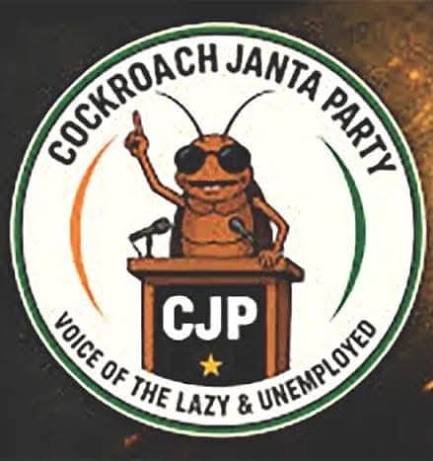
Delhi : Though the Cockroach Janata Party (CJP) has created a significant ripple on social media, so much so that digital users and the general public alike have begun viewing it as a new beacon of hope for Indian democracy. However, it failed to replicate the same on the ground. Opposition political parties also took note of its popularity in the virtual world, viewing the CJP as an emerging force capable of—if not replacing—certainly challenging the alleged arrogance of the ruling dispensation in New Delhi and various other states.
Leveraging its 22-million-strong Instagram following, the CJP called upon its supporters to gather at the iconic Jantar Mantar to demand the resignation of Union Education Minister Dharmendra Pradhan. Meanwhile, Union Education Minister successfully conducted NEET examinations on June 21, 2026.Former Aam Aadmi Party (AAP) activist and media professional Abhijeet Dipke arrived in Delhi amidst high drama. While his supporters on social media anxiously anticipated his potential detention at the Delhi airport, those fears proved unfounded when Dipke was smoothly handed an official permission letter to protest at the venue. Ultimately, the CJP’s initial plan to gherao (encircle) the Parliament Street police station was nipped in the bud by the administration.The CJP is continuing with its protest and Sonam Wangchuk on hunger strike but with very little crowd mostly onlookers or media.
Although the gathering was planned for 9:00 AM on June 6, 2026 the first day of protest, which was delayed. Heavy police bandobast (arrangements) was made to maintain peace and law and order, given Jantar Mantar’s proximity to Parliament. Despite the much-hyped presence of climate activist Sonam Wangchuk on the very first day, the expected crowds failed to turn up, disheartening the organizers. Unlike the massive footfall at India Against Corruption protest in 2011, the CJP protest withered away after lunch as exhausted, dehydrated organizers left the venue to replenish themselves. It resurfaced on June 20, 2026 with the Wangchuk later announcing hunger strike but public support is far from being a reality as was claimed.
Opposition Support Backfires
The immense traction the CJP enjoyed online enticed India’s opposition parties—particularly the Congress and the Samajwadi Party (SP)—to offer full-throated support. Leaders took to X (formerly Twitter) to proclaim that Gen Z would hit the streets because the CJP was championing the youth-centric
On the other hand, a section of political analysts argues that opposition parties missed a golden opportunity by not supporting CJP physically. Had they mobilized their own cadres to swell the ranks, they could have put the ruling government on defensive. Instead, they chose to withhold their ground force, stalling any potential momentum for a wider political movement.
Questions have also arisen regarding the legitimacy of the CJP’s 22 million followers, with detractors debating whether the digital base is genuinely Indian or bolstered by accounts from Pakistan, Bangladesh and many other Middle-East countries. Rumours circulated that anti-India forces were driving the social media campaign without any real grassroots foundation. Nevertheless, widespread anger among Gen Z remains a tangible reality.
Is India’s Gen Z Divided?
The sharp political polarization gripping India is equally evident among Gen Z, who appear divided into three distinct camps:
The Pro-Establishment Camp: This segment resonates strongly with the BJP’s narrative of nationalism. Unconcerned with the issues raised by the CJP, they thrive within the current dispensation’s ecosystem and echo its rhetoric.
The Partisan Opposition Camp: These are Gen Z supporters of the Congress who take up socio-political issues enthusiastically but often abandon them midway to pursue other priorities.
The Silent Majority: This group feels that street protests and dharnas are not their cup of tea. They remain focused on their immediate goals, such as preparing for competitive examinations. Their civic participation is limited to occasionally airing random views only when a media microphone is thrust in front of them. Notably, a vast majority of these individuals do not even own social media accounts.
CJP’s Failure Termed a “BJP Conspiracy”
Following the lacklustre turnout at Jantar Mantar, several social media influencers and staunch critics of Prime Minister Narendra Modi began labelling the CJP as a tactical construct of the BJP itself. Before the event, one prominent influencer had predicted a crowd so massive that it would encircle Parliament and force Modi and Shah to flee the country—a hyperbole that exposed the influencer’s ideological bias.
When the protest failed, critics pivoted to a conspiracy theory: they argued that the CJP was created by the government as a “safety valve” to intentionally channel and fizzle out public anger against the Modi administration. According to this theory, the BJP succeeded in its design to neutralize dissent. This narrative of decline gained traction as a subsequent CJP call to action in Lucknow also petered out with zero turnout.
Social Media Meltdown
The stark contrast between online hype and ground reality triggered a massive social media meltdown among CJP loyalists. Supporters began offering various excuses for the low footfall, blaming the extreme Delhi heat, strict police restrictions, the presence of right-wing activists at the venue, and bias from mainstream (“Godi”) media.
Just as the movement’s digital popularity had skyrocketed, it nosedived with equal velocity. The group’s prospects were further damaged by a mysterious, polarizing post advising Muslims to stay away from the protest. Ultimately, the dominance of professional social media protesters alienated the genuinely aggrieved students who had real stakes in the issue.
Real World vs. Virtual World
The episode highlights the vast chasm between the virtual and real worlds. While millions may “like” or “share” an idea on social media, digital metrics alone cannot dislodge a democratically elected government.
The Indian electorate is well aware that mobocracy is no substitute for democracy. Political battles in India are won on the ground, not on timelines—a reality thoroughly understood by established political parties like the Congress, SP, TMC, DMK, and NCP. India possesses a resilient democracy, and for any movement to succeed, virtual anger must translate into deep-rooted, real-world organization. As things stand, the CJP has failed to bridge that gap.