
Kailash Chandra
Raipur: One of the greatest strengths of the Indian family system is that children do not grow up only with their parents but also with grandparents, siblings, cousins, uncles, aunts, and other family members. In a joint family, children learn the art of living together long before they enter the outside world. When three or four children eat together, play together, share their toys, take care of one another, quarrel, reconcile, and celebrate together, they naturally acquire the values of social living without any formal instruction. They learn that life is not merely about fulfilling personal desires but also about respecting the feelings, needs, and aspirations of others. The family becomes their first classroom, teaching cooperation, tolerance, sacrifice, patience, discipline, responsibility, and mutual dependence.
In such an environment, affection, emotional bonding, belongingness, and the joy of sharing develop naturally. Living together, working together, sharing meals, and standing beside one another during happiness and adversity become everyday habits rather than moral lessons. These experiences gradually shape an individual’s character and lay the foundation of social harmony, mutual trust, peaceful coexistence, and national integration. In this sense, the family is not merely a biological institution but the first school where responsible citizens and compassionate human beings are nurtured.
India’s civilization can never be understood merely through its geography, political institutions, or economic achievements. At its heart lies a unique civilizational framework built upon family, tradition, values, and the continuity of generations. For centuries, the Indian family has been far more than a household consisting of parents and children. It has served as an institution where moral values, discipline, social responsibility, respect for relationships, and cultural traditions are transmitted from one generation to another. This is why the Indian family has always been regarded as the living foundation of Indian civilization.
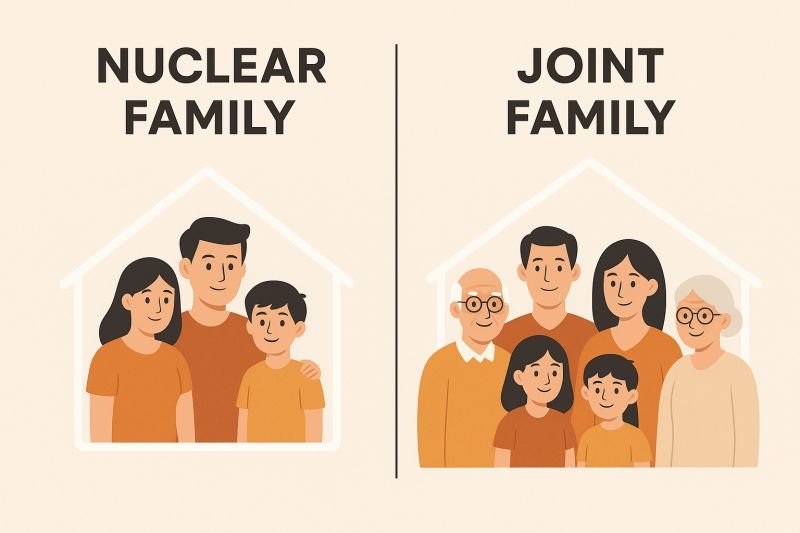
Today, however, this foundation is passing through a period of profound transition. Joint families are steadily giving way to nuclear families. Urbanization, employment-driven migration, consumerism, individual aspirations, and changing lifestyles have transformed the structure of family life. This transformation is not merely a change in living arrangements; it has far-reaching implications for India’s cultural continuity and the emotional bonds that connect generations. Therefore, the real question is not whether joint families are superior to nuclear families, but whether India is gradually losing one of its greatest civilizational strengths.
Traditionally, a joint family represented much more than several people living under one roof. It was a way of life rooted in collective responsibility and shared existence. Grandparents contributed wisdom, parents provided leadership and care, uncles and aunts offered support, and children grew up amidst affection, guidance, and security. Difficulties were shared, responsibilities were distributed, and decisions benefited from collective experience. Children naturally learned cooperation, empathy, patience, and the importance of community. The joint family taught that life is not merely about rights, but equally about duties, discipline, and coexistence.
The emergence of the nuclear family, on the other hand, is largely a consequence of modern economic realities. Professional mobility, urban living, limited housing, and the desire for privacy have made nuclear families increasingly common. Undoubtedly, they offer several practical advantages, including greater independence, quicker decision-making, financial flexibility, and personal privacy. Yet, when detached from India’s cultural ethos, the nuclear family often risks becoming merely an efficient living arrangement rather than a centre of value formation. As a result, parents experience increasing psychological and financial pressure, children often receive limited exposure to intergenerational relationships, and elderly family members frequently face loneliness and neglect.
This is where the cultural strength of the Indian family becomes particularly significant. Its true strength has never depended upon its size but upon its value system. It is within the family that children first learn respect for elders, care for younger members, hospitality toward guests, reverence for food, celebration of festivals, patience during adversity, and the ability to place collective welfare above personal interest.
Schools may impart knowledge, governments may guarantee rights, and markets may provide material comforts, but it is the family that shapes character, emotional intelligence, and moral responsibility.
Another remarkable feature of the Indian family system has been its ability to maintain meaningful relationships across generations. Grandparents are not merely elderly relatives; they are living repositories of experience, cultural memory, ethical wisdom, and spiritual traditions. Parents represent responsibility and productive engagement with society, while children symbolize hope and the future. When these three generations remain connected, the family becomes much more than a place of residence—it becomes a living tradition that preserves and renews civilization itself.
One of the greatest challenges of contemporary India is the gradual weakening of intergenerational dialogue. Children increasingly inhabit the digital world, young adults remain overwhelmed by professional competition, and many elderly people feel marginalized even within the homes they helped build. Shared meals are becoming less frequent, family conversations are diminishing, storytelling traditions are disappearing, and cultural memory is fading. The consequences extend far beyond loneliness among senior citizens; younger generations risk losing their connection with their civilizational roots, inherited values, and collective identity.
At the same time, it would be simplistic to romanticize every joint family or dismiss every nuclear family. Not every joint family has been harmonious, nor is every nuclear family deficient. Joint families have also experienced conflicts related to property, authority, and interpersonal tensions. Likewise, many nuclear families successfully preserve strong moral values, emotional warmth, and close ties with their extended relatives. Therefore, the essential issue is not the external structure of the family but its inner spirit. A joint family without affection, respect, dialogue, and responsibility becomes merely a crowd. Conversely, a nuclear family that nurtures respect for elders, meaningful relationships, cultural traditions, and regular interaction with the extended family can preserve the essence of Indian family values.
The real concern arises when excessive individualism transforms the family into a purely utilitarian arrangement. When “I” replaces “we” as the centre of life, relationships gradually become transactional, consumption replaces companionship, and personal convenience outweighs collective responsibility. Such a shift weakens not only the family but also society itself. A nation with fragile families ultimately faces weakened communities, growing isolation, declining social trust, and cultural insecurity.
The need of the present time is not to engage endlessly in debates over joint versus nuclear families, but to preserve the enduring values that have always defined the Indian family. Families must revive meaningful conversations, shared meals, respect for elders, value-based upbringing of children, and strong emotional connections across generations. Even if modern realities make traditional joint families less practical, nuclear families can still preserve the civilizational spirit that has long distinguished Indian society.
India’s true strength lies not merely in its demographic size, technological advancement, or economic growth. Its greatest strength lies in its family system—a system that connects individuals to their roots, nurtures character, instills responsibility, and binds generations into a continuous cultural tradition. If this institution weakens, India will face not only social challenges but also a gradual erosion of its civilizational identity.
The task before contemporary India is therefore not to preserve the external form of the joint family at all costs, but to revive its foundational values—mutual affection, shared responsibility, intergenerational solidarity, cultural continuity, and collective well-being. Only by preserving these timeless principles can India ensure that its families continue to remain the strongest pillars of its civilization in the twenty-first century.