
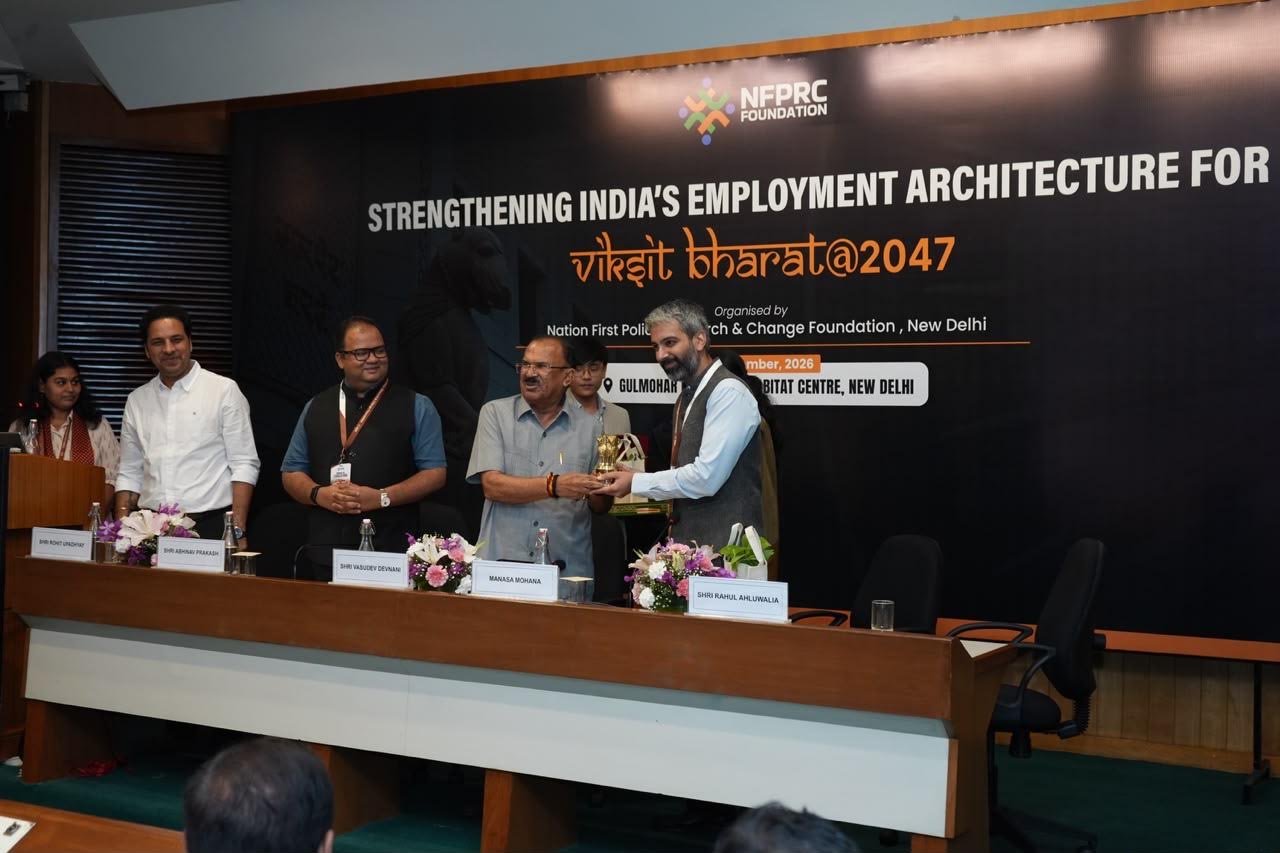
New Delhi: The Nation First Policy Research and Change Foundation (NFPRC) convened a workshop for Legislators at Gulmohar Hall, India Habitat Centre, bringing together Members of Parliament, Members of Legislative Assemblies, and policy experts for discussions on strengthening India’s employment ecosystem. The deliberations focused on key areas including education and skilling, investment-led industrialisation, and the use of digital communication in legislative processes. The workshop saw participation from 40 public representatives from the Lok Sabha, Rajya Sabha, and State Assemblies from across the country.
Following the strong participation and response to its earlier legislative programs, NFPRC organised the workshop to facilitate meaningful dialogue between elected representatives and policy experts. Discussions focused on strengthening the link between education, skills and employment, expanding job opportunities through investment and industrial growth, and improving constituency-level communication and outreach. The programme also highlighted the importance of evidence-based policymaking and effective implementation frameworks to help legislators address local priorities and deliver better outcomes for their constituents.
Inaugurating the workshop, Shri Abhinav Prakash, Board Member, NFPRC Foundation, highlighted the central role of employment and economic opportunity in the nation’s journey towards Viksit Bharat @2047. He emphasised the importance of building on India’s progress by strengthening the linkages between education, skills and industry requirements, while promoting investment and industrial growth aligned with local strengths and opportunities. Encouraging legislators to translate these discussions into constituency-level action, he underscored their pivotal role in fostering local economic growth and expanding employment opportunities.
In address as the Presiding Chair of the workshop, Shri Vasudev Devnani, Hon’ble Speaker of the Rajasthan Legislative Assembly, emphasised the need to systematically map the skills, capabilities and aspirations of local youth with emerging employment opportunities in their respective regions. He highlighted the importance of strengthening education–skills–industry linkages, enabling institutions to respond to local economic needs, and encouraging investments that build on regional strengths. He underscored the role of legislators in promoting government schemes and ensuring that their benefits reach the eligible working population, facilitating industry–institution partnerships, and creating an enabling ecosystem where local talent can access meaningful employment opportunities closer to home.
Shri Shashank Mani, Member of Parliament, Lok Sabha, delivered a session virtually titled “Driving Employment through Investment & Industrialisation.” He highlighted the significant opportunity to expand livelihoods by combining formal employment with entrepreneurship, particularly across India’s Tier-2 and Tier-3 districts. Drawing on his decade-long initiative in Deoria and neighbouring districts, he presented the “Amrit Prayas” and “Jagriti”models, built around six pillars spanning high-employment manufacturing, agri-processing and tourism. He outlined a ten-year strategy to strengthen the local economic ecosystem, catalyse investment and create lakhs of additional jobs in the constituency. Reflecting on India’s employment journey, he described the evolution of the national approach through a building metaphor: “In Modi 1.0, the foundation for employment was laid; in Modi 2.0, the walls were built; and in Modi 3.0, the roof is being built.” He said this progression reflects the continued strengthening and expansion of the country’s employment and entrepreneurship ecosystem.
Shri Rahul Ahluwalia, Director at Foundation For Economic Development, delivered a session titled “Driving Employment through Investment & Industrialisation.” The session examined how India can accelerate export-led growth and job creation through greater global investment, lower input costs, and a stress-free business environment, with Vietnam and GIFT City as models. Discussions also highlighted the significant potential of manufacturing exports and tourism to expand employment opportunities, while emphasising how states can accelerate reforms that simplify compliance and create a more enabling business environment. Legislators can play a proactive role by identifying local constraints, supporting the development of investment opportunities, attracting anchor investors, facilitating businesses, and promoting reforms that streamline licensing and inspection processes, helping ensure that increased investment translates into sustainable jobs, livelihoods, and broad-based local growth.
Communication expert Dr. Rohit Upadhyay, conducted a capacity-building session on digital and social media communication for legislators. The session provided legislators with practical insights into social media platforms, citizen engagement, analytics, and digital content strategies. It also covered countering misinformation, and the responsible use of AI in public communication. The discussion highlighted how digital tools can help legislators understand public sentiment, tailor content across platforms, respond to emerging narratives, and strengthen communication and engagement with constituents.
In his closing remarks, Shri Vasudev Devnani acknowledged the valuable contributions of the distinguished speakers and participating legislators for their active engagement. He reiterated the Foundation’s commitment to promoting informed policy dialogue, strengthening legislative capacity, and encouraging evidence-based decision-making through research and collaboration.
The workshop reinforced NFPRC’s commitment to connecting policy research with practical governance. Discussions focused on institutional strengthening, innovative policymaking, and improved public service delivery. The programme concluded with a collective emphasis on stronger partnerships and the sharing of best practices to advance inclusive and results-driven governance in line with the vision of Viksit Bharat@2047.
Participating legislators welcomed the workshop as a useful platform for constructive policy dialogue, exchange of experiences, and sharing of best practices. The discussions also supported continuous learning and contributed to strengthening legislative capacity. NFPRC plans to build on this engagement through future dialogues, thematic consultations, and ongoing research-based initiatives focused on informed policymaking and effective legislative practices.