
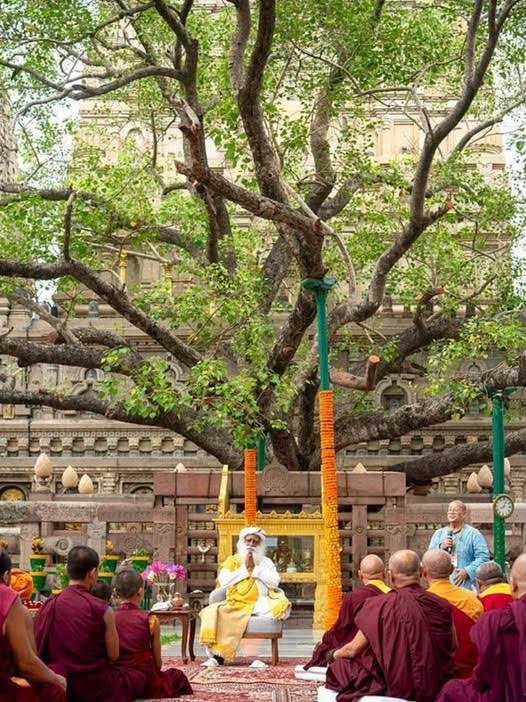
GAYA Ji (Bihar) : Sanatan Dharma is a great tradition in which tirthas (pilgrimage sites) hold profound significance. These are not merely geographical locations but powerful centres of spiritual energy, where millions of devotees have been journeying for centuries in search of moksha (liberation). If a person claims to be a Shiva devotee, a representative of Sanatan Dharma, and a promoter of Indian spiritual heritage, it is natural to expect that he or she will show equal respect to all major tirthas of the Sanatan tradition. Faith cannot be limited to words or public speeches alone; it must also be reflected in conduct, behaviour, and complete dedication.
Recently, Sadguru Jaggi Vasudev visited Gaya. He toured the Mahabodhi Temple, and the photographs and videos of his visit were seen across the country. His respect for the Buddhist pilgrimage site is commendable. However, he did not consider it necessary to visit the ancient Vishnu Pada Temple located in Gaya, the sacred city of Lord Vishnu, the bestower of moksha.
Vishnu Pada Temple is an extremely holy site in the Sanatan tradition. It houses the sacred footprints of Lord Vishnu, and devotees perform shraddha and tarpan here for the peace of their ancestors’ souls. This place is believed to grant liberation. In Sanatan Dharma, both Vishnu and Shiva are equally worshipable. For a self-proclaimed Shiva devotee to overlook a major Vishnu tirtha naturally raises serious questions.
The glory of Sanatan Dharma lies in its inclusiveness and wholeness. It equally reveres Shiva, Vishnu, Devi, Surya, Ganesha, and all other deities. Pilgrimage to tirthas is a symbol of this wholeness. When a spiritual leader selectively visits only certain sites and ignores the foundational pillars of Sanatan Dharma, it sends a message that some tirthas are less important. Such selective reverence weakens the unity of Sanatan Dharma.
A person who promotes Indian spiritual tradition is expected to show equal respect to major pilgrimage centres such as Ram Janmabhoomi, Dwarka, Badrinath, Jagannath Puri, Kashi, Prayagraj, and Gaya. Focusing only on Buddhist sites while representing Sanatan Dharma appears incomplete. Sanatan is not merely a subject of words and platforms; it is equally a matter of living faith and consistent conduct.
Today, as Sanatan Dharma strives to strengthen its roots globally, the responsibility of its promoters increases manifold. They must prove through their actions that they are serving the entire Sanatan tradition, not just a convenient or fragmented version of it. The neglect of sacred sites like Vishnu Pada Temple is not merely a question of personal faith but an issue concerning the honour and dignity of the entire Sanatan tradition.
True spiritual guides are those who view all deities and all tirthas with the same reverence. The protection and promotion of Sanatan Dharma will be meaningful only when there is harmony between words and actions.