
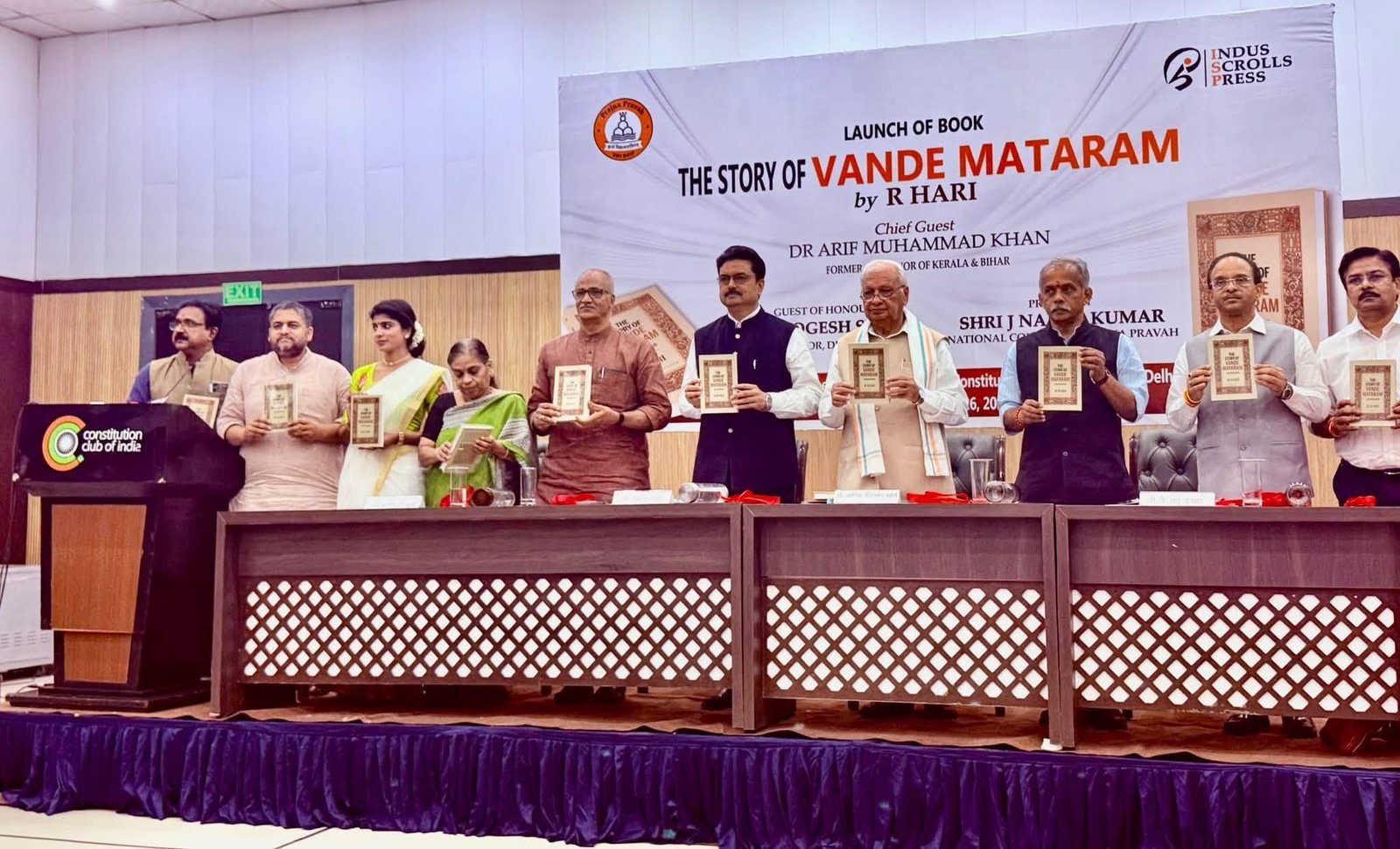
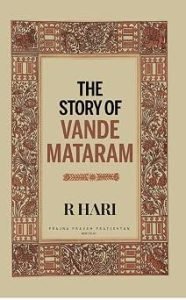
New Delhi. On 26 October 2026, a significant literary and intellectual event took place at the Deputy Speaker Hall in the Constitution Club of India Annexe, New Delhi. Under the joint auspices of Pragya Pravah (Delhi Province) and Indus Scrolls Press, the English translation of the late Ranga Hari’s Malayalam work The Story of Vande Mataram (वंदे मातरम् की कहानी) was released. The original book was translated into English by Dr. Mercy Jill.
The book was originally written in Malayalam and became a bestseller in Kerala. After its Hindi translation, the English edition will now extend its reach to a national readership. The purpose of the book is to dispel several myths associated with the national song, and to explain its origin, its place in the freedom struggle, the public emotions linked to it, and its continuing relevance. Special thanks were expressed to G. Sridharan (also referred to as G. Sridhattan), publisher of Indus Scrolls Press, for bringing out the publication.
Dr. Arif Mohammad Khan, former Governor of Kerala and Bihar, released the book as the chief guest. Prof. Yogesh Singh, Vice-Chancellor of the University of Delhi, was the special guest, while J. Nandakumar, National Convener of Pragya Pravah, presided over the programme. On this occasion, in-depth discussions were held on the historical journey of Vande Mataram, its cultural significance, its role in the freedom struggle, and the various debates associated with it.
In his address, Dr. Arif Mohammad Khan described the book as the true story of Vande Mataram and highlighted its historical importance. Sharing his personal experiences with Ranga Hari, he remembered him as a scholar, an accomplished writer, and a committed patriot. He said that the work clarifies the origin of the national song, its role in the freedom movement, and the emotions and controversies associated with it. J. Nandakumar described Vande Mataram not merely as a song, but as the soul of the freedom struggle and a powerful voice of Indian consciousness. He also pointed to the “step-motherly treatment” it received during the Congress regime. Prof. Yogesh Singh discussed the historical background of the song and provided a detailed synopsis.
The book was originally written in Malayalam and became a bestseller in Kerala. After its Hindi translation, the English edition will now extend its reach to a national readership. The purpose of the book is to dispel several myths associated with the national song, and to explain its origin, its place in the freedom struggle, the public emotions linked to it, and its continuing relevance. From the stage, special thanks were expressed to G. Sridhattan of Indus Scrolls Press for the publication.
Ranga Hari: An Intellectual Warrior and Litterateur
Shri Ranga Hari (popularly known as Hari ‘Ettan’ or Hariji) was a prominent thinker, writer, and senior leader of the Rashtriya Swayamsevak Sangh (RSS). He was born in December 1930 (5 December, according to most sources) in the Tripunithura/Ernakulam region of Kerala to Ranga Shenoy and Padmavati. He became an RSS swayamsevak at the age of thirteen and a full-time pracharak in 1951. He was the first pracharak from Kerala to rise to the highest levels of national leadership in the organisation.
After the ban on the RSS following Mahatma Gandhi’s assassination in 1948, he participated in the satyagraha demanding the lifting of the ban and spent several months in jail. During the Emergency of 1975, when the RSS was banned again, he was one of the principal organisers of the underground resistance network in Kerala. From 1983 to 1994, he served as the Prant Pracharak of Kerala and guided organisational expansion amid political challenges. From 1991 to 2005, for fifteen years, he held the responsibility of the ideological training of the Sangh as Akhil Bharatiya Bauddhik Pramukh.
He was an extraordinary polyglot. He wrote approximately 43 books in Malayalam, 11 in Hindi, and 2 in English, focused on Hindu thought, nationalism, and history. One of his most notable contributions was the editing and compilation of the twelve-volume Sri Guruji Samagra, a collection of the writings and speeches of the second Sarsanghchalak, M.S. Golwalkar (Guruji). He also wrote profound analytical works on various characters of the Mahabharata. He passed away on 29 October 2023 at the age of 93 in Kochi. The final phase of his life was also spent in writing and study.
The English launch of The Story of Vande Mataram is an important step in further disseminating Ranga Hari’s intellectual legacy. This work not only brings to light the historical journey of Vande Mataram, but also rekindles that national consciousness which gave strength to the freedom struggle. Such events encourage serious dialogue on Indian history, culture, and national identity.