
Mayank K ‘Morningstar’
There’s a new bizarre trend sweeping across the internet. Gen Z, while often vocally reserved, is increasingly projecting itself as a supporter of the left’s latest toolkit initiative, the “Cockroach Janata Party.” Social media is being flooded with countless posts and AI-generated slop surrounding the trend.
But is reality really as simple and obvious as it appears? Probably not. The answer seems far more ambiguous and also far more difficult to uncover.
Delhi : Since its advent in 2014, the incumbent government at the center has been rigid and uncompromising toward all forms of Naxalism, and Urban Naxalism has been no exception. The Prime Minister made this stance very clear when he said, “We will have to defeat all forms of Naxalism, be it gun-toting or pen-wielding.” However, the term “Urban Naxal” was not widely used in mainstream political discourse during the early 2010s. At that time, Maoist insurgency was operating strongly across several Indian states. Nationalist circles were already discussing the existence of urban support systems for Maoists. Their attempts at “political education” and “student mobilization” in universities (ref: Urban Perspective: Our Work in Urban Areas, a document by CPI Maoist), along with the role of intellectual circles and civil society networks, were not hidden from the public. It was during this period that Indian national politics began undergoing a transition, leading to several new developments; a nationwide shift from the left to right wing politics.
Among the most notable was the India Against Corruption (IAC) movement of 2011, which led to the emergence of a new leader, Arvind Kejriwal. Almost overnight, his name was on everyone’s lips, especially within the progressive urban circles of New Delhi. He quickly gained traction in Delhi by projecting anti-corruption politics, subsidized utilities, and an anti-VIP culture. This rise culminated in his emergence as one of the most prominent leaders during the 2013 Delhi Assembly elections. For the first time, this may have presented an opportunity for alleged Urban Naxal circles to engage with this new political phenomenon in Delhi, though they had initially remained skeptical of this emerging political force. Initially, the bond was not very clearly evident or visible at first, it kept appearing recurrently until it became distinctly noticeable in 2018. A series of events that followed vigorously established this bond. During the anti-CAA protests, while AAP maintained a cautious public position, it allegedly gained indirect electoral benefits by encouraging and inciting sections of the protesters during the Covid-19 pandemic. Student involvement was also significant, particularly at the university level, with support from its student wing, Chhatra Yuva Sangharsh Samiti (CYSS).
What followed next were the Farmers’ Protests of 2020–21, where a set of economically significant amendments introduced during the Covid-19 period was strongly opposed by farmers, particularly from Punjab — another major bastion of AAP, where the party eventually came to power in 2022. The protests also caused massive traffic congestion and public inconvenience at the time.
After establishing a substantial presence through these civil society mobilizations, it was time for Arvind Kejriwal to rise to prominence, and he seemingly did so on the support structure allegedly nurtured by the academic ecosystem associated with so-called “urban naxals.” This was also the phase when the Aam Aadmi Party invested heavily in PR and social media campaigns. For the first time, YouTubers and influencers were seen working for the party round the clock, often from foreign soil and, allegedly, with foreign funding.
It was during this period that a YouTuber, allegedly an offshoot of the AAP IT Cell, launched his channel and gained considerable traction among left-leaning youth. However, it was later observed that a large section of his followers were not even Indian, and consequently, his influence reportedly had a negligible impact on the voters’ mindset, especially among the youth.
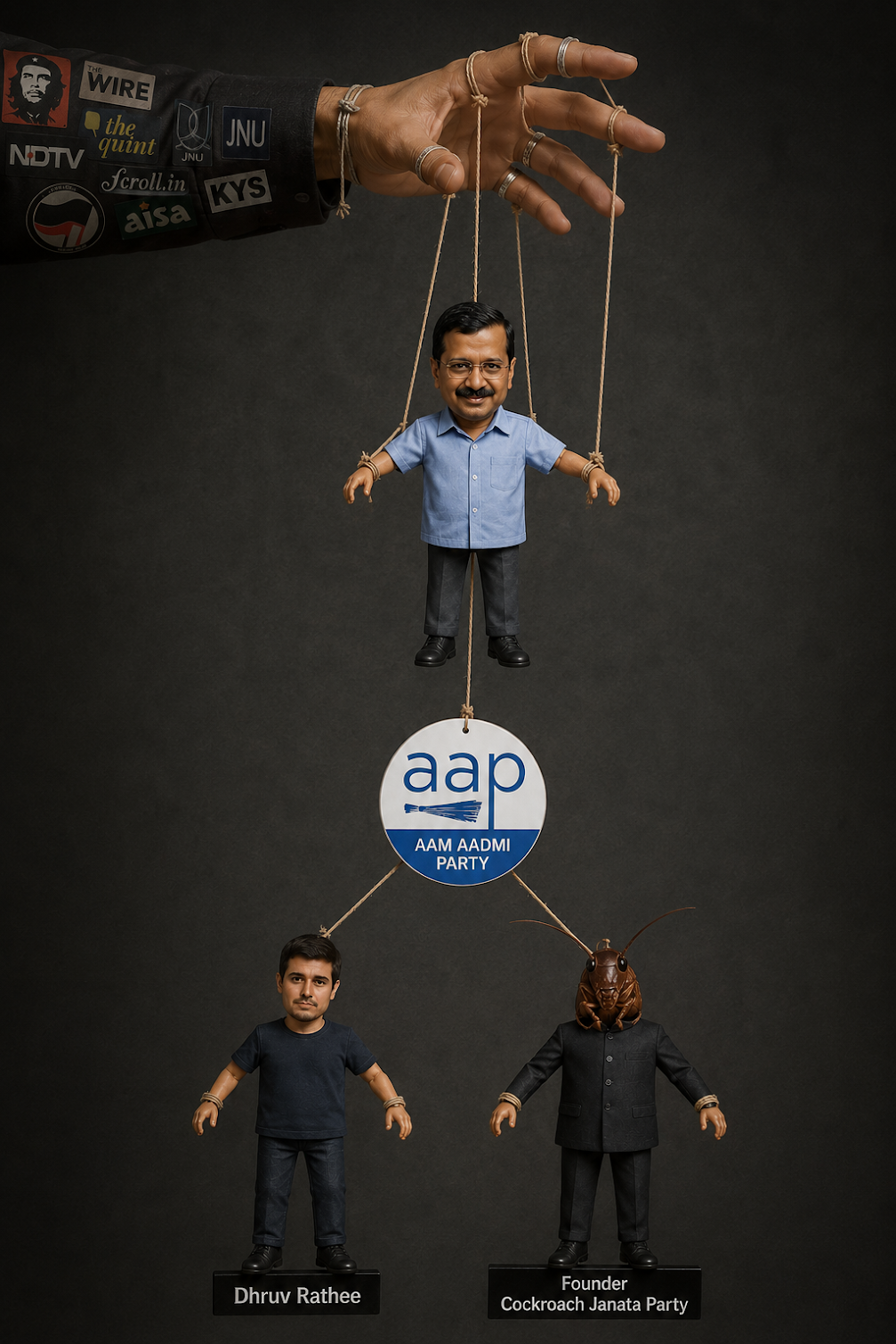
More recently, the so-called “Cockroach Janata Party” (CJP) has emerged as yet another social media gimmick. That’s trending everywhere. The modus operandi appears to involve seeding an ex-AAP IT cell worker, based and trained in the US, operating from the US. The obvious question that follows is: is he also funded by the US? Looking at previous records and the so-called deep state’s interest in the South Asian region, it is not a very difficult conclusion to draw.
The left faction has realized that making its presence felt among the internet using Gen Z is only possible by either keeping up with or initiating trends that are unique and stand apart. Guess what? A new toolkit, present for quite some time, has recently been activated. A new outfit, the Cockroach Janata Party has gained prominence among the youth. Headed by Abhijeet Dipke, a former AAP IT cell worker, it is now making headlines.
The page, which boasts more followers than the BJP, reportedly has almost half of its followers from Pakistan. Ironically, the same faction that raised concerns over privacy issues with the Sanchar Saathi app has willingly provided personal data to a US-based platform through Google Sheets. In an era of social media and AI slop, this appears to be nothing more than momentary hype.
However, another interesting observation is the behaviour of the toolkit; the way it constantly adapts to trends and searches for new ways to regain its lost grip. At the moment, though, it seems as distant as a cockroach is from a HIT spray.