
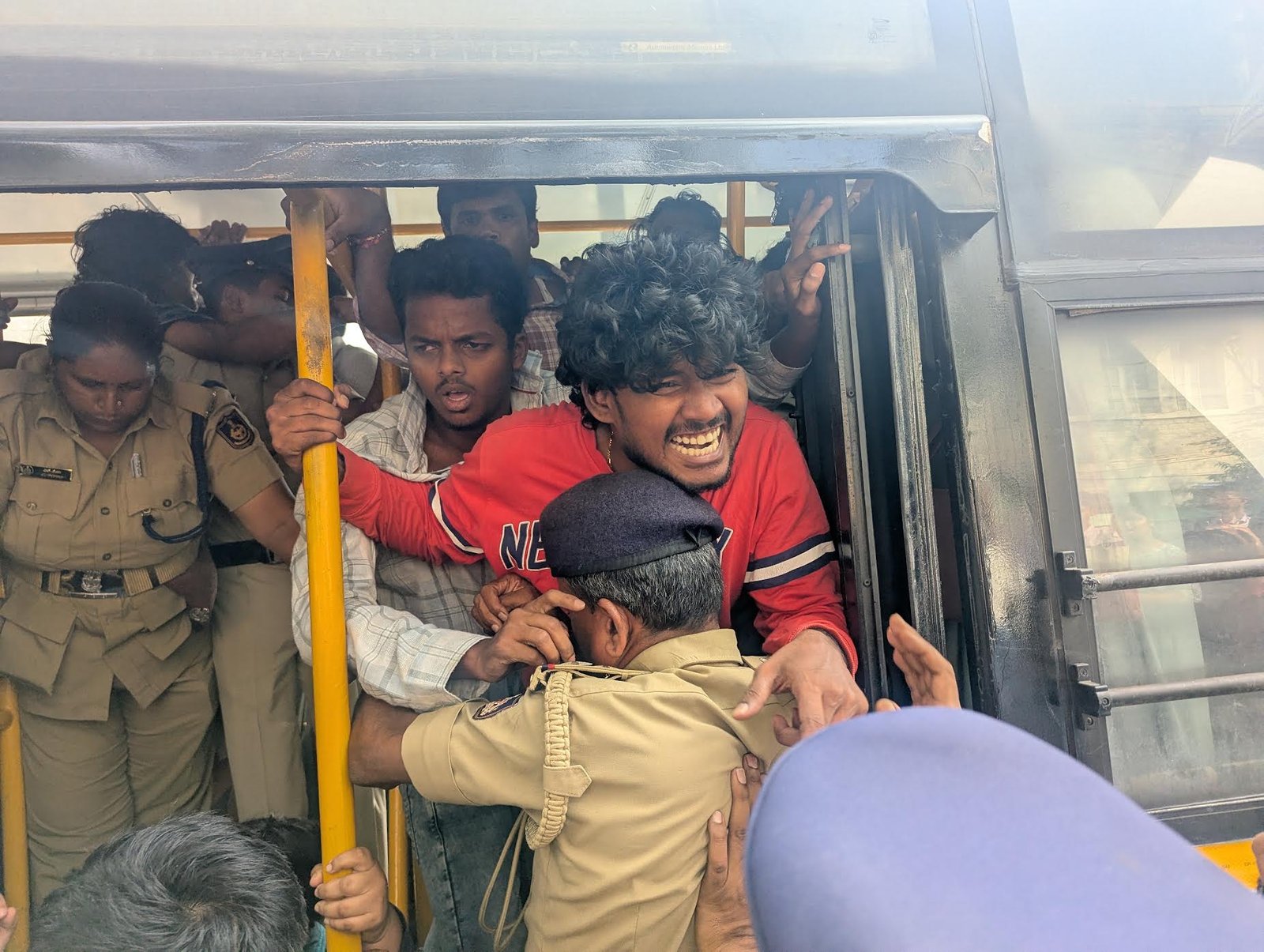
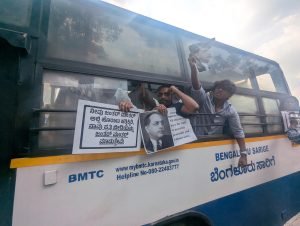
Bengaluru : In Congress-ruled Karnataka, Bengaluru police detained dozens of protesters opposing the Special Intensive Revision (SIR) of electoral rolls and the Election Commission of India on Monday. The action took place outside SJP College, opposite the Chief Electoral Officer’s office and less than a kilometre from Freedom Park – the city’s designated protest site. Police invoked a technical restriction that demonstrations are permitted only inside Freedom Park.
Plainclothes personnel were seen pushing, dragging and forcibly loading protesters into buses. Among those detained and later released were activist-author Aakar Patel, members of the All India Lawyers’ Association for Justice, and activists from the “My Vote, My Right” coalition. Advocate Vinay Sreenivasa said force was used and several people were taken to the City Armed Reserve grounds. Clifton Rozario, national general secretary of AILAJ, was assaulted. Reports also described police pulling at the clothes of women protesters while few women officers were present.
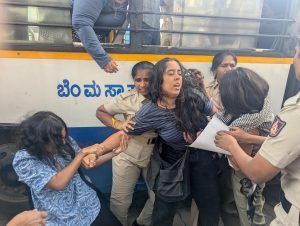
Photojournalists covering the detention faced direct action. One was beaten by four personnel. Three others were manhandled. Cameras and mobile phones were snatched and damaged. A photographer who continued filming was ordered to delete footage; an officer threatened him with jail after he was pushed to the ground, pulled by the collar and hit on the leg. Journalists had been documenting police handling of women protesters. A senior officer later said the matter would be inquired into.
The same day, Karnataka Chief Minister D.K. Shivakumar was in Delhi protesting against the Delhi Police. The contrast was immediate: a Congress chief minister publicly criticising police action in a BJP-ruled city while his own administration’s police were detaining anti-SIR demonstrators and interfering with journalists in Bengaluru. The protesters had demanded that the SIR exercise be scrapped and that Chief Election Commissioner Gyanesh Kumar resign, citing risks of mass disenfranchisement. Police maintained that the gathering lacked permission and that those who refused to shift to Freedom Park were taken into preventive custody and released.
The episode has drawn criticism on social media, including from individuals whose family members were detained and who tagged Congress leaders. Yet the wider media response has been muted compared with similar incidents involving central agencies or police in BJP-ruled areas. When cameras are seized or journalists are obstructed in Delhi or other opposition-ruled narratives, several television anchors, independent journalists and content creators quickly frame the events as an assault on press freedom or an “Emergency.” Equivalent footage from Bengaluru has produced far less sustained coverage or rhetorical escalation.
This pattern is not new. Coverage of police conduct frequently appears calibrated to the political colour of the government in power. When the ruling party is viewed as an adversary, restraint becomes “fascism”; when it is aligned, the same methods are described as routine law-and-order measures. Photojournalists in Bengaluru attempting to record the use of force against students and women protesters received little of the solidarity that would likely have been extended had the same sequence occurred outside a BJP chief minister’s office.
Journalism’s core function is scrutiny of power, not selective amplification according to partisan alignment. When outlets and creators treat identical tactics as existential threats in one capital and routine enforcement in another, the resulting credibility deficit is self-inflicted. Bengaluru’s journalists, whose equipment was seized and whose footage was demanded for deletion, are left to note that the volume of outrage often tracks the political assignment more closely than the facts on the ground.