
Meghna Das
Dimapur (Nagaland) : Indigenous societies have historically relied on oral traditions to preserve cultural memory in the absence of written records. Among the Ao Naga of Nagaland, folk tales, ritual chants, myths, and festival narratives function as living archives that uphold collective identity. This article examines Ao Naga oral traditions as living archives, aiming on how memory is carried across changing geographical spaces and generations. By exploring the preservation tactics of Ao Naga communities in the hill homeland of Nagaland and of migrant settlers across other places, the study examines the preservation of oral memory. Although the Ao Naga oral traditions have been well documented in the existing scholarship, much of it is descriptive rather than on the processes of conservation and transmission in everyday life. To fill this void, the study emphasizes how the Ao people actually play an active part in maintaining their cultural memory and continuity. It examines the continuity of oral traditions by looking at community practices, cultural performances, and intergenerational transmission of these traditions in a qualitative manner through interviews. Moreover, the study aligns with the recognition awarded to Guru Sangyusang S. Pongener for his lifelong efforts in the preservation of Ao Naga folk songs, arts, and indigenous cultural heritage by the Padma Shri award in 2026, highlighting the long-standing relevance of community-driven conservation of Ao Naga oral traditions as living archives.
Voices from the Hills
For indigenous societies, memory plays a central role in the survival of culture. Belief systems, history and social values have traditionally been transmitted through oral means rather than written documentation. These oral traditions comprising folk tales, myths, songs, ritual chants, genealogies, and festival narratives serve as repositories of collective identity and knowledge. Such systems have been termed as living archives in recent academic discourse, archives that are embedded, performative and upheld by community involvement. Among the Ao Naga of Nagaland, oral tradition has historically been vital in preserving cultural lineage. Before the origin of modern education and formal record-keeping, traditions were passed down orally to convey knowledge related to clan histories, origin myths, agricultural cycles, customary laws, moral values, and cosmological beliefs. Even with the opening of Christianity and the wide exposure to global cultures, the oral belief system continues to persist in everyday life of the Ao Naga community.
This study also examines the Ao Naga oral tradition carrying memory across changing spaces. With increasing migration, the Ao Naga population is now dispersed across diverse regions beyond their hill homeland searching for employment, education, or urban life. This holds serious significance in the process of continuation of such traditions that bring up how traditions are acclimated in new environments, how memory travels with people and intergenerational transmission sustains cultural essence outside the homeland.
OBJECTIVES
- To examine Ao Naga oral traditions as living archives of cultural memory.
- To analyse how oral traditions are held, sustained and transmitted across generations, geographical spaces, communities and performances.
STATEMENT OF THE PROBLEM
Although a burgeoning body of scholarship on Indigenous oral traditions, current research tends to focus on documents and descriptions, not on the processes of preservation and transmission that make up the lives of Indigenous peoples. The study on Ao Naga oral traditions have focused primarily on the reinterpretation of traditional concepts in the modern world, particularly outside Nagaland, and on intergenerational transmission of oral traditions, participation of communities, festive aspects and the effect of migration. To fill the void of things remaining underexplored, this research delves into oral traditions as dynamic living archives which reflect Ao Naga people’s memory and cultural continuity in the face of shifting geographical spaces in which they live. It aims to consolidate the previous knowledge about Ao Naga oral tradition.
REVIEW OF LITERATURE
The Ao Naga oral traditions are already identified as living archives which respect cultural memory, identity, history and beliefs, as well as social structures. Temsula Ao, ImlerenlaLongkumer, ResenmenlaLongchar talk about the preservation of history and the construction of Ao Naga identity through oral literature and Supong Jamir stresses Ao Naga religion as a practice that governs their social life and identity. The present research aims at filling this gap by exploring the ways in which Ao Naga oral traditions are passing down and being preserved in the evolving geographical locations and generations.
METHODOLOGY
The present qualitative study aims at analyzing the Ao Naga oral traditions that relates to the philosophical, sociological, cultural, spatial and educational dimensions in the process of constructing collective identity. It reviews published research to gain insight into gaps in research and the obstacles and opportunities in maintaining these traditions from one generation to the next and across geographical distances.
Primary data for this study was carried out through telephone interviews. Data of five Ao Naga individuals who have been actively engaged with oral tradition in different degrees like community participation, storytelling practices, cultural performances, academic involvement and social engagement were collected as a suitable sample for this research. Each participant had their lived experiences with at least one oral narrative. Some integrated more narratives that they considered significant. They were pre-informed about the objective of the study and sessions were conducted prior to the interviews.
The interviews were unstructured and conversational in nature. There was no strict adherence to the predetermined sequencing of questions, it was used only as a flexible reference rather than as a rigid framework. The conversations were allowed to flow naturally enabling participants to narrate their experiences, memories, and personal reflections freely. They were given full liberty to elaborate, diverge and share stories that emerged organically during the interactions recognising that oral traditions are deeply emotional experiential and heart centred forms of expression. All interviews were audio-recorded with consent. This open and flexible approach enabled rich narrative responses and felicitated the emergence of personal memories connected to Ao Naga oral traditions.
FINDINGS AND DISCUSSION
The researcher engaged deeply with the audio recordings, paying close attention to recurring ideas, emotional expressions, and meaningful reflections shared by the participants with transcriptions and thematic network analysis. Through reflective engagement, significant patterns and common concerns were identified. The researcher then organised these recurring ideas into thematic clusters based on their conceptual similarities. Rather than mechanically coding, the themes emerged organically from the narrative themselves.
As a result, the responses were grouped into six major themes, reflecting Ao Naga oral traditions as living archives:
- Memory Lives in the Voice – Participants highlighted that Ao oral traditions are based on nature and myths, including the Longterok (Six Stones) origin story, which influences Ao identity, world view, ecological ethics and human-nature Spirits. These traditions serve as metaphysical archives, in which cosmological thought and collective memory is stored.
- Stories Bind the Community – Participants spoke about how storytelling, songs and family and community conversations are important in language learning and in developing identity, kinship and values, and how oral traditions provide a basis for social cohesion.
- Carrying the Hills Across Spaces – Participants from beyond Nagaland reported the support of Ao Naga Associations and churches, particularly the Ao Baptist Church in Delhi, which shows how oral traditions survive and evolve as a way of life during the course of migration.
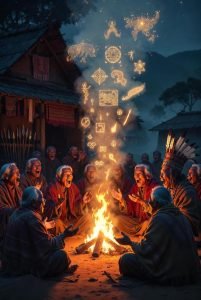
- Passing the Fire Forward – Elders, especially grandparents, transmit the language, stories and cultural values through their everyday stories and conversations and this continues across generations despite the influence of dominant language.
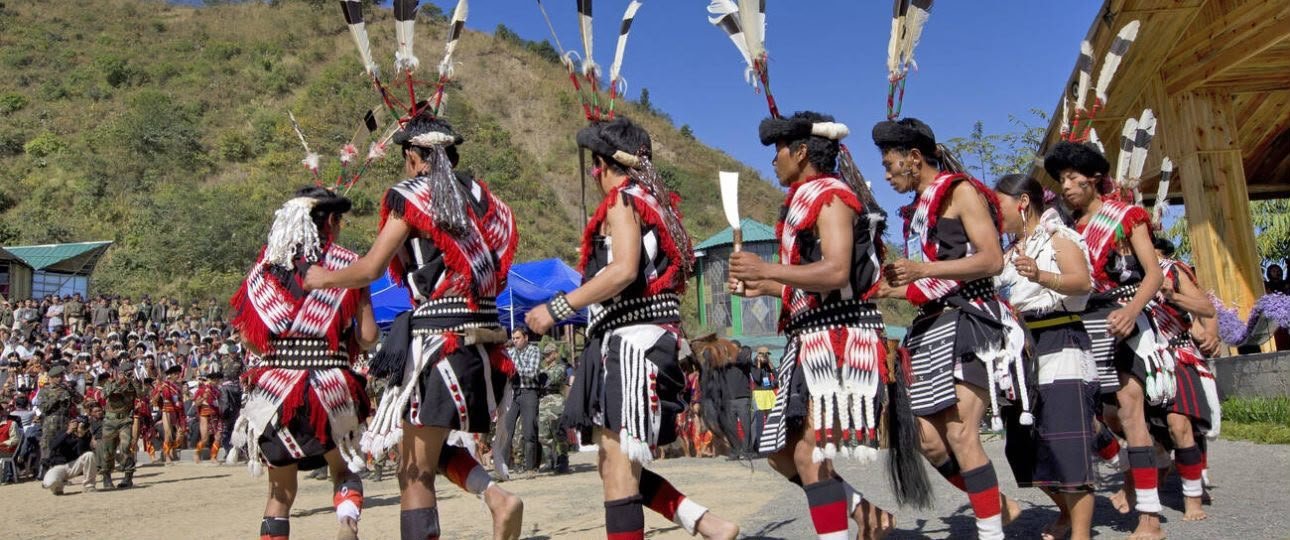
- Singing the Season, Living the Culture – Participants noted festivals like Moatsu, Tsungremmong and the Hornbill Festival as the performative places where Ao oral traditions, language, and collective memory are maintained, in addition to church music, traditional songs and community dramas.
- Learning to Belong – They spoke of the importance of Ao language, songs, and stories being taught in churches, Sunday schools, and children’s services in Ao communities of Nagaland and migrant communities, and how oral traditions are used in semi-formal education and adapted to modern settings.
The experiences of the participants indicate an oral tradition that is a living archive, maintained by philosophy, community, migration, intergenerational transmission, cultural performance and education. They are strong, resilient, adaptive and community driven rather than being weakened in modern or migratory environments.

IMPLICATIONS
The findings of this study highlight important implications for indigenous knowledge, preservation, cultural sustainability, and educational practice, challenging the dominance of written and institutional archives. The philosophical grounding implies the implications for indigenous epistemology and archival theory that must be reconceptualised to include voice, ritual, land, and stories as legitimate forms of knowledge and preservation. Sociologically, preservation policies focus not only on formal institutions but also support community based and household level practices where oral knowledge is naturally transmitted. The spatial dimension implies for migration and diaspora studies that indicates cultural continuity is not dependent solely on territorial rootedness, but on relational networks and collective organisation. Implications of cultural sustainability prioritise living platforms of heritage transmission through performance. Inter-generational transmission, particularly through elders and grandparents, remains central to language preservation especially with the advent of westernisation and huge differences in dialects. Integrating oral traditions into curriculum design, education and youth programs can strengthen implications in the field of education and faith based learning connecting the younger generations precisely.
The study ultimately suggests that protecting indigenous heritage requires moving beyond textual documentation towards supporting live realities as the essence of tradition is felt and lived and should not be forgotten with written documentation.
Living Archives in Transit
This study set out to examine Ao Naga oral traditions as living archives and to understand how memory is carried across changing geographical spaces. Through qualitative engagement with 5 Ao Naga participants, the research revealed that oral traditions remain deeply embedded in philosophy, sociological, spatial, cultural, intergenerational, and educational dimensions of Ao life. Far from being static remnants of the past, these traditions continue to function as dynamic systems of memory, identity and belonging. The thematic framework of this study demonstrates metaphysical understanding, kinship bonds, identity beyond territorial boundaries sustaining relationally rather than being geographically confined. It also focuses on performance as a means of renewing memory and the critical role of emotional inheritance. Nevertheless, illustrations of institutional platforms maintain cultural connectivity with contemporary frameworks.
Overall, the study reaffirms that Ao Naga oral traditions are not fading cultural remnants but are resilient living archives that travel with people, adapt to new spaces and continue to shape identity across time. Recognising and nurturing this oral tradition is essential for sustaining indigenous knowledge and cultural continuity in an increasingly globalised world.
REFERENCES
- Ao, Temsula. “The Ao Naga Oral Tradition”. Bhasha Publications, 1999.
- Alam, Mehebub and Pandey, Maya Shankar. “The Nation and its North-east: A Critical Reading of The Ao-Naga Oral Tradition by Temsula A”. Literature&Aesthetics 32(2). 2020.
- Longchar, Resenmenla. “Oral Narratives of Ao-Nagas: Constructing Identity“ Centre for Folk Culture Studies School of Social Sciences, University of Hyderabad. 2011.
- Jamir, P. Supong. “The Ao Naga Traditional Indigenous and Religious Beliefs”. Fazl Ali College Journal, vol.6, 2016, pp. 1-8.
- Longkumer, Imlirenla. “Interpreting Ao Naga oral literature: A Study Of Select Folksongs, Folktales and Proverbs”. School of Humanities and Education, Nagaland University, Kohima. 2021.
- Dr.Saikia, Jitu. “Sociocultural characteristics of the Naga tribes in Sivasagar District, Assam: An ethnographic study”. Education Administration Theory and Practice Journal 31(2). 2025.
- Basumatary, Deepak. “Revisiting Orality in North-East India”. MRB publishers(India). 2017.
- Nora Pierre(1989). “Between Memory and History: Les Lieux de Memoire”. Representations, no. 26, Special Issue:Memory and Counter-Memory, Spring 1989, pp. 7-24.
- Levi-Strauss, Claude. “Structuralism and Myth”. The Kenyon Review, vol. 3, no. 2, 1981, pp. 64-88.
- Dahal, Hikmat. “Folktales: A Moral Message from the Past to the Future Generation”. Nepal Journal of Multidisciplinary Research4(1). 2011.
(The author, Meghna Das, is associated with the Department of Sociology at Bharati College, University of Delhi.)