
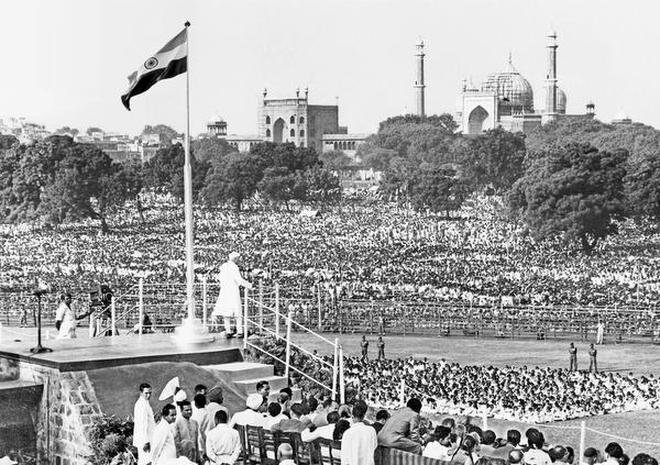
Delhi : India’s independence was not merely an event involving the transfer of political power; it marked the beginning of rebuilding a nation that, after centuries of political instability, colonial rule, Partition, and profound social challenges, established itself as a democratic republic. The history of India after 1947 is not merely the history of governments and political parties. It is also the history of movements, public sentiments, dissent, struggles, sacrifices, and decisions that repeatedly influenced the direction of the country.
If we examine the history of independent India carefully, we find that many important changes emerged as a result of public movements and popular pressure. At times, movements compelled governments to change their policies; at other times, they strengthened democracy. There have also been movements that posed serious challenges to national unity and the constitutional order. Therefore, the value or legitimacy of any movement should not be judged merely by the size of the crowd involved or by which government it opposed. The real questions are: What was the objective of the movement? What kind of language did it use? What methods did it adopt? And what consequences did its ultimate goal have for the nation, society, and Constitution?
One of the greatest challenges before India after 1947 was national integration. The country had been divided on religious lines, resulting in the displacement, violence, and insecurity of millions of people. At the same time, integrating hundreds of princely states into the Indian Union was an enormous historical challenge. Through the efforts of Sardar Vallabhbhai Patel and V. P. Menon, most of the princely states were integrated into India. The integration of Hyderabad, the Junagadh question, and the incorporation of other princely states demonstrate that nation-building does not happen merely by drafting a Constitution; it also requires political will and a strong commitment to national unity.
The Kashmir question was another complex legacy of this historical period. Following the accession of Jammu and Kashmir to India, the Pakistan-supported tribal invasion and the subsequent war of 1947–48 took the issue to the international arena. A large part of Kashmir came under Pakistan’s control, which India continues to refer to as Pakistan-occupied Jammu and Kashmir. Therefore, the historical pain and questions surrounding Kashmir in India cannot be viewed solely through the lens of contemporary politics. The issue is connected with the longer historical processes of independence, Partition, war, national security, and incomplete integration.
In this context, a question has repeatedly arisen: What did post-1947 Indian politics learn from the Kashmir problem? The purpose of history should not merely be to blame one individual or political party. History gives us an opportunity to understand the circumstances of the time, the alternatives that were available, and the long-term consequences of the decisions that were taken. To understand India’s policy on Kashmir, it is necessary to examine together the 1947–48 war, the decision to take the matter to the United Nations, the ceasefire, the constitutional arrangements surrounding Article 370, the political developments of 1953, and the separatism that emerged in later decades.
India’s history also demonstrates how important it is to maintain a balance between national interests and democratic dissent. Criticism of a government is not criticism of the nation. Governments come and go, but the nation and the Constitution are enduring institutions. Therefore, every citizen has the right to oppose government policies, ask questions, and participate in peaceful democratic movements. This is one of the fundamental strengths of democracy.
At the same time, however, it is equally important to understand that opposing a government is not the same as engaging in activities against the sovereignty and integrity of the nation. If a movement demands a change in a policy, law, or government decision and presents its case within the constitutional framework, it is part of democratic life. But if the language of a movement moves towards violence, separatism, terrorism, or the weakening of the sovereignty of the country, it becomes necessary to critically examine such a movement and its consequences.
During the 1960s, major movements emerged in South India, particularly in Tamil Nadu, around the question of language. Strong opposition to Hindi was expressed, and the central government had to take several political and administrative decisions concerning language policy. This example demonstrates that national unity cannot be strengthened by ignoring India’s diversity.
The Bihar Movement of 1974 and Jayaprakash Narayan’s movement for ‘Total Revolution’ constitute an important chapter in the history of Indian democracy. Students and citizens raised their voices against corruption, inflation, unemployment, and the functioning of government. Jayaprakash Narayan called not merely for political change but also for social and moral transformation. The movement profoundly influenced Indian politics and ultimately contributed to the political developments that paved the way for a change of government in the 1977 elections.
Yet one of the most serious chapters of this history is the Emergency of 1975. During the Emergency, restrictions on civil liberties, freedom of the press, and political opposition raised profound questions about Indian democracy. Many opposition leaders were arrested, press censorship was imposed, and the space for political dissent was severely restricted. When the people were given an opportunity in 1977, voters used their electoral power to bring about a change of government. This demonstrated the extraordinary strength of Indian democracy.
The history of the Emergency also teaches us that democracy is not merely about holding elections. A functioning democracy also requires a free press, an independent judiciary, civil liberties, political dissent, and institutional checks and balances. Therefore, the “dark truth” of the Emergency should not merely be used as a political slogan against a particular party or generation; it should serve as a warning for future generations that, regardless of who is in power, the protection of civil liberties and constitutional institutions must remain paramount.
Similarly, the period of militancy and separatism in Punjab represents one of the most sensitive chapters in India’s history. When violent separatism emerged amid questions of religious identity, political discontent, and regional demands, its consequences were devastating for both society and the nation. Operation Blue Star in 1984, the assassination of Prime Minister Indira Gandhi, and the anti-Sikh violence that followed are among the deeply painful chapters of Indian history. These events demonstrate that when political or social crises turn into violence, ordinary citizens often bear the greatest burden.
In Jammu and Kashmir, terrorism and separatism during the 1980s and 1990s also severely disrupted ordinary life. The displacement of Kashmiri Pandits remains a profound tragedy in Indian history. Terrorism forced thousands of families to leave their homes. This suffering cannot be reduced to merely a statistic in political debates. Behind those numbers were human memories, homes, temples, neighbourhoods, livelihoods, and generations of social relationships.
Nevertheless, the study of history should not be limited to remembering suffering; it should also enable us to learn from it. If a community has suffered injustice, there must be a demand for justice. If terrorism has occurred, terrorism must be opposed. If human rights violations have occurred anywhere at the hands of the state, they too must be examined impartially. Nationalism does not mean covering up our mistakes. Genuine patriotism requires the courage to confront the truth in order to make the nation stronger.
That is why, whenever we examine a movement today, we should ask at least three questions:
First, what is the issue behind the movement?
Second, what language and methods is the movement using?
Third, what is the ultimate objective of the movement?
If a farmer protests for agricultural rights, students demand reforms in the education system, employees raise concerns about salaries and service conditions, or citizens demand changes to a law, these actions fall within the sphere of democratic rights. Dissent is not necessarily a weakness of democracy; it can be evidence of a vibrant democratic system.
However, if violence occurs in the name of a movement, public property is destroyed, ordinary citizens are intimidated, or calls are made to undermine India’s sovereignty and territorial integrity, it becomes necessary to raise questions. No ideology, organisation, or political party can automatically be placed above national interests simply because it is politically close to our own beliefs.
This is also where communication concepts such as the “Spiral of Silence” become relevant. When individuals in a society begin to feel that expressing their genuine opinions may result in social exclusion, ridicule, or pressure, they may choose to remain silent. Gradually, an environment can emerge in which one particular viewpoint appears more powerful than the actual diversity of public opinion. Therefore, democracy requires not only freedom of expression but also a culture of listening to disagreement.
Social media has made this situation even more complex. A photograph, video, slogan, or statement associated with a movement can reach millions of people across the country within minutes. This can increase public awareness, but misinformation, half-truths, and emotional propaganda can also spread rapidly. Therefore, before supporting or opposing any movement, citizens should verify facts and examine the available evidence.
India’s greatest strength lies in its diversity and democratic capacity. From Mahatma Gandhi’s freedom movement to Sardar Patel’s national integration, from Jayaprakash Narayan’s democratic movement to the peaceful transfer of power following the Emergency, India has repeatedly demonstrated that the power of the people can change the course of history.
But people’s power becomes national power only when it is accompanied by wisdom, constitutional restraint, and responsibility.
Therefore, the need today is not to dismiss every movement simply by labelling it “anti-government” or “pro-government.” We must examine whether a movement is bringing India together or driving it apart; whether it is strengthening or weakening democratic institutions; whether it is protecting citizens’ rights or encouraging violence; and, most importantly, whether its purpose is to make India better or to challenge India’s unity and sovereignty.
For a democratic citizen, the choice is not simply between supporting a movement or supporting a government. The real choice is between truth and falsehood, justice and injustice, constitutionalism and anarchy, and national unity and national disintegration.
Supporting “Bharat Mata” does not mean supporting a particular government. Similarly, criticising a government does not mean opposing India. Understanding this distinction is one of the defining characteristics of a mature democracy.
Our nation is greater than any single government, political party, leader, or ideology. From 1947 to the present, India has passed through numerous political storms. The tragedy of Partition, the integration of princely states, the Kashmir question, linguistic movements, wars, the Emergency, separatism, terrorism, and numerous popular movements have all tested Indian democracy. Every period has taught us something.
Therefore, instead of remembering history selectively, we must study history in its entirety. If we remember the pain of 1947, we must also remember the Constitution of 1950. If we remember the unresolved dimensions of the Kashmir question, we must also remember the suffering of the people living there. If we remember the dark chapter of the Emergency, we must also remember our commitment to protecting democratic rights. If we oppose terrorism, then the protection and pursuit of justice for innocent citizens must be equally important.
Ultimately, India’s strength does not lie in a single slogan; it lies in the constitutional spirit that tells us that despite our differences of opinion, we are one nation.
Let there be movements—but within the Constitution.
Let there be dissent—but with facts and reason.
Let there be criticism of the government—but within democratic norms.
And let there be love for Bharat Mata—expressed through the protection of the freedom, dignity, security, and rights of every citizen of India.
This is the perspective that can help us understand the India that emerged after 1947 and contribute to building a better India for the future.
History does not merely tell us what happened in the past; it also asks us what we intend to learn from that past and what kind of India we wish to build for the future.
And perhaps, today, that is the most important question of all:
Do we want an India where we have the courage to call wrong things wrong, the freedom to support what is right, and the wisdom to place the national interest above every individual, political party, or ideology?
Movements, Democracy, National Unity and History: India After Independence
Dr. Rudresh Narayan Miishra