
Delhi : The first shock came from the sky. The second came from history.
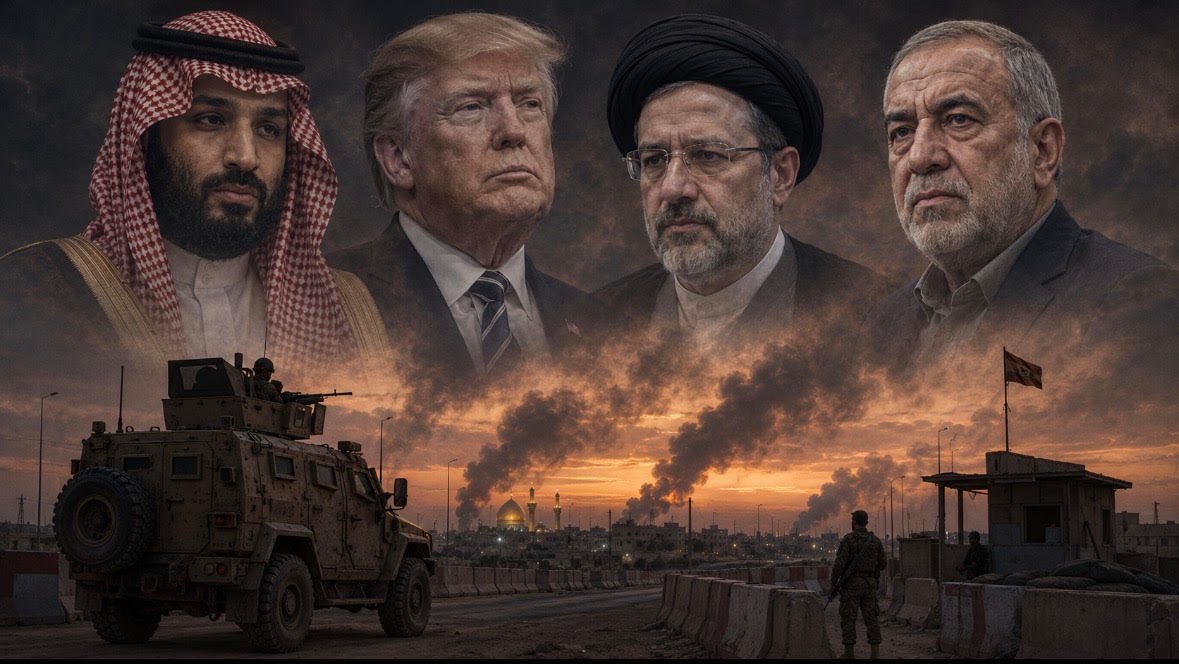
When Saudi fighter aircraft joined the United States in striking Popular Mobilisation Forces positions across Iraq, Riyadh did more than retaliate against alleged drone attacks on its oil infrastructure. It crossed a political threshold. The operation was widely described as Saudi Arabia’s first publicly acknowledged military intervention inside Iraq since the 1991 Gulf War—and the first time Riyadh had openly joined American strikes in the present conflict with Iran.
The PMF said at least 20 of its members were killed and 32 wounded. Funerals followed. Protesters in Baghdad demanded the expulsion of the Saudi ambassador. Kataib Hezbollah warned that a response was inevitable. The airstrikes may have destroyed weapons and logistics sites, but they also handed Iran-aligned factions something equally valuable: a grievance capable of mobilising Iraq’s Shia street.
Saudi Arabia says drones launched from Iraqi territory had targeted petroleum facilities in Riyadh and the Eastern Province. US Central Command said more than 30 drone attacks had been directed by Iran’s Islamic Revolutionary Guard Corps against American forces and Saudi energy infrastructure within 72 hours. Iraqi factions denied responsibility, suggesting Yemen’s Houthis were behind the attacks. Baghdad said it was investigating when the bombs fell.
Riyadh invoked Article 51 of the United Nations Charter and called the operation self-defence. Iraq called it a violation of sovereignty. The PMF saw something more combustible: a Sunni Arab monarchy ruled by the House of Saud attacking armed Shia formations on Iraqi territory.
In the Middle East, geography has a memory.
Karbala has the longest one.
The modern strikes were not an attack on the shrine of Imam Husayn. Saudi Arabia in 2026 is not the Emirate of Diriyah. Crown Prince Mohammed bin Salman’s state is built around investment, technology and economic transformation, not the territorial expansionism of an eighteenth-century Najdi emirate.
Yet historical memory does not operate like a court of law. It does not ask whether two events are identical. It asks whether they feel connected.
In 1801—or April 1802, according to the chronology accepted by many historians—forces of the First Saudi State entered Ottoman Iraq and sacked Karbala. Led by Saud bin Abdulaziz, thousands of fighters attacked the city, killed inhabitants and plundered the shrine of Husayn ibn Ali, the Prophet Muhammad’s grandson and the central martyr of Shia Islam. Academic accounts describe the campaign as explicitly sectarian pillage.
The raid combined strategy, wealth and doctrine. The Saudi-Wahhabi alliance was expanding beyond Najd. Karbala’s shrine contained valuable donations. But ideology supplied the moral licence. The movement associated with Muhammad ibn Abd al-Wahhab condemned shrine veneration and several Shia religious practices as unacceptable innovations, even forms of polytheism.
To the attackers, Karbala represented religious corruption. To Shias, its desecration represented an attack on faith, identity and the family of the Prophet.
More than two centuries later, the PMF does not need to prove that 1802 has returned. It only needs Iraqi Shias to feel that it might have.
That is the hidden danger of the Saudi intervention. A destroyed warehouse can be rebuilt. Missiles can be replaced. Historical trauma, once reactivated, becomes political ammunition.
The Sunni-Shia division began with the dispute over political and religious leadership following the Prophet’s death. But the conflict did not remain a theological argument. The killing of Imam Husayn at Karbala in 680 gave Shia Islam its enduring narrative of martyrdom: a righteous minority confronting overwhelming and illegitimate power.
Empires later weaponised the division. The Ottoman-Safavid contest gave sectarian identity territorial borders. Iran’s 1979 revolution transformed Shia political mobilisation into a challenge to the conservative Arab order. The American invasion of Iraq in 2003 then overturned a Sunni-dominated regime and opened Baghdad to Shia parties, several with deep connections to Tehran.
Saudi Arabia watched Iran gain what geography had long denied it: strategic depth through Iraq, Syria and Lebanon. Tehran presented itself as the defender of Shia communities and the sponsor of an “axis of resistance.” Riyadh positioned itself as a leading Sunni Arab power resisting Iranian expansion.
The rivalry spread. Hezbollah became Iran’s dominant partner in Lebanon. Syria turned into a regional battlefield. Bahrain’s Shia opposition was viewed through the lens of Iranian influence. Yemen’s Houthi movement brought the conflict to Saudi Arabia’s southern border and the Red Sea. Local struggles were absorbed into a larger confrontation in which sectarian identity supplied the slogans and geopolitical competition supplied the weapons.
Iraq became the most valuable arena because it is Arab, oil-rich and Shia-majority. It is also institutionally divided.
The PMF emerged as a powerful force in 2014 after the Iraqi army collapsed before Islamic State, a violently anti-Shia Sunni extremist organisation. Its fighters helped stop the jihadist advance and gained enormous legitimacy. Baghdad later incorporated the PMF into the national security structure, yet several factions retained independent commanders, economic networks and close ties to Iran.
This contradiction now sits at the centre of the crisis. Washington and Riyadh describe their targets as Iranian proxies. Baghdad must explain why foreign aircraft bombed men formally attached to the Iraqi state. PMF leaders can present themselves simultaneously as national soldiers, victims of foreign aggression and guardians of the Shia community.
Prime Minister Ali al-Zaidi faces a trap with no clean exit. His government has pledged to bring weapons under state control by September 30, when remaining American forces are expected to withdraw. Powerful factions such as Kataib Hezbollah have rejected disarmament. Before the airstrikes, al-Zaidi could argue that militias would have no justification for retaining independent arsenals after the US departure. Now their commanders have a devastating reply: who will defend Iraq when American and Saudi aircraft return?
Riyadh faces its own paradox. The operation was intended to restore deterrence. But by joining strikes inside Iraq, Saudi Arabia may have damaged the PMF militarily while rescuing it politically. Tehran could hardly design a more effective recruitment image than Saudi jets over Iraqi soil as Shia pilgrims travelled towards the holy cities.
None of this means the present confrontation is merely another round of an eternal Sunni-Shia war. That argument is attractive because it is simple. It is also wrong.
Saudi Arabia and Iran are competing over strategic depth, energy routes, regime security, American power and the political future of the Arab world. Religion does not explain every missile launch. It does, however, provide the language through which power struggles are legitimised—and through which compromise becomes betrayal.
Baghdad must now decide whether it is a sovereign state with one military or an arena containing several armies. If al-Zaidi moves forcefully against the militias, he risks being branded Washington and Riyadh’s local enforcer. If he retreats, Iraq remains a launch pad for Iran’s regional network and a target for further Saudi or American retaliation.
In 1802, fighters from Najd entered Karbala carrying swords, muskets and a doctrine that treated the shrine as an offence. In 2026, Saudi pilots arrived with precision weapons, intelligence support and a legal claim of self-defence.
The methods have changed. The Saudi state has changed. The strategic contest has changed.
But across the Shia political imagination, one image may survive every qualification: armed power from Arabia has again crossed into Iraq.
And once Karbala enters the argument, a military confrontation stops being only strategic.
It becomes sacred.