

THE CJP FILES
STORY 2 · A MEDIA SCAN INVESTIGATION
8588833548: The Party Line Journalists Passed Along
How an AAP-origin protest helpline lost its political label on the way from a partisan amplifier to credentialed journalists – and later CJP’s Saakshi portal
NARRATIVE INVESTIGATION
Article by Vedansh Pandey
Chief Editor, Media Scan
MEDIA SCAN
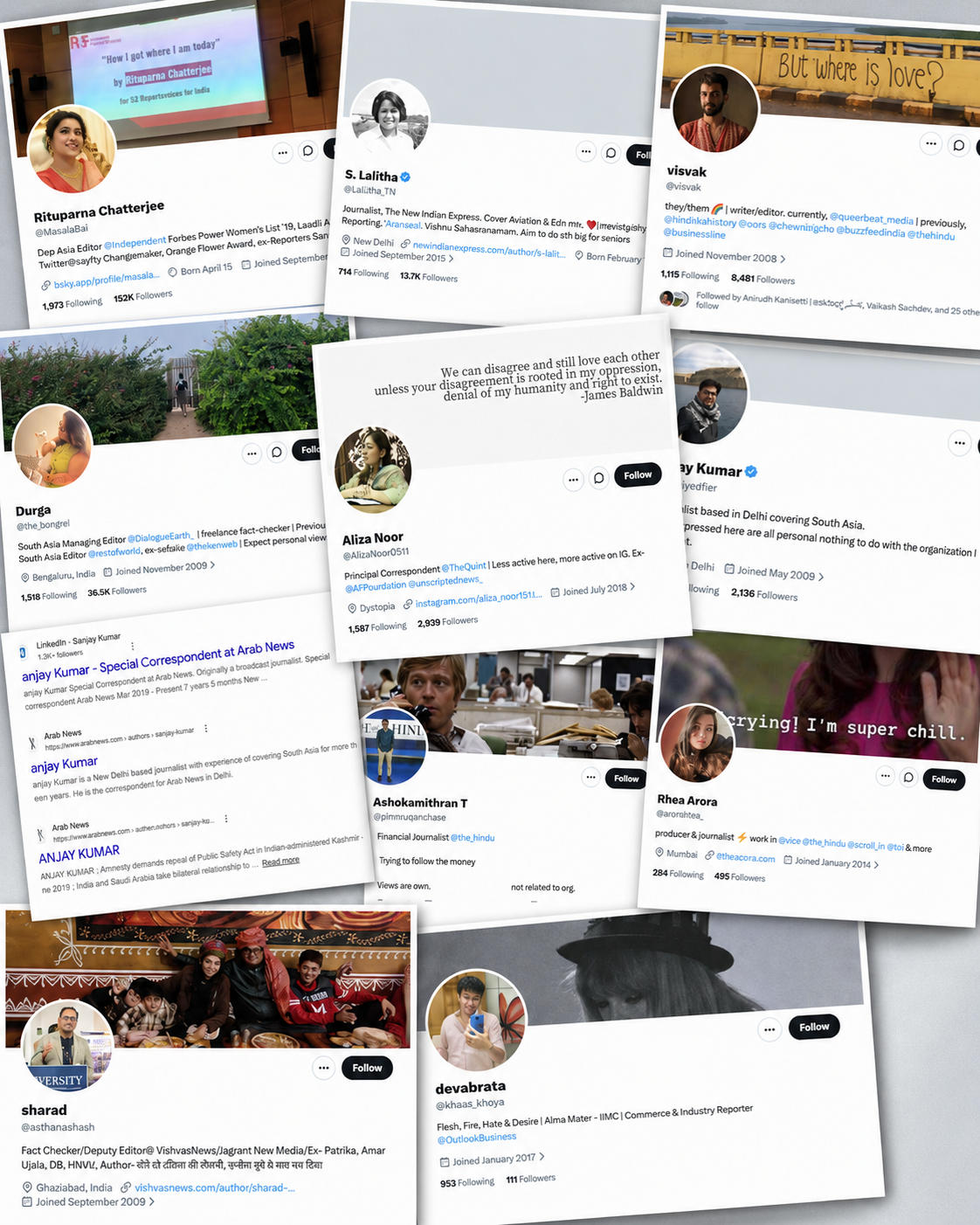
Cover visual: preserved profile screenshots from the reporting archive. 28 July 2026
THE CJP FILES · STORY 2
The number was launched by AAP as legal and medical assistance for protesters affected by the crackdown. It then reached the public through a partisan pro-Kejriwal account without any party label. At least 12 independently verifiable journalists and editors associated with The Independent, The New Indian Express, The Quint, The Hindu, Arab News, Dialogue Earth, Queerbeat, The Goan, Vishvas News, DataLEADS and Outlook Business reposted the message through their personal accounts—without disclosing its political origin or publicly indicating what they had verified.

What Part One established
Part One of The CJP Files began inside CJP’s Saakshi portal, where 8588833548 appeared among public emergency contacts as a neutral-looking protest medical- aid line. Following the number backwards, the investigation found that Arvind Kejriwal and the Aam Aadmi Party had already launched and promoted it as part of AAP’s legal-and-medical response to the Delhi crackdown. Saakshi did not prominently tell its users that history.
That first story established the number’s provenance and its later institutional adoption by CJP. This second story examines the corridor between those two points: the partisan account that removed the party label, the thousands of accounts that carried the message onward, and the professional journalists whose names could make a bare promise appear already checked.
Five words
| “Legal help will be provided.” |
The promise occupied five words.
There was no lawyer’s name beside it. No organisation claimed responsibility. No explanation identified who would answer, where the call would go, what help would follow, or what would happen to the information supplied by the person seeking assistance.
| “Delhi students If police is picking you up, pls call at 8588833548 and inform. Legal help will be provided.”
Arun Arora’s X post, 22 July 2026, 7.08 p.m. · Open the preserved source post |
For a student being pushed into a police vehicle, the message was designed to leave little room for hesitation. Call. Inform. Help will come.
In the compressed language of a crisis, it looked like public-service information: direct, neutral, operational. It carried none of the clutter of a political appeal. There was no party symbol, no politician’s name, no campaign slogan. Nothing in the words told the reader that the number had already been placed into public circulation by Arvind Kejriwal and the Aam Aadmi Party.
The number was not politically anonymous.
Its politics had simply fallen away.
What happened next is a study in how provenance can disappear online without the information itself changing. A number can leave a party announcement, pass through a partisan account, enter the timelines of established journalists and arrive looking less political at every stage. By the time the same number appeared inside the Cockroach Janta Party’s Saakshi portal, its AAP origin was once again absent from the presentation.
The route was not hidden. It was scattered across party announcements, social-media posts, API records, professional biographies and a protest repository. Reassembled, the records trace a progression:
A documented chain of diffusion
| AAP and Kejriwal launch the number | A partisan account removes the party label | Journalists and civic actors carry the post | Saakshi lists the same number without AAP attribution |
A documented chain of diffusion. It does not, by itself, establish coordination or common control.
The records establish the route. They do not establish the motives of everyone who travelled along it. That distinction is the central discipline of this investigation.
The journalists may have been trying to help detained students. Some covered education, civil rights, politics and social justice. In the turbulence of a police crackdown, a message offering legal assistance could reasonably look like something that needed to move quickly.
But an operational helpline is not an ordinary opinion. It asks a vulnerable person to act. The caller may reveal a name, location, police station, injuries, family details and participation in a political protest. When that number reaches the public beneath the professional identity of a reporter or editor, readers may assume that someone has already asked the most basic questions: Who is answering? Who controls the information? Is a lawyer actually waiting at the other end?
The available evidence does not show whether those questions were asked.
That is precisely why they must be.
The number Kejriwal put into public

The political origin was public. Kejriwal announced 8588833548 as an assistance channel for students affected by the arrests. Image reproduced from the Part One reporting archive; press photograph credited there to Outlook India/PTI.
The political origin of 8588833548 was public before Arun Arora posted it.
After the crackdown on the Cockroach Janta Party protest in Delhi, Kejriwal and AAP presented the number as part of a political and operational response. People affected by the police action-students, protesters, detainees and families-were asked to use it to seek legal and medical assistance. AAP said its teams would respond. Kejriwal announced the digits himself in a public video. 1
Party-linked accounts circulated the number. The official AAP Uttarakhand account distributed it. Lawyers, volunteers and political workers described activity involving police stations, detained students, families and medical support. Contemporary reporting described the channel explicitly as an AAP initiative. 2 3
AAP later said that hundreds of students and young people had received legal or other assistance through the line. Those figures are party claims, not an independently audited record of every call, intervention or release. But the wider trail matters for another reason: it indicates that the promise of assistance was not necessarily fictitious. There is public evidence of AAP-linked lawyers and medical personnel taking part in real protest-response activity.
| This is not a story about an obviously fake number being carelessly spread by journalists. It is a story about a politically sourced number being spread without its politics. |
That distinction changes the ethical question. A party-run or party-launched helpline can provide real assistance. It can also receive sensitive information. A caller may still choose to use it, but the choice is meaningfully different when the caller understands who sits behind the channel.
A student contacting the National Legal Services Authority knows they are approaching a statutory legal-aid institution. A person calling the police emergency number knows the state is receiving the information. Someone using a party-linked protest helpline may also receive valuable assistance, but they are entitled to know that their details may be entering a political network.
The question is not whether AAP was permitted to help protesters.
The question is why the party’s identity disappeared from the message that travelled furthest.
The account that removed the label
The post came from Arun Arora.
At the historical snapshot preserved for this investigation, Arora’s X account had approximately 73,600 followers. Its visible political pattern consistently promoted Kejriwal and attacked Narendra Modi. The evidence supports describing it as a high-reach partisan pro-Kejriwal account.
It does not support calling Arora a formal AAP official.
No public evidence presently establishes that he held an appointed party position, controlled the helpline, directed its lawyers or possessed formal authority to promise legal assistance. He may have received the number from someone directly involved. He may have known that lawyers were responding. He may have been repeating wording supplied by an organiser.
The public record does not answer those questions.
His post supplied certainty where his own authority remained unidentified: “Legal help will be provided.”
It did not say that AAP had announced the number. It did not say that Kejriwal had promoted it. It did not identify a lawyer, legal collective, medical team, data controller or supervising organisation.
It also did not say: “AAP says legal help will be provided.”
That small difference is the hinge of the story.
The first formulation presents the promise as fact. The second attributes it to a political source. Attribution would not have made the number less useful. It would have made the transaction more transparent.
Instead, the post converted a party-origin resource into something that resembled politically ownerless civic infrastructure. Once reposted, it could appear in a follower’s timeline beneath the name and biography of an entirely different person.
This is how context thins online. The number remains intact. The words remain intact. The political provenance drops out.
| “Legal help will be provided.”
Five words, one number, no named lawyer, no operator, no privacy explanation and no political attribution. |
Twenty-eight pages of direct reposts
To follow the message beyond Arora’s account, this investigation examined records returned by X’s retweeted_by endpoint for the exact post ID 2079924084100702626.
| 2,546
unique direct retweeters preserved |
28
API pages saved |
1
continuation token still present |
The collection is incomplete. API credits were exhausted while a next_token remained, indicating that additional pages were available but not retrieved. Accounts later deleted, suspended, made private or otherwise unavailable may also be absent. The figure of 2,546 is therefore not necessarily the total number of direct retweeters. It is the preserved floor.
What the data proves: X returned the listed accounts as direct retweeters of one exact post. What it does not prove: motive, knowledge, individual repost time, instructions, coordination, endorsement, independent verification or actual audience reach.
X did not return the thoughts of the retweeters. It did not say who first sent them the message, whether they saw it in a WhatsApp group, whether a friend asked them to amplify it or whether they independently encountered it in their timelines. It did not show whether anyone called the number before sharing it.
It did not establish endorsement.
A person can repost to endorse, criticise, archive, alert or help. Because these were direct reposts without added text, the dataset itself cannot distinguish among those possibilities.
Nor can follower counts be treated as actual reach. Not every follower sees every repost. Audiences overlap. Platform algorithms distribute content unevenly. Impression data was unavailable.
The dataset can map the carriers. It cannot read their intentions.
The false start: twenty-six “media” accounts
An automated biography screen of the 2,546 accounts initially produced 26 possible media-professional signals.
That figure looked significant. It was also unreliable.

Inside it were several categories that could not ethically be merged: an AAP media coordinator, a CJP spokesperson with a journalism background, a political cartoonist, a film editor, citizen-journalist accounts, an aspiring journalist and profiles that used the word “journalist” without an independently verifiable institutional record.
A political communications worker is not analytically equivalent to an independent reporter. A movement spokesperson circulating information connected to their own movement is not performing the same role as an editor at an unrelated publication. A biography containing the word “journalist” is not sufficient proof of current professional status.
The initial 26 were therefore subjected to manual review. Party figures were separated into a party-communications layer. CJP representatives were placed in a movement-amplification layer. Media-adjacent occupations, unresolved identities and unsupported employer claims were removed.
What remained was smaller and more defensible:
| At least 12 independently verifiable journalists and editors in the preserved partial dataset directly reposted Arun Arora’s exact message through their personal accounts. |
They represented approximately 0.47 per cent of the saved 2,546-account population.
Their combined declared follower count at collection was approximately 186,430. That is not an estimate of the number of people who saw the message. A substantial portion belonged to one account, audiences overlapped, and the platform supplied no impression data.
All 12 accounts existed before CJP emerged. Their median age was approximately 12 years. None displayed an explicit AAP or CJP affiliation in the captured biography screen.
The finding is not that the media organisations reposted the number.
The finding is that journalists associated with those organisations did so through their personal accounts.
That boundary is essential.
THE VERIFIED PROFESSIONAL-MEDIA COHORT
The people whose names travelled with the post
Each name below is linked to a professional role independently verified in the audit. The verified proposition is the same for every person: the individual’s personal account appears in the preserved exact-retweeter population for Arora’s post. Employer participation is not established.
| Rituparna Chatterjee @MasalaBai
Deputy Asia Editor The Independent Verified proposition: personal account appears in the preserved exact-retweeter population. |
S. Lalitha @Lolita_TNIE
Senior Assistant Editor The New Indian Express Verified proposition: personal account appears in the preserved exact-retweeter population. |
| Visvak @visvak
Contributing Senior Editor Queerbeat Verified proposition: personal account appears in the preserved exact-retweeter population. |
Durga M Sengupta @the_bongrel
South Asia Managing Editor Dialogue Earth Yes — ‘Expect personal views’ Verified proposition: personal account appears in the preserved exact-retweeter population. |
| Aliza Noor @AlizaNoor1501
Principal Correspondent The Quint Verified proposition: personal account appears in the preserved exact-retweeter population. |
Sanjay Kumar @destinydefier
Delhi Correspondent / South Asia journalist Arab News Yes — views described as personal and unrelated to employer Verified proposition: personal account appears in the preserved exact-retweeter population. |
| Ashley do Rosario @ashrosarioingo1
Journalist / columnist The Goan Yes — ‘Tweeting purely in personal capacity’ Verified proposition: personal account appears in the preserved exact-retweeter population. |
Ashokamithran T @jpmuruganchase
Business and economy reporter The Hindu Yes — views own, not related to organisation Verified proposition: personal account appears in the preserved exact-retweeter population. |
| Rhea Arora @arorarhea_
Features reporter and documentary producer Freelance; bylines in VICE, The Hindu, Scroll, TOI and others Verified proposition: personal account appears in the preserved exact-retweeter population. |
Sharad Prakash Asthana @asthanashash
Fact-checker / Deputy Editor Vishvas News / Jagran New Media Verified proposition: personal account appears in the preserved exact-retweeter population. |
| Arijit Gupta @Arijit17Gupta
Junior Research Analyst and Reporter DataLEADS; freelance bylines in Frontline, Outlook, The Leaflet and others Yes — RTs and opinions described as personal Verified proposition: personal account appears in the preserved exact-retweeter population. |
Devabrata Dutta @khaar_khowa
Correspondent Outlook Business Verified proposition: personal account appears in the preserved exact-retweeter population. |


When credibility moves with the messenger
Imagine the post arriving in a timeline from two different directions.
In one version, it appears beneath the name of an account whose political loyalties are apparent. A reader may recognise the source as partisan and interpret the promise accordingly.
In the other, the same words appear beneath the name of a journalist whose biography identifies them as an editor, correspondent, fact-checker or rights reporter.
Nothing in the sentence changes.
But the reader’s relationship to it may.
Professional identity can function as a silent credential. A reporter does not need to write “I have verified this” for some followers to assume that a minimum level of checking has taken place. The assumption may be unreasonable. It may also be entirely predictable.
This is the ethical significance of the journalists’ presence in the chain.
Their reposts could have increased confidence in Arora’s message. They may have reassured readers who would have treated the same instruction differently had it remained confined to an openly partisan network. They could have helped the number move from political circulation into professional-media networks without restoring the attribution removed from the original post.
That is an inference, not a measured fact.
There is no evidence showing how many followers saw the reposts or how many relied on them. No caller has been identified as having dialled the number because a particular journalist shared it. The data does not establish that the journalists intended to lend credibility to AAP.
But credibility does not require coordination to travel.
Sometimes it is carried passively, attached to a name.
The case for urgency
There is a strong and humane explanation for the reposts.
Students were reportedly being detained. Families may not have known where they had been taken. Injured protesters may have required medical assistance. In such circumstances, an operational message offering legal support is not received as an abstract political claim. It is received as a possible lifeline.
A journalist encountering it may have faced an immediate practical choice: share now, or delay while trying to establish every detail.
Several of the journalists covered fields that made the message especially salient. S. Lalitha covered education. Aliza Noor covered human rights, social justice and politics. Rituparna Chatterjee’s institutional biography recorded work involving civil rights. Visvak and Durga M Sengupta worked in rights-oriented or public-interest editorial environments. Arijit Gupta’s stated interests included education, politics and human rights.
Even those outside those beats may have reposted from ordinary concern for student safety.
The wording encouraged speed. It did not ask the reader to assess a complex argument. It offered a number and promised assistance.
The wider evidence that AAP-linked lawyers and volunteers were actually engaged in protest-response work strengthens the good-faith explanation. Journalists may have known, through reporting or direct contacts, that lawyers were active even if they did not publicly identify the party behind the number.
A repost made in that context is not inherently evidence of political advocacy.
Nor is it enough to dismiss the act as “just a retweet.” A direct repost can be both a small action and a consequential one. The proper assessment depends on what the person knew, what they checked, how urgent the situation was and what a reasonable reader might infer from their professional identity.
Three live possibilities:
- The journalist independently verified the number and shared it to help detained students.
- The journalist shared it urgently without checking the operator or political provenance.
- The journalist knew it was an AAP resource but did not consider party attribution necessary.
The dataset cannot determine which explanation applies to any individual. Their answers are the missing evidence.
The professional questions
| Verification
An operational helpline can be tested. A journalist can call or message, identify the operator, ask which lawyers are monitoring it and establish whether the promise is authorised. A bare repost is not proof that no private check occurred. |
Transparency
“AAP says legal help will be provided” preserves the emergency information while restoring the missing source. Political provenance does not invalidate aid; it allows a caller to make an informed choice. |
| Independence
A personal account is not a newsroom account. But a “views personal” disclaimer limits employer attribution; it does not necessarily erase an identifiable journalist’s responsibilities concerning accuracy and context. |
Minimising harm
A detained student may disclose a name, live location, police station, injuries, family contacts and protest participation. There is no evidence of misuse, but the sensitivity of the exchange raises the standard of care. |
| Correction
The records do not show whether any journalist later added attribution, removed the repost or learned that the number had entered Saakshi. A correction would not prove dishonesty; it would show that new context was treated as material. |
Accountability
The evidence does not establish what the journalists knew, what they checked, how the post reached them or whether anyone asked them to carry it. |

The number arrives at Saakshi

The second disappearance. Saakshi placed 8588833548 among institutional emergency contacts and described it as a Delhi protest medical-aid line. The captured page did not prominently identify AAP. Source: preserved page capture, 28 July 2026.
The number’s journey did not end in the timelines of reporters, political workers and ordinary users.
It later appeared on Saakshi, the Cockroach Janta Party’s protest-evidence repository.
On the captured Resources & Aid page, Saakshi placed 8588833548 among a sequence of institutional emergency contacts: the National Human Rights Commission, the National Legal Services Authority, police emergency services, ambulance numbers and national emergency medical services.
The AAP-origin number appeared as:
| “Delhi Protest Medical Aid Helpline” “Free medical assistance for protesters in Delhi.” Open the public resources page · Open the preserved source post |
The page did not prominently identify AAP beside it. Saakshi described itself elsewhere as an initiative of the Cockroach Janta Party.
The absence of political provenance therefore recurred at two distinct stages.
Arora’s post did not tell students that AAP had launched the number.
Saakshi’s institutional presentation did not prominently tell users either.
The connection is significant but bounded. It establishes that CJP later adopted or listed a support channel publicly launched through AAP. It does not establish that AAP created CJP, financed its original rise, controlled its social-media accounts or owned Saakshi.
Those larger claims require different evidence.

The July sequence. Kejriwal’s announcement and Arora’s unattributed post preceded the registration and public rollout of Saakshi. Graphic reproduced from Part One.
The strongest supported sequence remains:
| AAP operational launch and party-network circulation. Arun Arora’s unattributed public-service framing. Journalist and civic diffusion. CJP and Saakshi adoption. |
The unanswered ring
On 28 July 2026, during reporting for Part One, 8588833548 was called.
It rang. No one answered that attempt.
That fact carries far less meaning than it may initially seem to.
A single unanswered call does not establish that the line was inactive during the protests. It does not disprove AAP’s claims that people received assistance. It does not show that the operator was avoiding scrutiny or that no lawyer ever answered another caller.
It establishes only that one call, made at one particular moment, was not answered.
The questions that remain
Arun Arora should be able to answer who supplied the number and who authorised the wording.
Did he speak to a lawyer? Was he part of an organised distribution group? Did he know who controlled the information supplied by callers? Why was AAP’s name absent from a number Kejriwal and the party had publicly promoted?
AAP should be able to identify the operational controller of the channel. Which lawyers and medical personnel answered? What information was collected? Where was it stored? Were journalists or media figures asked to amplify the number? Did the party know it had been presented on Saakshi without AAP attribution?
CJP and Saakshi should be able to explain how the number reached the portal. Was permission obtained to list it? Did CJP know that it had been launched through AAP? Were any party-linked lawyers included in the “verified legal aid” network described by the platform?
And each journalist should be asked a simpler set of questions.
| Did you know?
Did you check? Did anyone ask you to repost it? Did you consider what a detained student might reveal? Did you later learn who was behind the number? Would you add the political attribution now? |
It would be reckless to call the journalists knowing partisan amplifiers. The evidence does not establish dishonesty, coordination, payment, newsroom involvement or allegiance to AAP.
It establishes a chain of transmission and a missing label.
The phrase that travelled through that chain was uncomplicated:
| “Legal help will be provided.” |
It may have been true. It may have led students towards lawyers at a moment when they needed them. It may have been shared by journalists acting out of urgency and concern.
But an accurate promise can still be incomplete.
A useful number can still carry politics.
And a repost can still borrow credibility from the profession named in the biography above it.
| When a reporter or editor places a professional identity above a repost, what level of verification is the reader entitled to assume has already occurred? |
READER LINKS AND EVIDENTIARY TRAIL
Source trail
For direct retweeters, X does not generate a separate permanent public status URL for the repost. Inclusion is established by the preserved API return; the links below lead to the common source post, public announcements, captured pages and professional-role verification points.
1. Kejriwal announces 8588833548: https://www.youtube.com/shorts/prL9JrooTcU
2. AAP Uttarakhand circulation: https://x.com/AAPUttarakhand/status/2079515649723056139
3. Contemporary report on AAP’s legal-and-medical assistance: https://www.newindianexpress.com/states/delhi/2026/Jul/22/cjp-protest-opposition-launches-helpline-for-injured-stuck-students
4. Arun Arora’s exact post: https://x.com/Arun2981/status/2079924084100702626
5. Saakshi Resources & Aid: https://cjp-saakshi.com/resources
6. CJP denial of AAP association: https://www.facebook.com/watch/?v=1012429517999290
7. Raw exact-retweeter archive: exact_retweeters_2079924084100702626.csv; exact_retweeters_2079924084100702626.json; exact_retweeters_2079924084100702626_pages.jsonl; exact_retweeters_2079924084100702626_summary.json. Collection status: partial; continuation token remained.
8. Journalist-specific audit: CJP_Journalist_Retweeter_Rigorous_Audit(1).md; CJP_Journalist_Retweeter_Rigorous_Audit(1).xlsx; CJP_verified_journalist_retweeters(1).csv.
9. Part One: “Who’s Really Answering CJP’s Helpline?” The CJP Files, Media Scan, 28 July 2026.
