
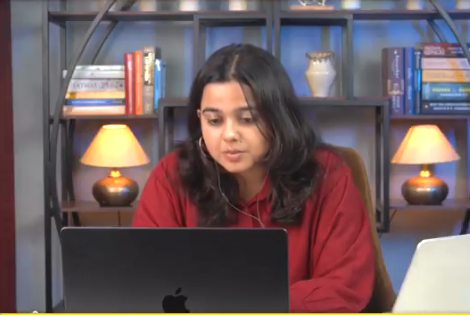
Delhi : Ritika Chandola, by turning into an Undercover Cockroach, rips open the veil of Engagement-Farming Hungry ‘Boti Media’. How are protests like CJP exploited for political gains? Ritika explains.
No clear motive, no leader… How are CJP-style protests turned into violent mobs? These cockroaches couldn’t even plan a four-hour event properly, yet they were shouting slogans to change the country. Somewhere using abusive language against Lord Ram, somewhere spewing hatred against Brahmins — this was the real face of Jantar Mantar.
Delhi. When the so-called “Cockroach Janta Party” (CJP) protest was underway at Jantar Mantar in Delhi, an unknown girl named ‘Diksha’ was roaming around wearing a CJP mask. No one knew that behind this mask was OpIndia’s young journalist, Ritika Chandola. For four hours, she stayed among these ‘cockroaches’, listened to their conversations, observed their agenda up close, and the exposure she delivered became a stinging slap for the Boti Media.
Ritika Chandola, who works as an anchor, researcher, and writer at OpIndia, is known for her sharp political satire and courageous ground reporting. At Jantar Mantar, she not only exposed the reality of a single protest but completely unmasked the entire ‘Boti Media’ ecosystem.
Boti Media – that is, those YouTubers and journalists who feed on agendas (boti) and shape their reporting accordingly. Their face was already suspicious, but Ritika laid it completely bare with ground truth.
Met Arfa Khanum, Agenda Delivered
At Jantar Mantar, journalist Arfa Khanum Sherwani met Ritika (as Diksha). Instead of asking questions, she remained busy pushing her agenda. No clear motive, no visible leadership, yet attempts were made to give the crowd a violent-political colour. Ritika showed how heavy the outrage is on social media and how hollow the ground reality is. Her reporting clearly explained how protests like CJP are used for political benefit.

No Planning, No Students – Still Slogans to Change the Country
These ‘cockroaches’ couldn’t even plan a four-hour event properly, yet they kept raising slogans to change the nation. Abusive language against Lord Ram at one place, hatred towards Brahmins at another, and encircling journalists somewhere else. Where were the real students? Instead of discussing real issues like paper leaks, there was heavy politics. Ritika asked: Was this a student movement or a hub for engagement farming?
The ‘Boti Media’ ran Diksha’s statements without verification but didn’t even feel the need to ask who was behind the mask. The hunger for TRP and agenda crushed the truth.
Ritika Chandola’s reporting is commendable because she took a risk. Alone, wearing a mask, she entered the midst of opponents and brought out the truth. Her reporting with OpIndia proved that real journalism is not about flattering agendas but confronting ground realities.
Postmortem of an Ecosystem
Delhiites know this gang – Arfa Khanum, Ajit Anjum, Ravish Kumar, Sakshi Joshi, Ashutosh Gupta, Abhisar Sharma and others – very well. From Jawaharlal Nehru to Rahul Gandhi, they shed the cloak of neutrality and shamelessly stand in their defence.
Their shamelessness no longer hides. Ritika exposed the entire ecosystem at Jantar Mantar – how these people create hype, sell outrage, and try to convert ground failure into ‘moral victory’.
Ritika’s reporting proved the massive gap between social media outrage and reality. The lack of real students in the CJP protest, the overload of political agenda, and the complicity of ‘Boti Media’ – everything came to the fore.
India today needs young journalists like Ritika Chandola, who can blend into the crowd and still extract the truth. She showed how hollow and hungry for engagement farming the Boti Media truly is. Her undercover reporting at Jantar Mantar exposes not just one event, but an entire distorted ecosystem.
