
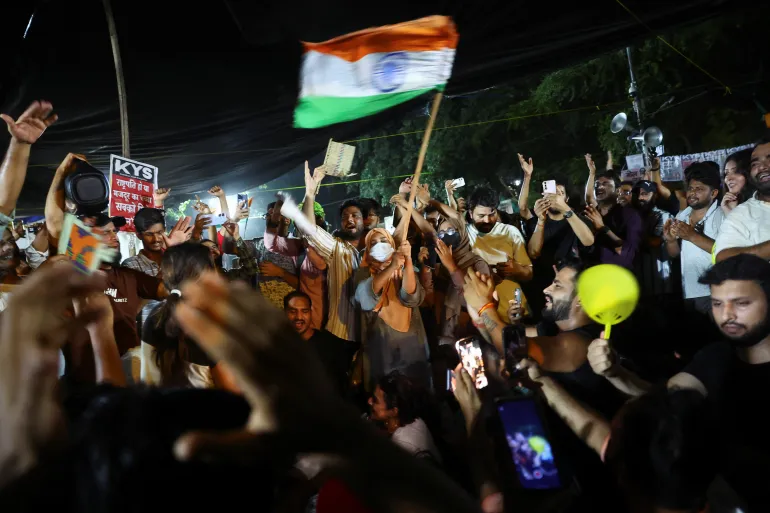
Delhi : I broadly support nationalist forces. But nationalism cannot mean defending every failure of the State or dismissing every popular protest merely by alleging foreign funding, political manipulation or an international conspiracy.
Political forces—domestic and foreign—may undoubtedly attempt to exploit a movement of this scale. We must remain vigilant about that. But the possibility of exploitation does not make the underlying grievances of India’s students imaginary.
The examination system in this country is a genuine menace. Paper leaks, arbitrary evaluations, unequal opportunities, institutional favouritism and an almost complete absence of accountability can destroy years of a student’s life. The present protests began over examination irregularities and have now grown into a much wider expression of anger against institutional corruption, unemployment and the treatment of young people by the State. They have already forced the government to respond publicly and announce fast-track courts for examination-leak cases.
I understand the helplessness of these students because I have lived through it myself.
While studying at the Faculty of Law, University of Delhi, I witnessed what I considered the open compromise of the examination process. Teachers would disclose examination questions in classrooms with an astonishing sense of impunity. This was happening inside an institution that proudly invoked its legacy of producing judges, senior lawyers and constitutional functionaries.
The greater the institution’s claims to prestige, the more disturbing its lack of internal accountability appeared to me.
I did not merely complain informally. I approached the Delhi High Court through W.P.(C) 13094/2019. I sought a judicial inquiry into nepotism, falling standards of legal education and disregard of the law within the Faculty of Law. I sought an independent system for paper-setting and evaluation, model answer keys, revaluation rights, access to answer scripts, compliance with the Right to Information Act and disclosure of data concerning complaints against the University’s examination system. These were not retrospective inventions; they formed part of the reliefs recorded in the judicial proceedings.
While the petition remained pending, the University did not meaningfully reform its practices. What I had challenged continued, in my experience, with complete impunity.
My immediate academic grievance involved parity and the opportunity to complete clinical subjects through a supplementary or re-examination process. During the proceedings, I informed the Court that other similarly placed students had been given such opportunities. The University was then required to clarify the position.
The University ultimately admitted on affidavit that students had, in fact, been re-examined in a clinical subject even though, according to the University itself, no rule permitted it. It recorded that one Law Centre had conducted these re-examinations without informing the Dean. Yet the University declared that it was not inclined to revisit those students’ results. In other words, an irregular benefit was acknowledged, its beneficiaries retained it, no comparable relief was extended to me, and no meaningful inquiry followed.
That admission remains part of the judicial record.
My case was not simply about passing an examination. It was about whether a public university could apply one standard to favoured students and another to those who questioned the system.
Instead of receiving protection as a student raising issues of public accountability, I was repeatedly made to feel that I had become the problem. In open court, I was warned that costs could be imposed upon me for pursuing these issues and for filing RTI applications seeking information from the system. I experienced those warnings not as encouragement to refine my case, but as an attempt to intimidate an unrepresented student into silence.
A writ petition is supposed to offer an expeditious and comparatively inexpensive constitutional remedy. My plea involved my immediate academic future. Yet the relevant relief was prolonged for years. By the time the system moved, the damage had already been done.
A remedy concerning a student’s examination cannot remain meaningful when it arrives after the student’s academic life has been derailed. Justice delivered after the opportunity itself has disappeared is often no justice at all.
There was no major student organisation standing with me. There was no media campaign. There was no national outrage. There was no crowd outside the University or the Court. I fought largely alone and eventually decided to abandon my law degree at Delhi University.
What disturbed me most was the convenience with which the system could exhaust an ordinary litigant.
Institutions know when the person standing before them lacks money, influence, political backing and the resources required to pursue repeated appeals. The powerful can keep litigating. An ordinary person can be silenced simply by prolonging the proceedings until the very purpose of the case disappears.
The easier course, in my view, is often not to confront the powerful institution but to discipline the inconvenient individual who has questioned it.
This is why my heart goes out to the students protesting at Jantar Mantar.
Students are among the most vulnerable sections of society. Upright and ethical students who question authority often have an especially difficult time in public institutions where patronage, entitlement and institutional self-protection have become deeply entrenched.
The system does not always silence them through a reasoned rejection. It can silence them through delayed examinations, arbitrary marking, missing records, unanswered representations, procedural objections, endless adjournments and the quiet certainty that nobody outside the institution will care.
The recent response from the Supreme Court to a request for urgent intervention over alleged police action against the protesters was deeply troubling. When video evidence was mentioned, Chief Justice of India Surya Kant reportedly said that the Court was not interested in watching the videos, did not have time to watch them and that its time should not be wasted. Whatever the procedural deficiencies of the request, such language inevitably reinforces the public perception that the individual seeking enforcement of constitutional rights is an inconvenience to the institution created to protect those rights.
This attitude is not unfamiliar to people who have personally appeared before constitutional courts without the protective layer of senior lawyers and institutional connections.
The episode involving Prabal Pratap also deserves reflection. After his disruptive and abusive conduct inside the Supreme Court, the Court initially declined to pursue action against him and expressed sympathy. Within days, however, Delhi Police arrested him and another student in connection with the courtroom incident.
His conduct may have been wholly indefensible. But the sequence raises a broader question about the relationship between judicial statements, police power and the fate of an individual after public attention has moved elsewhere. I also do not see the movement placing judicial accountability—or the resignation of the Chief Justice—at the centre of its demands, despite the Chief Justice’s remarks having become an important part of the movement’s public narrative.
A movement against institutional arbitrariness must ultimately be willing to question every powerful institution, not merely the government of the day.
The debate over judicial accountability is not new. One of the Modi government’s first major constitutional initiatives after assuming office in 2014 was the National Judicial Appointments Commission. It sought to replace the judge-controlled collegium with a six-member appointments commission. It was ratified by numerous states and received broad political support, but the Supreme Court struck it down by a 4:1 majority in October 2015 on the ground that it endangered judicial independence.
There were legitimate concerns about executive interference in judicial appointments. But striking down the NJAC did not answer the equally legitimate concerns about opacity, favouritism and the absence of external accountability within the collegium. The proposed alternative disappeared, while the institution effectively continued to supervise its own appointments and internal accountability.
Judicial independence is indispensable. But independence without transparency can gradually become insulation, and insulation without accountability can become impunity.
My experiences have not been limited to Delhi University. Whether one approaches a university, a regulator, a tribunal or a court, the ordinary person frequently encounters an institutional preference for the status quo. In bodies such as SEBI, RBI, NCLT and NCLAT, a person fighting on merit and without institutional backing can face an exhausting combination of procedural resistance, opacity and indifference.
I have personally experienced how difficult it can become even to file and have a matter properly placed before NCLAT, a tribunal exercising enormously consequential appellate jurisdiction in competition and company-law matters. Access to justice can be obstructed before the merits of a case are ever heard—through registry objections, discretionary procedures and requirements that are inconsistently communicated or applied.
The Right to Information Act, too, is being hollowed out by delay, non-response and procedural evasion. On paper, the citizen possesses a right to information. In practice, the individual may spend years trying to obtain an answer and then more years appealing against the refusal.
Technology makes this imbalance even more dangerous.
The State and large institutions possess unprecedented access to data, surveillance capabilities, legal resources, digital infrastructure and the capacity to shape public narratives. The individual citizen becomes increasingly transparent to the State, while the State’s own decision-making remains opaque to the citizen.
Those with access to technology, money and institutional networks can preserve records, influence narratives and pursue remedies indefinitely. Those without such resources can be profiled, ignored, exhausted or discredited with far greater ease.
This is precisely why individual rights matter. They are most important not when the individual is popular, powerful or politically useful, but when the individual stands alone against an institution.
Even allegations of foreign support must be approached with intellectual honesty. Foreign assistance does not automatically prove that a domestic grievance is false. History itself is more complicated: Netaji Subhas Chandra Bose sought international support, including from Germany, for India’s struggle against British rule. That historical fact does not make every form of foreign involvement legitimate, but it demonstrates why the source of assistance cannot be the sole test of the justice of a cause.
Transparency about funding is necessary. Political capture must be resisted. Violence must be rejected. But none of these concerns should be used as an excuse to ignore the examination leaks, arbitrary institutions and shattered futures that produced the anger in the first place.
At the same time, the problem is much deeper than one minister, one government, one Chief Justice or one political regime.
Justice Atul Sreedharan recently observed that corruption has become normalised to such an extent that the average Indian may no longer regard it as wrong unless the person involved is caught. That observation identifies an uncomfortable social reality.
Corruption survives not only because corrupt people occupy high offices. It survives because society learns to accommodate it.
People seek favours when it benefits them, remain silent when someone else is victimised, celebrate connections over merit and treat the person demanding rules as impractical, troublesome or foolish. The beneficiary of an irregular examination opportunity rarely asks whether another student was denied the same chance. The person whose file moves through influence rarely objects to the system that kept another citizen waiting.
An average Indian too often becomes a spectator until the injustice reaches his own doorstep.
Leaders and institutions are, ultimately, reflections of the society from which they emerge. Replacing one political party with another will not by itself cure a civilisation that has internalised patronage, selective morality and indifference towards the rights of strangers.
Protests may come and go. Governments may issue statements. Ministers may resign. New committees and fast-track courts may be announced. But no lasting reform will occur unless the character of society itself rises.
We must learn to stand beside people who are right even when they are unpopular, politically inconvenient or unable to offer us anything in return.
Therefore, while remaining alert to political manipulation, I welcome this awakening.
This movement has given countless young people a collective voice that individuals like me did not have when we fought alone. It has forced examination corruption and institutional accountability into the national conversation. It has reminded a powerful government that a democratic mandate does not extinguish the right to dissent.
I hope the movement remains peaceful, transparent and independent. I hope its idealism does not fade once political organisations begin competing to capture it. I hope it expands its demand for accountability beyond one ministry and applies the same constitutional standards to universities, regulators, police authorities, tribunals and the judiciary.
Most importantly, I hope the government understands that individual rights are not inconveniences standing in the way of national progress.
They are the very foundation of the Indian Constitution.
A nation does not become strong by silencing its weakest citizens. It becomes strong when even the most ordinary student can question the most powerful institution—and still receive a fair hearing.
