
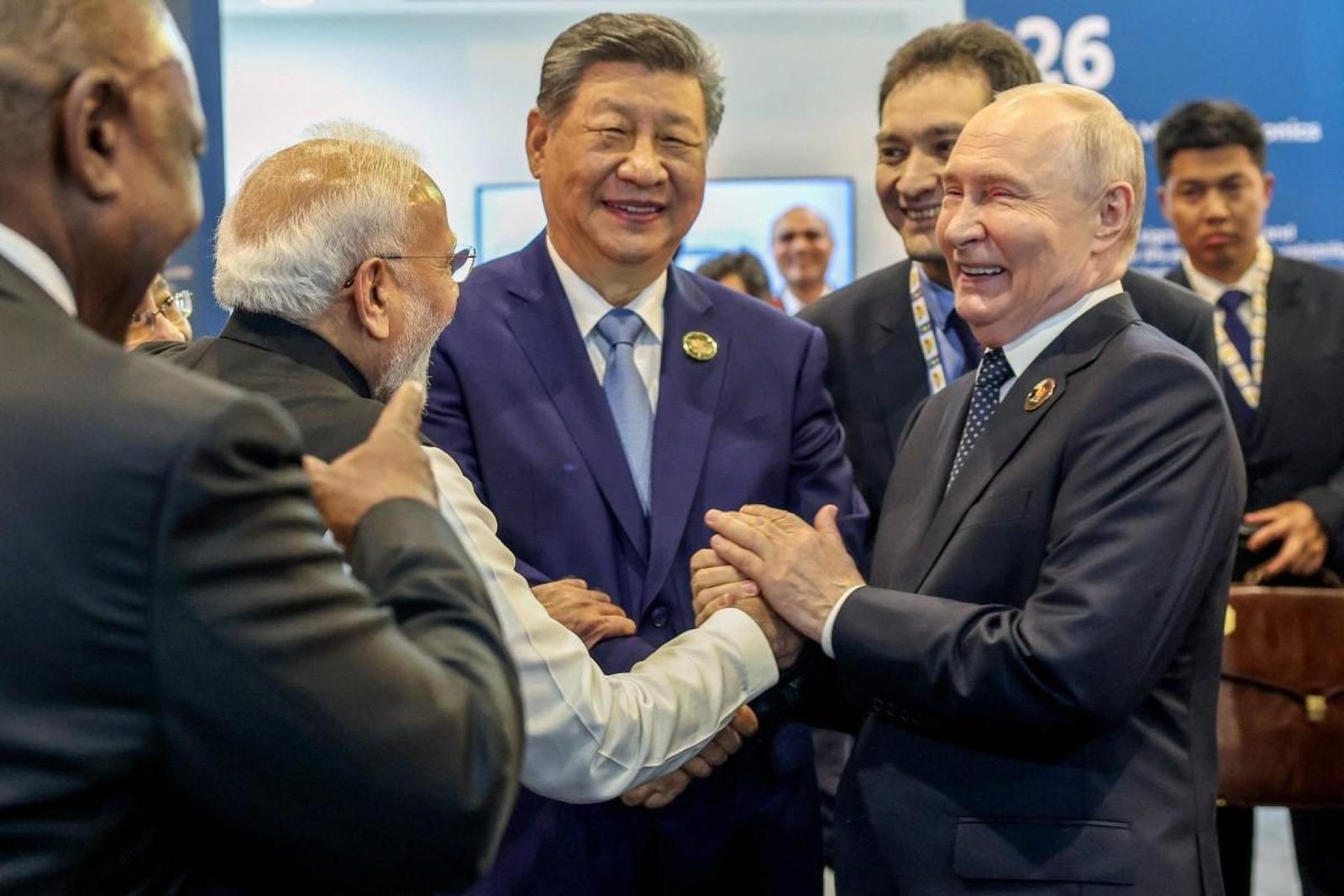
Delhi : When Prime Minister Narendra Modi, President Xi Jinping and President Vladimir Putin meet in New Delhi, the most consequential image may again be the leaders of India, China and Russia standing together. A year after their huddle at the Shanghai Cooperation Organisation summit in Tianjin, the three gather in a BRICS that is larger, more politically divided and more openly exposed to pressure from the United States. Xi is making his first visit to India in seven years. Putin is attending his first summit outside Russia since the invasion of Ukraine. Modi is trying to hold relationships with both while retaining close ties with the West. The photograph will carry weight in Western capitals. Whether the handshake changes anything beyond optics depends on what the grouping can actually deliver.
The three countries together represent a large share of the world’s population, manufacturing capacity, energy trade and diplomatic reach. Their coordination, even if incomplete, signals that power is no longer concentrated in a single Western-led centre. That is the factual core of the claim that China, Russia and India are emerging as a new pole. It is also incomplete. Emergence is not the same as a unified bloc. The relationship is transactional, asymmetric and laced with unresolved disputes. The handshake is real. So are the reasons for caution.
A larger BRICS, and a harder one to manage
BRICS has travelled far from the four-country acronym coined by Goldman Sachs economist Jim O’Neill in 2001. Brazil, Russia, India and China became a political grouping in 2009. South Africa joined in 2011. Egypt, Ethiopia, Iran and the UAE entered in 2024. Indonesia joined in 2025. Saudi Arabia is listed in BRICS documents among the expanded members but has repeatedly stopped short of formally confirming accession, even as it participates in meetings.
The numbers look formidable. The expanded grouping accounts for roughly 49 percent of the world’s population, 39 percent of global GDP and 23 percent of international trade. Membership now stretches from Asian manufacturing powers to Gulf energy exporters, African economies and Iran. Breadth, however, is also the grouping’s weakness. BRICS has no treaty, no permanent secretariat and no common budget. Decisions require consensus. At the May 2026 foreign ministers’ meeting in New Delhi, members failed to issue a joint statement. Differences between Iran and the UAE over a live regional confrontation were among the obstacles. Two countries inside a forum that claims to speak for the Global South stood on opposite sides of a conflict. Expansion has increased reach faster than it has increased the capacity to act.
That matters for any claim of a new world power. Size without cohesion produces photographs more readily than policy. The three largest members can give the forum political weight. They cannot automatically convert that weight into a single strategy.
Three powers, three motives
Russia has the strongest incentive to push BRICS toward a more functional alternative to Western economic structures. Sanctions have made Moscow more dependent on non-Western markets, payment arrangements and diplomatic partners. India has become a major buyer of Russian oil while maintaining defence and energy links with Moscow. After meeting in New Delhi on 11 September, Modi and Putin agreed to pursue stronger economic, defence and energy cooperation and reiterated a target of raising bilateral trade from nearly $70 billion to $100 billion by 2030. Putin has argued that BRICS should become more practical, with cooperation in technology, infrastructure, investment and payments. That is a different proposition from an annual summit and a communiqué.
China has a larger strategic objective. Beijing wants greater influence in institutions where Western powers still set many of the rules, while reducing vulnerability created by dependence on dollar-based finance and Western-controlled technology and markets. Xi’s message at the 2025 SCO summit in Tianjin was explicit: a more representative global system and opposition to what he called hegemonism and power politics. The BRICS project fits that language.
India’s calculation is different again. New Delhi does not want BRICS to become a China-Russia-led anti-American bloc. It wants the forum as another instrument of strategic autonomy, alongside the Quad, the G20, relations with Europe and its partnership with the United States. India’s emphasis on national currencies and interoperable payment systems illustrates the distinction. It is looking for more options, not announcing the end of the dollar.
These motives can overlap without merging. Russia needs partners after isolation. China wants a non-Western centre of gravity. India wants room to manoeuvre. That overlap can produce coordination on payments, development finance and diplomatic messaging. It does not erase competing interests.
The China-India relationship is the real test. The 2020 Galwan clash froze much of the political relationship. Troops remained deployed along the disputed frontier. India restricted Chinese investment and apps. An October 2024 disengagement agreement led to withdrawals from key friction points and a gradual reopening of diplomatic and commercial channels. Xi’s visit now gives both sides a chance to consolidate that thaw. India has resumed direct flights, eased some visa restrictions and relaxed parts of earlier investment controls. Chinese firms have begun testing the waters again, though major companies remain wary of security scrutiny.
The economics make the relationship impossible to ignore. Chinese imports into India reached $113.5 billion in 2024/25. India’s trade deficit with China hit a record $99.2 billion. Electronics, batteries and solar equipment remain areas of heavy Indian dependence on Chinese supply chains. A thaw has practical value. It is not reconciliation. Military deployments along the border remain substantial. Territorial disputes persist. Indian concerns about Chinese strategic behaviour have not disappeared. The deficit itself gives India a reason to seek more Chinese capital goods while worrying about excessive dependence.
Finance, America, and the case for caution
The strongest case for systemic change lies in finance, and it is also where expectations most often outrun reality. BRICS has no common currency and no serious near-term prospect of replacing the dollar. The work is more modest: settling more trade in national currencies, connecting payment systems and improving interoperability between central-bank digital currencies. India has pushed a proposal to link BRICS digital currencies for cross-border payments. The aim is faster and cheaper settlement, not a new reserve currency. Technical obstacles remain, including incompatible systems, convertibility, trade imbalances and India’s reluctance to create deep financial dependence on China.
The New Development Bank is the clearest existing institution. Established in 2015, it has approved about $42.9 billion for 139 projects in infrastructure, water, transport and clean energy. India alone had 32 approved projects worth $9.53 billion by the end of 2025. That is real output, even if it remains small beside the World Bank and other Western-backed lenders. The next step is expanding local-currency lending, improving payment links and giving the bank more room to mobilise private capital. Finance ministers and central bank governors have endorsed reforms to the IMF and World Bank, greater use of national currencies and faster cross-border payments.
American pressure has helped push the three largest political powers closer. It does not give the rest of BRICS a common foreign policy. India has faced US pressure over Russian oil. China remains America’s principal strategic competitor. Russia is under extensive Western sanctions. Other members have no shared interest in confronting Washington. Saudi Arabia continues to balance the United States and China. The UAE has its own security and economic calculations. Brazil has traditionally resisted turning BRICS into an explicitly anti-Western organisation. Indonesia has reasons to deepen relations with several major economies at once. Even India’s BRICS diplomacy is about reforming the system and widening room for manoeuvre, not forming an alternative bloc with China and Russia.
That is the caution that must accompany the friendship. The three leaders can stand together because each gains something from the image and from selected cooperation. They should not treat the image as a substitute for hard limits. India cannot ignore the border, the trade deficit or the risk of becoming a junior partner in a China-centred economic order. Russia’s wartime isolation makes it a demanding partner whose priorities will not always match New Delhi’s. China will pursue influence in institutions and markets whether or not India is comfortable. Consensus among eleven members with conflicting wars, borders and alliances will remain fragile, as the failed May communiqué already showed.
The handshake can accelerate a change already under way: more countries want alternatives to Western financial and political structures without necessarily wanting to abandon them. BRICS gives them a forum for hedging. Population and economic weight give the forum credibility. The NDB, payment discussions and expanding network give it some institutional substance. What it does not yet give is a coherent new power. The test will be found in less photogenic places: whether the India-China border détente holds, whether payment infrastructure works, whether the NDB can scale, and whether eleven countries can agree on enough common ground to turn declarations into institutions. Another Modi-Putin-Xi photograph will be a symbol. Substance still has to catch up.