
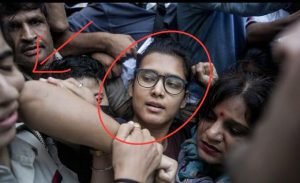
This was no sudden outburst of emotion. Aggression was prepared in a planned manner for the cameras. As soon as the coordinator gave a signal, small groups would stand up, raise slogans, deliver aggressive sound bites in close-up, and then sit back down. Security personnel were present, but no one was stopped. There was only vigilance and observation. The aim of the entire scene was not to gather a crowd on the street but to manufacture a narrative of “tricolor, anger, repression” on social media. When you watch the reels on your phone, you will see a crowd, passion, and injustice. On the ground there was neither a crowd, nor silent support from people nearby, nor any real involvement of the student wings of any major political party.
The Truth of Connaught Place: Not a Crowd, but a Crowd of Cameras
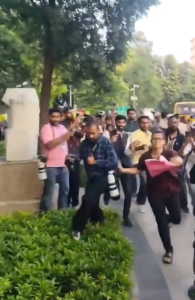
An eyewitness who covered the “Wave the Tricolor” march at Connaught Place described what they saw throughout the day, laying bare the full script of this drama. Until 5 in the evening there was no crowd or agitation. The metro was open, the roads were open, yet no public support was visible. After 5 p.m., groups of 30–40 people arrived—linked to left revolutionary youth organizations. They came with full videography teams shooting close frames from different angles. The camera would stay on, the coordinator would give a cue, people would chant slogans with enthusiasm and wave the tricolor (or the red flag), then move on for the next angle. Every organization had brought its own team. YouTubers and influencers filled the gaps.
In close-ups even a small crowd looks large. An aggressive sound bite has greater impact in a reel. At times there were attempts to provoke security personnel by invoking democracy and the tricolor. The camera was always on. When these reels go viral, viewers feel the entire city is on the streets. The reality was that there was neither large-scale public participation, nor support from ordinary people nearby, nor any spontaneous outrage. It was a flash-mob-style flash protest, planned and executed for social media. The line between journalist and reel-maker has disappeared. The protesters themselves have become YouTubers and journalists. Don’t let others work—make their videos, and that too with planning. A journalist was stopped from working three times. The question is: where are we headed?
Congress’s Paid Propaganda Network and the Role of IFF
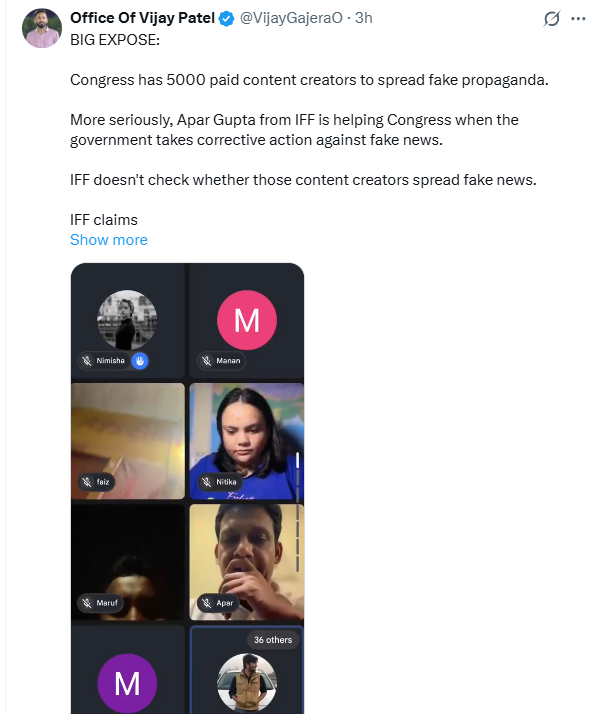
Behind this drama are not merely a few youth organizations. A recent exposé claims that Congress has around 5,000 paid content creators whose job is to spread fake propaganda. Among them are former editors of some channels. By becoming content creators they are minting money from both YouTube and the party.
When the government takes action against fake news, the role of Apar Gupta of the Internet Freedom Foundation (IFF) comes to the fore. It is claimed that he is helping Congress. IFF claims to be neutral, but the pattern of coordination suggests otherwise. Building a narrative of “censorship” and “movement” without investigating the creators spreading fake news is not neutrality but political alignment.
This is not a new pattern. Earlier too, Congress has faced allegations of paying influencers to malign events or gather crowds. In some cases creators themselves made claims and later deleted the videos. Congress denied the charges. But when a tricolor march shows small groups, professional cameras, close-up shooting, and viral reels all at once, the question arises how spontaneous these “movements” really are and how much they are network-driven.
In a democracy there is a right to protest. But when the purpose of the protest is to wave a red flag under the cover of the tricolor and make reels; when there is no crowd on the ground but a crowd of cameras; and when paid networks and so-called neutral organizations work in the same direction—then this is not a movement, it is a drama. The truth has already been exposed. Now the question is how long viewers will continue to accept it as real.