
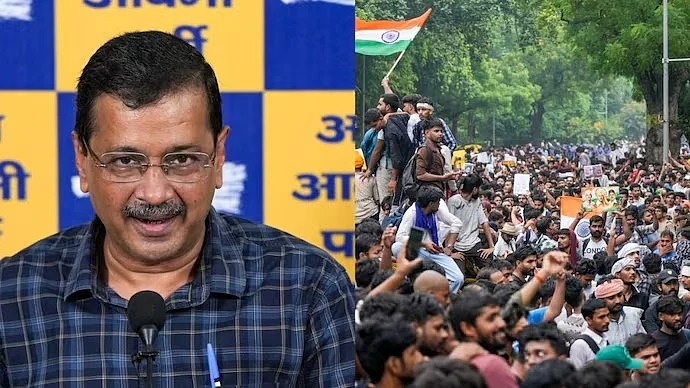
CJP calls itself an independent movement. But the protest helpline on its official Saakshi portal was launched by the Aam Aadmi Party — and the portal never says so.
A MEDIA SCAN INVESTIGATION
Article by Vedansh Pandey
Chief Editor, Media Scan
Cover: preserved Saakshi page; Outlook India/PTI image · 28 July 2026
 
Cover visual cue: preserved Saakshi resources page and the Kejriwal/protest press image used in the PDF. |
THE CJP FILES | THE AAP HELPLINE INSIDE CJP’S SAAKSHI PORTAL
On the afternoon of 28 July 2026, the journey through the Cockroach Janta Party’s digital infrastructure took only two clicks. The first page belonged to CJP’s principal website. It described a service called Saakshi — “witness” — as the movement’s evidence vault: a place where protesters could deposit original photographs and videos, preserve their metadata and create records that could later be used by lawyers. A link carried visitors to a separate domain, cjp-saakshi.com. Its “Resources & Aid” page was calm and institutional. Beneath its logo was a short description: essential information, legal rights and contacts for citizens participating in protests. The National Human Rights Commission appeared first: 14433. Then the National Legal Services Authority: 15100. Police emergency: 112. The fourth entry was different. It was not a national institution or a three-digit emergency service, but an ordinary mobile number: 8588833548. “Delhi Protest Medical Aid Helpline,” the page called it. “Free medical assistance for protesters in Delhi.” Below it appeared the national ambulance and emergency medical-service numbers. Nothing beside 8588833548 identified a political party. Nothing told an injured student, a detained protester or a worried parent that the number had been publicly launched by the Aam Aadmi Party, promoted by Arvind Kejriwal and circulated as an AAP legal-and- medical assistance channel. Yet that was the number’s documented origin. The discrepancy was visible in the simplest possible comparison: what AAP said the number was, and what Saakshi told its users it was.
The Saakshi page, captured at 3.30 p.m. on 28 July, placed the mobile number among government and public emergency services and described it only as medical aid. On the same page, Saakshi called itself “a pan-India evidence repository” and “an initiative of the Cockroach Janta Party.” During the reporting process that day, I called the number. It rang. No one answered that attempt. An unanswered call proves almost nothing. It does not establish that the line was inactive, that its operators were avoiding questions or that it had failed to help anyone. But the silence sharpened an institutional question that neither website answered: Who, exactly, was behind the line? And once the number had entered CJP’s official protest infrastructure, what happened to the names, injuries, detention locations, police-station details and family contacts that frightened students might send through it? The trail began a week earlier.

The number inside Saakshi. The captured Resources & Aid page lists 8588833548 between public emergency contacts. |
The number inside Saakshi. The captured “Resources & Aid” page lists 8588833548 between public emergency contacts and describes it only as a Delhi protest medical-aid line. Open the page. Source: preserved page capture, 28 July 2026. 20 July: the crackdown On 20 July, protesters associated with the Cockroach Janta Party marched in Delhi as part of its “Sansad Chalo” mobilisation. The demonstration ended in police action, detentions and competing allegations. Protesters accused police of indiscriminate force; police accused sections of the gathering of breaching barricades and attacking personnel. By the following day, photographs and videos of injured or detained students were circulating widely. The crisis created two immediate needs: locating people who had been taken away and arranging lawyers or medical assistance for them. It also created an opening for established political organisations to enter the response. On 21 July, Arvind Kejriwal himself put the number into public circulation. In a short video concerning students arrested during the Jantar Mantar protest, Kejriwal looked into the camera and announced the helpline number digit by digit: 8588833548. The video remains publicly accessible here: “Jantar Mantar Protest म ें Arrest हुए छात्रों क े लिए Helpline Number 858-8833-548” — YouTube Shorts. This attribution is therefore not an inference drawn merely from the political affiliations of people who subsequently shared the number. Kejriwal personally publicised it as a channel for students affected by the arrests. The number was placed in the open by AAP’s national convenor before it was repackaged by other accounts as generic legal assistance and before it appeared on Saakshi as a politically unattributed medical-aid resource. Contemporaneous reporting described the channel explicitly as an AAP initiative. Kejriwal said students requiring legal or medical assistance could contact the number and that AAP’s legal and medical teams would help affected protesters. He also addressed the families of detained students, telling them that the party stood with them. The launch was reported by Outlook India and The New Indian Express. AAP’s intervention was therefore public, politically branded and operationally framed. The party did not describe 8588833548 as an anonymous citizens’ helpline whose provenance was uncertain. It presented the number as a service created or adopted and backed by AAP.
The number then moved through the party’s public machinery.

Kejriwal puts the number in public |

CJP denies an AAP association |
At 4.05 p.m. on 21 July, the official AAP Uttarakhand account circulated the same helpline. The message was also propagated through accounts presenting themselves as AAP media officials, state social-media organisers, former elected representatives, doctors’ cell members, student-wing functionaries and local volunteers. These biographies establish what the accounts publicly claimed at the time of collection; they do not prove that each appointment was current or that every retweet followed an internal instruction. But the combination of Kejriwal’s announcement, official state-unit circulation and role-bearing party profiles supports a clear conclusion: this was not a telephone number that AAP supporters happened to discover independently. It was part of an organised public party response. AAP-linked lawyers and office-holders subsequently described visits to police stations, attempts to locate missing students and efforts to secure releases.
One of the most consequential public trails involved Advocate RishiKesh Kumar. On 23 July, an X post attributed to his account asked users searching for a missing student to send information or WhatsApp the same helpline number. The preserved status URL is x.com/rishikeshlaw/status/2080124369909800979. He later reported that the student had been found. The archive also records that AAP leader Saurabh Bharadwaj publicly thanked RishiKesh Kumar and other volunteers who had remained available on the legal helpline. The evidence does not identify who owned the SIM or physically held the handset, but it places Kumar within the operational legal-response layer rather than among ordinary social-media amplifiers. AAP later referred to the number as the AAP Student Helpline and claimed that its legal team had assisted hundreds of students through calls and messages. Those figures remain party claims until independently verified through case records. But they establish that AAP publicly asserted continuing operational responsibility for the channel. Then the number’s political identity began to disappear. 22 July, 7.08 p.m.: the message that travelled At 7.08 p.m. on 22 July, Arun Arora published a short instruction on X: “Delhi students If police is picking you up, pls call at 8588833548 and inform. Legal help will be provided.” The original post remains identifiable here. There was no mention of AAP. Arora did not create the helpline; Kejriwal had announced it the previous day. But his wording transformed a politically branded party resource into something that read like generic civic information. That transformation mattered because of Arora’s place in the network. His profile did not declare a formal AAP position, and a previous statement preserved in the audit said he did not hold party office. The evidence does not justify calling him an AAP official.
His public posting history, however, showed sustained support for Kejriwal and AAP. More significantly for the wider CJP investigation, Arora had already been posting about the Cockroach Janta Party during its May launch window. At 6.20 p.m. on 16 May, he published an AAP-CJP electoral joke. The next day, he posted an invitation to Mahua Moitra to join CJP. These posts do not establish that Arora created the movement, controlled its accounts or received directions from AAP. They establish something narrower: an influential pro-AAP digital voice who was present in the public conversation around CJP’s May rise became, two months later, the author of the principal viral message distributing AAP’s assistance number. A note on retweet links An X retweet does not create a separate permanent status URL. For a named direct retweeter, this story links to the person’s profile and to Arun Arora’s original post. Inclusion in the retweeter population is established by the preserved X API return and should be supported in publication by screenshots from the data archive. Open the source post x.com/Arun2981/status/2079924084100702626 Arora’s helpline post became the centre of a direct-retweeter investigation. Using X’s official retweeted_by endpoint, the investigation preserved 28 pages containing 2,546 unique accounts that had directly retweeted his post. No duplicate user IDs appeared. But the collection stopped after API credits were exhausted, while a continuation token remained. That makes 2,546 a floor, not necessarily the complete population. The data is powerful in one narrow respect. It establishes that a particular account was returned by X as a direct retweeter of Arora’s exact post. It does not establish why the user retweeted, when the repost occurred, whether the user had received an instruction, whether the number was independently verified or whether the user knew that AAP operated it. The API files contained user profiles and pagination data. They did not contain individual retweet timestamps. There was no WhatsApp-group export, no Telegram instruction channel, no payment trail and no device-level evidence of common control.

What the preserved X API collection can and cannot show. |
What the preserved API collection can and cannot show. It proves inclusion in the returned direct-retweeter population. It does not prove timing, motive or coordination. Graphic based on the raw API archive. What emerged was not proof of a single coordinated conspiracy, but a layered population: AAP role-bearing accounts, CJP representatives, journalists, lawyers, doctors, academics, campaigners and thousands of ordinary users carrying the same politically unattributed instruction. The first name in the file The first record in the preserved retweeter dataset belonged to Saurav Das. His captured biography described him as “Chief Spokesperson, Cockroach Janta Party.” His appointment had also been publicly reported when CJP announced its spokespersons in early June. Das was not simply a person expressing sympathy for CJP . He was part of its recognised leadership. His presence among the direct retweeters provides the clearest bridge between the AAP- origin helpline message and CJP’s formal structure. A retweet does not have a separate independent URL. The reader can inspect Arun Arora’s source post and Das’s public profile; his direct-retweeter inclusion is preserved in the raw API return.
A single repost does not show that Das helped create the helpline or coordinated AAP’s campaign. Protest leaders routinely circulate whatever legal or medical help is available. But it establishes that the AAP-origin channel had entered CJP’s formal leadership network before the same number appeared on Saakshi. Another account, @indian_nagrik, linked the helpline further back into CJP’s launch period. At 6.46 p.m. on 16 May, the account published a post beginning with a self-description as a CJP spokesperson. The post discussed AAP volunteers and the emerging movement. The same account later appeared among the direct retweeters of Arora’s helpline post. At 2.51 a.m. on 22 July, Saurav Das publicly acknowledged or tagged the account. On 23 July, @indian_nagrik publicly addressed Das and CJP leadership. No formal appointment letter for @indian_nagrik has been recovered. Its exact organisational authority therefore remains unresolved. But the combination of a launch-window spokesperson claim, early CJP activity, direct inclusion in the helpline retweeter population and later interaction with formal leadership makes it more than an ordinary follower. It is a documented bridge between CJP’s May emergence and the July assistance network. Another retweeter supplied a more personal anecdote. The profile of Mayank Sharma described him as a former AAP Uttarakhand spokesperson. Shortly before the Delhi march, Kishlay Sharma published a post saying Mayank Sharma had called him at around 11.30 p.m. and asked whether he was coming to Delhi. The account suggests activity beyond passive reposting: a personal telephone call attempting to establish whether someone would attend. But it remains one recipient’s public statement. No call record, instruction sheet or broader recipient list has been obtained. It would be improper to turn one late-night call into proof of a mass mobilisation operation. The verified facts are narrower: Mayank Sharma was present in the preserved direct- retweeter population; his public profile associated him with AAP Uttarakhand; and one contemporaneous account described him calling before the march. The scale and purpose of any wider calling effort remain unable to determine. Together, these accounts produce a defensible sequence:
AAP publicly launched the channel. An official AAP state unit circulated it. A high-reach pro-AAP amplifier repackaged it without party attribution. CJP’s chief spokesperson and an early CJP-associated account directly retweeted that unattributed message. The same number later appeared in CJP’s Saakshi ecosystem. That is a documented operational interface. It is not proof of common ownership. When a party message becomes public- service information The helpline did not remain inside openly partisan networks. The initial automated screening marked 26 accounts as potentially associated with media. A later manual audit narrowed the publication-safe cohort to at least 12 independently verifiable journalists and editors associated with identifiable outlets. They included Rituparna Chatterjee, identified by The Independent as a deputy Asia editor; S. Lalitha of The New Indian Express; Visvak of Queerbeat; Durga M Sengupta of Dialogue Earth; and Aliza Noor of The Quint. The cohort also included Sanjay Kumar, Ashley do Rosario, Ashokamithran T, Rhea Arora, Sharad Prakash Asthana, Arijit Gupta and Devabrata Dutta. None of these retweets has a separate permanent status URL. Each name above links to the account involved; the common item they directly reposted was Arora’s helpline message. Their inclusion is independently preserved in the X API collection. Together, the 12 accounts had approximately 186,430 declared followers when the data was captured.
That number is not an estimate of how many people saw the message. Followers overlap; platforms do not display every repost to every follower; and the dataset contains no impression data. Nor does their inclusion establish that any media organisation participated. The reposts came from individual accounts. Several biographies expressly described their posts as personal views. An employee’s retweet is not automatically an action of the employer. The benign explanation is substantial. A journalist covering education, civil liberties, politics or police action could see a message promising legal help to detained students and share it because it might protect someone in immediate distress. A lawyer, doctor, academic or activist could do the same. But every such repost performed an additional function, intended or not: it gave the message another layer of credibility while leaving its political source unstated. By the time the number appeared in the feed of an editor, reporter or fact-checker, it no longer necessarily looked like an AAP campaign resource. It looked like neutral emergency information passed from one trusted person to another. The appropriate reporting questions are therefore not accusations of collusion. They are questions of verification and provenance: Did the journalists know that the number was publicly associated with AAP? How did the message reach them? Did they verify the operator before circulating it? Did any party or protest organiser request the repost? Would they have added attribution had they known that AAP’s legal and medical teams were handling the channel? The dataset cannot answer those questions. It makes them reportable.
23 July, 5.16 p.m.: the domain appears The technical birth of Saakshi can be dated more precisely than its public rollout. The authoritative registration record shows that cjp-saakshi.com was registered at 5.16.56 p.m. IST on 23 July 2026. The public record can be inspected through the RDAP domain lookup. The registrant’s name was redacted. The record placed the registrant contact in Delhi and identified Cloudflare as the registrar. The technical timestamp. The RDAP record places registration of cjp-saakshi.com at 5:16:56 p.m. IST on 23 July 2026. Open the live lookup. That registration occurred two days after Kejriwal announced the helpline and less than 24 hours after Arora published the unattributed legal-help message. Public rollout followed over several days. On 24 July, CJP representatives reportedly announced an evidence-collection website at Jantar Mantar. The platform invited protesters to submit photographs and videos of alleged police violence. Das said the material would be examined, police personnel identified and legal complaints pursued. The public account of that launch is available in The Times of India’s report on the evidence website. On 27 July, the platform received a more formal unveiling at a press conference in New Delhi.

The technical timestamp: cjp-saakshi.com registration record. |
A Reuters photograph from the press conference shows Das holding up a screen displaying CJP’s website and Saakshi evidence vault. Reuters dated the image 27 July. By 28 July, the main CJP website was directing users to Saakshi and its resources page was live. The chronology therefore contains three dates describing three different stages: The domain was registered on 23 July. The evidence-collection initiative was publicly reported on 24 July. The formal press-conference presentation occurred on 27 July. The CJP-to-Saakshi link and the helpline listing were verifiably live by 28 July. This sequence matters. AAP’s assistance number did not originate inside an old, pre-existing CJP evidence platform. The number had already been publicly launched, circulated through party units and distributed through Arora’s viral post before the Saakshi domain existed. The July sequence. The helpline announcement and viral post preceded the registration and public rollout of Saakshi. Graphic based on public announcements, preserved pages and the RDAP registration record. What Saakshi asked people to preserve The Saakshi resources page was unusually specific about the evidentiary value of original files. “Do not edit the files,” it instructed users. “No trimming, no filters, no compression.”

The July sequence: helpline announcement, viral post, domain registration and public rollout. |
It warned users not to upload screenshots of videos and not to send a file to themselves through WhatsApp before uploading, because doing so could strip location and timestamp metadata. Those are sensible instructions for preserving digital evidence. They also demonstrate the sensitivity of the material Saakshi sought. Preserve the original. Saakshi instructed users not to trim, filter or compress files and warned that messaging apps could strip metadata. Source: preserved Saakshi page capture. An original protest video may contain faces, voices, nearby landmarks, timestamps, device information and geolocation data. It may identify a police officer, but it can also identify the person who recorded it, the people standing beside them and the route they travelled. Saakshi said the material could be made available through “verified legal aid” pathways. The public pages reviewed for this story did not identify those teams, explain how they were verified or state whether lawyers associated with AAP were included. Nor did the public material resolve who held administrator credentials, what logs were maintained, how long original files were stored or whether a contributor could request deletion. The helpline raised parallel questions. A student messaging while being taken into custody might plausibly disclose a name, telephone number, present location, police vehicle, destination, injury, police station or family contact.

Saakshi instructed users to preserve original files and metadata. |
The precise information collected through 8588833548 has not been established. Neither have the identities of the people who answered it, the location of the handset, the control of any associated WhatsApp account or the retention policy for calls and messages. There is also no present evidence that Saakshi’s database and AAP’s helpline records were technically connected. The number may simply have been copied into the resources page as an external emergency contact, with no exchange of data. CJP may have obtained permission to display it. AAP may have offered it after the crackdown solely as humanitarian assistance, without seeking influence over CJP . Those are plausible explanations. But even under the most benign explanation, an essential fact remained absent from the captured page: the contact was not politically neutral infrastructure. It was a channel that AAP had publicly announced and promoted through its legal and medical operation. Independence is not a binary question The helpline trail does not establish that AAP created the Cockroach Janta Party. The documentary trail is particularly significant because CJP’s leadership had publicly rejected suggestions of an organisational relationship with AAP. In a Facebook video framed around the question of whether CJP was an AAP “youth wing,” Saurav Das said that the organisation had no association with AAP. The video remains available at the link above, allowing readers to hear the denial in its original context. That statement and the helpline evidence must be placed beside each other carefully. The presence of an AAP-origin number on Saakshi does not, on its own, prove that Das’s denial was false. “Association” can refer to formal affiliation, ownership, political control or organisational subordination. CJP could have had no formal connection with AAP while still accepting legal or medical assistance from it after the crackdown. But the denial makes transparency more — not less — important.
When an organisation publicly insists that it has no association with a political party, the later appearance of that party’s assistance infrastructure inside the organisation’s official portal becomes a fact requiring explanation. At minimum, CJP must explain whether the number was listed with AAP’s permission, whether it understood who operated it and why its political origin was not disclosed to Saakshi’s users. The issue is not merely whether CJP was an AAP front. The evidence presently does not establish that. The issue is whether CJP’s public claim of organisational independence was accompanied by adequate disclosure when its protest-support system began relying on infrastructure publicly created and promoted by AAP. It does not show that AAP controlled CJP’s first social-media accounts, supplied its May messaging, funded its initial rise or held the credentials to its websites. The historical bridge audit found two significant launch-to-July links: Arun Arora’s May posts and @indian_nagrik’s launch-window spokesperson claim. But it found no administrator logs, funding records, planning documents or creator testimony placing AAP behind CJP’s original emergence. It found no affirmative evidence that foreign governments, universities, foundations or international organisations directed the retweet cascade. Nor did it find a common instruction group or payment system connecting the journalists, lawyers, doctors, academics and campaigners who carried the message. The July evidence establishes something different. It shows that once CJP had moved from viral online phenomenon to a protest organisation dealing with arrests, injuries and evidence collection, it did not construct its support infrastructure in an institutional vacuum. AAP publicly created a legal-and-medical assistance channel. An official party unit distributed it. AAP-linked lawyers used it in operational contexts. A pro-AAP amplifier repackaged it without identifying the party. CJP’s chief spokesperson and an early CJP-associated account directly reposted the message. Journalists and civil-society figures carried it into wider networks.
Then the identical number appeared on CJP’s newly created Saakshi platform. That sequence is a documented operational convergence. Whether it resulted from humanitarian cooperation, opportunistic adoption, political consolidation or a relationship that began earlier remains unresolved. These possibilities are not mutually exclusive. A political party can help injured or detained students out of genuine concern and still recognise political value in that assistance. A young movement can accept urgently needed legal support while continuing to consider itself independent. Cooperation after a crackdown does not necessarily establish control before it. But political independence is not measured only by the name on an organisation’s registration papers. It is also measured through infrastructure: Whose lawyers act? Whose telephone receives the calls? Whose personnel see the information? Who holds the records? And what are users told when those organisational boundaries become blurred? The missing label The most consequential feature of the Saakshi resources page may not have been what it said. It may have been the two words it did not say:
Aam Aadmi Party. The provenance of 8588833548 was not obscure. Arvind Kejriwal had personally announced the number in a publicly available video. He presented it as a channel for students affected by the Jantar Mantar arrests. AAP’s official units and party-linked legal network subsequently circulated and used it. CJP’s own public position was equally categorical in the opposite direction. Saurav Das had said that the organisation had no association with AAP. Those two public records create the central tension of the story. On one side was CJP’s assertion of organisational separation. On the other was a channel placed into public circulation by AAP’s most prominent leader, carried through AAP’s political and legal ecosystem, amplified by CJP figures and eventually displayed on CJP’s official evidence platform without identifying the party behind it. That sequence does not prove that CJP was controlled by AAP. It does not prove that its denial of formal association was dishonest. It may reflect emergency cooperation established only after the crackdown. But it does mean that the word “association” can no longer be treated as a complete answer. Did CJP mean that it had no formal membership or ownership relationship with AAP? Did it mean that AAP had no role in its May emergence? Or was it also denying any later operational cooperation? The distinction matters because the available evidence supports different conclusions at different stages. The evidence does not establish that AAP created CJP’s original May rise.
The evidence does establish that an AAP-publicised assistance channel later moved through CJP’s leadership network and entered its official protest-support environment. Perhaps Saakshi’s authors assumed that everyone already knew who had launched the number. Perhaps they copied a widely circulating contact without tracing its provenance. Perhaps they considered political attribution irrelevant while students required urgent assistance. Perhaps AAP gave CJP permission to display the number generically. Perhaps the channel was never integrated with Saakshi beyond a static listing. Those explanations remain plausible. None has yet been established. The number itself was displayed prominently. Its political origin disappeared not through encrypted code or a secret server, but through the absence of a label. At the time of this draft, formal explanations had not been obtained from CJP, AAP , Arun Arora, Mayank Sharma, @indian_nagrik, the Saakshi administrator or the person who controlled 8588833548. Each must be given a detailed right of reply before publication. The call to the number was not answered on the attempt made during reporting. Its operator’s identity remains unresolved. What remains after the unanswered ring is not proof of conspiracy. It is a series of precise and answerable questions:
Who controlled the line? What information did it collect? Did CJP obtain permission to list it? Were callers told that AAP-linked lawyers or volunteers might handle their information? Were AAP lawyers among Saakshi’s verified legal-aid teams? Could anyone with access to one system obtain information held by the other? What did CJP mean when it publicly said there was “no association” with AAP? And when, exactly, did emergency assistance become shared political infrastructure? The evidence does not establish that AAP manufactured CJP’s May rise. It establishes something narrower — and more firmly documented. After the movement had risen, after the march and after the crackdown, a number personally publicised by Arvind Kejriwal travelled through CJP’s leadership network and into its official evidence platform. During that journey, the number remained the same. Only its political identity disappeared.
Source trail and reader links
Every named person in the narrative is linked to the relevant public post, profile, video or article. For direct retweeters, X does not generate a separate public URL for the retweet itself; the preserved API data establishes inclusion, while the article links to the person’s profile and the common source post.
1. Saakshi Resources & Aid — https://cjp-saakshi.com/resources Preserved capture: “Saakshi — Protest Evidence Repository.pdf,” 28 July 2026, 15:30.
2. Kejriwal announces the number — https://www.youtube.com/shorts/prL9JrooTcU Reporting: Outlook India; The New Indian Express.
3. CJP denial of AAP association — https://www.facebook.com/watch/?v=1012429517999290
4. AAP Uttarakhand distribution — https://x.com/AAPUttarakhand/status/2079515649723056139
5. Arun Arora source post — https://x.com/Arun2981/status/2079924084100702626 Earlier CJP posts: 16 May and 17 May.
6. RishiKesh Kumar operational post — https://x.com/rishikeshlaw/status/2080124369909800979
7. Saurav Das profile — https://x.com/SauravDassss Direct-retweeter inclusion preserved in the X API archive.
8. @indian_nagrik launch-window spokesperson claim — https://x.com/indian_nagrik/status/2055638539434397740
9. Das’s later interaction — https://x.com/SauravDassss/status/2079678169691619468
10. @indian_nagrik addressing CJP leadership — https://x.com/indian_nagrik/status/2080219084856160690
11. Mayank Sharma profile — https://x.com/MayankSharmaAAP
12. Kishlay Sharma’s contemporaneous post — https://x.com/KishlaySharma/status/2078917300196172093
13. RDAP lookup — https://client.rdap.org/?type=domain&object=cjp-saakshi.com&follow-referral=1
14. Times of India launch report — https://timesofindia.indiatimes.com/city/delhi/cjp-launches-website-to-collect-evidence-against-cops/articleshow/132612177.cms
15. Reuters Connect press-conference photograph — https://www.reutersconnect.com/item/cockroach-janta-party-spokesperson-saurav-das-speaks-during-a-press-conference-in-new-delhi/dGFnOnJldXRlcnMuY29tLDIwMjY6bmV3c21sX1JDMkNNTUFORFJXSQ
