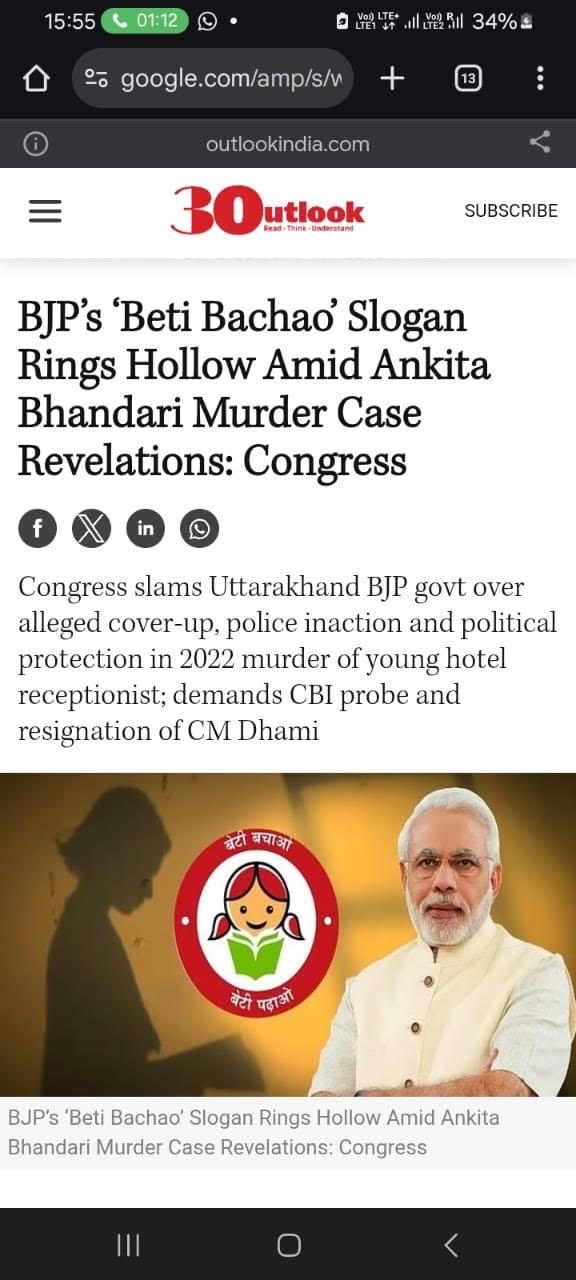
How The Hindu and Outlook India Published the Same Ankita Bhandari Headline With No Clear Attribution

2-1-11.jpeg

Delhi : The murder of Ankita Bhandari is a tragedy that demands care, accuracy, and restraint. It deserves journalism that separates facts from claims, grief from politics, and investigation from interpretation. That is precisely why recent coverage by two major Indian news organisations invites scrutiny—not for what they reported, but for how they framed it.

The Unsettling Similarity

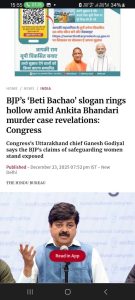
Readers scrolling through news feeds recently encountered an unusual sight: two independent outlets carrying the exact same headline, word for word, on the Ankita Bhandari case. The duplication wasn’t a paraphrase or a shared theme—it was identical language, identical framing, identical moral conclusion.
In professional journalism, headlines are not incidental. They are the clearest expression of editorial judgement. When two independent newsrooms arrive at the same headline—verbatim—it raises a straightforward public-interest question:
Was this independently edited reporting, or was it sourced from somewhere else?

The Attribution Gap

If a story is carried from a wire service or shared news feed, journalistic norms are clear: attribute the source transparently. Doing so protects readers, clarifies accountability, and preserves editorial integrity.
Yet in this instance, no clear attribution was visible—neither in the headline nor in obvious story metadata. For readers, that absence matters. Without disclosure, audiences cannot tell whether:
the headline reflects original editorial judgement, a shared wire copy, or a political statement reproduced wholesale. Transparency is not optional in sensitive cases; it is foundational.
When Framing Becomes a Verdict

The shared headline did more than report a statement—it delivered a conclusion. By declaring that a flagship slogan “rings hollow,” the framing moved from describing a political claim to endorsing its moral weight.

This matters because the Ankita Bhandari case is not merely a political talking point. It is an active site of public grief, legal process, and institutional responsibility. Journalism’s role here is to interrogate claims, not to amplify them as verdicts—especially when those claims originate from one political actor.

Independent Media, Identical Voice?

Independence in journalism is not only about ownership or funding; it is also about editorial distance. Different newsrooms are expected to:
ask different questions,
foreground different facts,
and apply their own editorial reasoning.
When that diversity collapses into headline uniformity, readers are justified in asking whether narrative convergence is replacing independent judgement. MediaScan does not allege collusion. But patterns matter—and identical headlines across independent platforms are a pattern worth examining.

What’s Missing-and Why It Counts

Equally telling is what the coverage did not foreground:
no clearly presented official response alongside the political claim,
no primary legal documents or court references to anchor the narrative,
no expert voices to distinguish allegation from adjudication.
The result is a story that risks politicising a crime rather than illuminating it.

Why Readers Should Care

Repetition creates perception. When the same headline appears across outlets, it can feel like confirmation-even when it is not. Over time, this blurs the line between reported fact and repeated framing.
For a public already navigating mistrust and information overload, journalism must work harder, not less, to show how stories are sourced, edited, and framed.

The Questions That Remain

MediaScan leaves readers with questions-not accusations:
Was this a wire story, and if so, why wasn’t that made explicit?
How did two independent editorial desks arrive at identical wording?
Why was a political claim framed as a moral verdict in the headline?
What safeguards exist to prevent narrative herding in sensitive cases?
These are questions journalism should welcome. Accountability strengthens credibility; silence erodes it.

A Call for Clarity

Ankita Bhandari deserves justice. Her family deserves dignity. And readers deserve clarity about how narratives are formed—especially when they appear, word for word, across independent newsrooms.

Journalism’s power lies not in speaking with one voice, but in earning trust through transparency. MediaScan exists to ask these questions so the public can read with open eyes. Media Scan Watching the media, so the public can judge for itself.

पब्लिक के लिए व्यवस्था का पब्लिक धज्जी उड़ा देगा, दीदी ई बिहार है

Bihar-700x525.png-1.webp

रेखा सिंह

पटना। बीते जून माह में मैं पटना आई थी और किसी काम के लिए राजा बाजार गई थी। राजा बाजार मेरे घर से नज़दीक ही पड़ता है, इसलिए पटना आने पर मैं शॉपिंग के लिए वहीं जाना उचित समझती हूं।

हुआ यूं कि उस दिन मैं कोई ज़रूरी सामान लेने राजा बाजार गई और समान लेकर घर जल्दी वापस आना था इसलिए कैब बुक की, लेकिन कैब आने में दस मिनट लेट दिखा रहा था तबतक मेरी नज़र सामने से आती पिंक बस पर गई, जिसके बारे में कुछ दिन पहले ही अख़बार में पढ़ी थी- ‘ कि पटना में अब महिलाओं के लिए पिंक बस की सुविधा शुरू की गई है,जिससे महिलाओं को यातायात करने में काफी सुगमता होगी’। मैं समझ गई कि यही वो पिंक बस है, तो क्यों न इसी बस से आज घर का रुख किया जाय! मैं झट से सड़क के उस पार चली गई और बस के पहुंचने से पहले वहां जाकर खड़ी हो गई । बस – स्टॉप तो अभी भी पटना में हर जगह निर्धारित नहीं की गई है, इसलिए कहीं भी हाथ दिखाने पर बस रुक जाती है। मुझे अंदाजा था कि जहां मैं खड़ी हुई हूं बस वहां ज़रूर रुकेगी और बस रुक भी गई। बस रुकते ही महिला कंडक्टर ने हाथ बढ़ाकर कर बोली –  आईए, मैडम! कहां जाना है आपको? गोला रोड, आरपीएस मोड, शगुना मोड़, कहां ?

– जी, मुझे गोला रोड जाना है। यह बोलकर मैं बस के अंदर चली गई। अंदर भीड़ थी। सारे सीट भर चुके थे और कुछ महिलाएं हैंगर पकड़ कर खड़ी  थीं। मैं भी जाकर उनके पीछे खड़ी हो गई। बस अपने अगले पड़ाव के लिए निकल पड़ी।

मैं भी हैंगर पकड़े खड़ी – खड़ी ये पिंक बस की विशेष सुविधाएं के साथ – साथ महिला कंडक्टर को देखकर खुश हो रही थी। मन ही मन सोच रही थी कि अब बिहार में हर वर्ग की महिलाएं हर क्षेत्र में अपना अधिकार और कर्तव्य सुनिश्चित ही नहीं करा रहीं, बल्कि बढ़ – चढ़कर अपना योगदान भी दे रही हैं!  

मैं,बिहार में पहली बार किसी महिला को बस कंडक्टर के  कार्य- भार को संभालते देख रही थी। वो महिला आत्मविश्वास और ज़िम्मेदारी से भरी हुई दिख रही थी! यूनिफार्म तो नहीं पहन रखी थी उसने नार्मल सारी ही पहनी हुई थी लेकिन बिहारी पुरुष कंडक्टर से थोड़े कम, लेकिन ऊंची आवाज़ में हर पड़ाव आने से पहले यात्रियों को आगाह कर रही थी चढ़ने – उतड़ने के लिए।अगला पड़ाव आया और बस रुक गई। तकरीबन दस महिलाओं की एक झुंड दनादन बस में घुस गई। श्रीमती कंडक्टर जी ने उन सारी महिलाओं का  टिकट काटना शुरू किया।महिलाओं के झुंड में से एक महिला पीछे से हाथ बढ़ाकर कुछ पैसे कंडक्टर जी के हाथ थमा दीए। कंडक्टर जी,  पैसे गिनने लगी और गिनने के बाद बोली  ” ई त’  मात्र पांच लोक के ही टिकट के पैसा दिए हैं जी, आरो पैसवा न दीजिए?

झुंड से दूसरी महिला बोली – अरे, रख लो जी! हमलोग त’ रोजे आते – जाते हैं बसबा से ऐतने पैसबा देते हैं और कोई कुछ नहीं बोलता है! और तू केतना  हुज्जत करती हो…नया कंडक्टर बनी हो का?

अब महिला कंडक्टर जी, बोलने लगी ” देखिए आपलोग ऐसे कीजियेगा तो कैसे होगा? हमको भी अगीला को हिसाब देना पड़ता है न ? हम कहां से देंगे पैसबा, अपना बाप घर से लाएंगे का?

 -” तुमको बताना पड़ता है…किसको जी?”

उसी झुंड की तीसरी महिला बोली!

– किसको? जानते नहीं हैं? कंडक्टर, इस बात को बोलकर थोड़े पीछे सरक कर खड़ी हो गई! लेकिन झुंड से अभी भी आवाज़ आ ही रही थी। पीछे बैठी सभी महिलाएं, साथ में मैं भी ये सब तमाशा देख रही थी ।

मामला थोड़ा गंभीर होने लगा था। कंडक्टर जी अकेली और वे पूरी झुंड थीं। दसो महिला का मुंह पक – पक चल ही रहा था।

अब कंडक्टर जी थोड़ा और गर्म होकर थोड़ी सख़्त आवाज़ में बोलना शुरू की –

” मैडम, पैसबा दीजिए, नहीं तो बस से उतर जाइए”
– नहीं उतरूंगी, क्या करोगी तुम ?

झुंड से एक महिला बोली।
अब बेचारी कंडक्टर जी, करती भी तो क्या करती?
वो ड्राईवर के तरफ़ देख रही थी और ड्राइवर साहेब को ज़रा सा भी फ़र्क नहीं पड़ रहा था इन हल्ला, चिल्ली से। और फ़र्क पड़ता भी तो क्यों? ये सब सुनना तो शायद उनका प्रतिदिन के आदतों में शुमार होगा, इसलिए वे बस ‘ बस’ के स्टीयरिंग थामे बस को अपनी रफ़्तार में भगाए जा रहे थे।
इधर झुंड और कंडक्टर जी के बीच बहस जारी ही थी। इतने में तपाक से झुंड से सबसे पीछे खड़ी महिला जिसने टिकट के पैसे दिए थे,वो एकदम कंडक्टर जी पर चढ़ कर बोली-

” तू जानत न हवा हमनी के, हम के हैं ? हम सब पार्टी के कार्यकर्ता हैं ..हमनी से पैसा मांगोगी तुम?
सच में, मैं इस तरह की “महिला” रंगदार नेताइन पहली बार देखी थी। उल्टा चोर कोतवाल को डांटे! ये कहावत एकदम चरितार्थ हो रहा था। अब कंडक्टर जी, भींगी बिल्ली की तरह एक – दो बार और म्याऊं , म्याऊं करके चुप हो गई। मुझसे ये बिल्कुल देखा नहीं गया ! मैं आगे बढ़ी और उस झुंड को बड़े इत्मीनान से बोली ” आप सब ख़ुद को किसी ख़ास पार्टी की कार्यकता कहकर फ्री में सरकारी सेवा का फायदा उठा रही हैं, और टिकट मांगने पर उल्टा कंडक्टर को उल्टा – सीधा सुना रही हैं ये कैसा तरीका है? आप लोग ही ऐसा करेंगी तो बाकी लोग क्या करेंगे? आपलोग सरासर गलत कर रही हैं? मुझे बोलते देख पीछे से कुछ और महिलाएं उन नेताइन महिलाओं पर बरस पड़ी ” आप जैसे लोगों के कारण ही ये सुविधा भी सरकार बंद कर देगी। फ्री में कब तक सुविधा देती रहेगी?

वे सारी महिलाएं मतसुन होकर हमारी बातें सुन रही थी, जैसे कुछ हुआ ही नहीं है। इतने में उनके पड़ाव आ गए और वे सारी भड़भड़ा कर उतर गईं।
मुझे बहुत हैरानी नहीं हुई इस बात से क्योंकि अभी भी बिहार में बेटिकट यात्रा करना लोग अपना अधिकार समझते हैं! मुझे उस समय थोड़ी हैरानी इस बात की हुई थी कि वे सारी महिलाएं,किसी ख़ास दल की कार्यकर्ता कहकर अपना धौंस दिखाकर पिंक बस में फ़्री में यात्रा कर रहीं थीं, जिसका किराया पहले से ही न्यूनतम रखी गई है,वो उतना भी पे नहीं कर सकती थी?

मैं तो कहूंगी लानत है ऐसे लोगों पर!
अब हमारा पड़ाव भी आनेवाला ही था। श्रीमती कंडक्टर जी, चुपचाप सीट के सिरहानी पकड़ कर खड़ी थी। मेरी नज़र उन से मिली! मैं मुस्कुराई तो उन्होंने भी मुस्कुराकर ही मेरे मनोभाव का आदर किया।

मैंने उनसे कहा – “आपको बधाई ” आपने बहुत हिम्मत वाला जॉब चुना है! क्योंकि मैंने महसूस किया है कि बिहार में महिला कंडक्टर का जॉब करना आसान काम नहीं है!

श्रीमती कंडक्टर जी ने मुझे “थैंक्स” बोली और साथ ही ये भी कही ” मैडम जी, ई बिहार है, यहां की सरकार पब्लिक के लिए कोनो व्यवस्था कर दे, लेकिन पब्लिक उस व्यवस्था का धज्जी उड़ा ही देती है।

– हां, ये बात तो है! पब्लिक और पॉलिटीशियन दोनों को जिम्मेदार होना होगा तभी कोई सिस्टम या सुविधा सुचारू रूप से चलेगा।
–  जी, मैडम!

मैडम जी, आपको हिएं न उतरना है, गोला रोड?

जी, जी यही उतरना है!

‘ बस’ अपने निर्धारित पड़ाव पर आकर रुकी, जहां मुझे उतर जाना था सो मैं उतर गई मन में कई सारे सवाल, जवाब और विचार लिए।
ओह! बिहार में” पिंक बस “का संस्मरण लिखते समय चूल्हे पर चावल चढ़ा रखी थी, लेकिन लिखने के धुन में इतनी बेसुध थी कि भात सहित पूरी केतली ही जल गई! जलने की बू आई तो मुझे लगा बाहर किसी ने कुछ जलाया होगा शायद! लेकिन जब किचन से धुआं निकलने लगा तब याद आया कि “हे भगवान मैंने तो चूल्हे पर भात पकने को रख आई थी!

ख़ैर….इस में लेखन का क्या दोष?

 (सोशल मीडिया से)

Gaunaha Police Station: Den of Corruption or Bastion of Justice? Serious Allegations of Protecting Mujammil Sheikh and Misleading Even the PMO

2-6-1.jpeg

Media Scan Desk

Bettiah (West Champaran): Serious allegations are being leveled against Gaunaha police station, located on the Nepal border in Bihar, a highly sensitive area. RTI activist Acharya Nitin Kumar Ravi has accused the station of protecting Mujammil Sheikh and his associates in a case involving land grabbing and crop looting, with police collusion. The station is alleged to have become a hub of corruption during the tenure of former station in-charge Rajiv Nandan Sinha, who was recently suspended on corruption charges while serving as Raxaul station in-charge. Demands are now rising for re-investigation of old cases handled during Sinha’s time, as the station’s report has allegedly misled the Prime Minister’s Office (PMO).

  Caption: Mujammil Shekh

Caption: Rajeev Nandan

Suspension of Former Station In-Charge Rajiv Nandan Sinha: Exposure of Corruption

In May 2025, Champaran Range DIG Harikishore Rai suspended Raxaul station in-charge Inspector Rajiv Nandan Sinha. The allegations were that Sinha took goods worth lakhs from local businessman Tunna Prasad on credit but did not pay. When the businessman demanded payment, Sinha implicated him in a false kidnapping case. Following the businessman’s complaint, the DIG personally investigated, found the charges true, and immediately suspended Sinha, initiating departmental proceedings.

This suspension raises questions about Sinha’s tenure as Gaunaha station in-charge. Nitin Kumar Ravi claims that under Sinha, the station was completely a center of corruption. Multiple complaints were filed in Gaunaha, but no action was taken. Now that Sinha’s corrupt character has been exposed, re-investigation of old cases during his tenure—especially the land dispute involving Mujammil Sheikh—is essential.

The Land Grabbing Case: Dispute Began During COVID Period

The root of the dispute lies in April 2021, when Nitin Kumar Ravi’s entire family was infected with COVID-19, and their house was declared a micro-containment zone and sealed. During this time, Mujammil Sheikh (father: Salim Sheikh, village: Gamhariya, Gaunaha), along with Saddam Sheikh, Sajjad Sheikh, his uncle, cousin, and other anti-social elements, attacked the caretakers of the land—Ramsharan Mahto and Anil Kaji—forcing them to leave through assault and threats.

The family immediately informed then-DM Kundan Kumar via WhatsApp. After COVID was controlled, a board was installed on the land stating: “This land is not for sale; ownership rights belong to Bamdev Jha.” Prabhat Kumar Jha applied to the Gaunaha circle officer for land measurement, mentioning Plot No. 02, Khesra 389, Thana No. 28, area three bighas. The land is jointly registered in the names of Pandit Umakant Jha and Bamdev Jha. Lagaan receipts, pattas, and documents were attached. Applications were also submitted to SP Bettiah, DSP Narkatiaganj, Circle Officer, and SDM Narkatiaganj.

On June 30, 2021, Prashant Jha filed a complaint at Gaunaha police station regarding forcible occupation and threats, but the station did not provide a receiving acknowledgment. As per Nitin, the station has no practice of giving receipts for applications.

Police Negligence: From Crop Looting to Hiding CCTV Footage

In September 2021, Circle Officer Amit Kumar called for original documents in a public hearing (janata darbar). On September 4, 18 documents were submitted, including a copy of a 1978 complaint. Still, no action was taken.

On October 15, 2021, Mujammil’s men looted the crop. A complaint with video evidence was submitted, but then-station in-charge Rajiv Nandan Sinha dismissed it as a janata darbar matter. On October 16, Mujammil came to the station in-charge’s chamber during janata darbar and, during an argument, confessed to attempting to create a fake patta. The entire incident was captured on CCTV (from 11 am to 3 pm), where Mujammil admitted to returning the crop and apologizing. Footage was requested via RTI but not provided.

Later, a minor theft FIR was registered, but names were changed—Nitin Kumar Ravi to Nishchit Kumar Singh, and father Jaishankar Jha to Jaishankar Singh. This was confirmed when documents were obtained from court. RTI responses were not given.

Contradictory Reports: Allegations of Misleading the PMO

The janata darbar ran from 2021 to 2024. Mujammil could not produce any proof of being a sharecropper (bataidar). In one letter, Suryakant Jha was called the owner; in another, merely a claimant. Circle Officer Amit Kumar issued a 2022 letter stating Mujammil was given the land on sharecropping, but RTI revealed no name was mentioned in the investigation.

The station prepared a report in Mujammil’s favor without investigation and sent it to the PMO. Nitin alleges the station is issuing different letters to correct previous mistakes in the accused’s favor. Trees were cut, crops looted repeatedly, but no FIR was registered. Despite fees paid for measurement, no date was fixed.

Nitin wrote to Bihar DGP demanding FIR against Mujammil, Salim, Saddam, and Sajjad. Former SI Vivek Kumar Balendu (now station in-charge) told media he had no knowledge of the case, despite having written reports earlier.

Mujammil’s Influence: Connections and Threats

Mujammil is a petty contractor with Narayani Construction Private Limited. He uses the company owner’s IAS son-in-law’s name to pressure the station and circle office. Allegations include brokerage using local leaders’ names and land grabbing with anti-social elements. Threats were issued that if the family comes to harvest, women will be used to harvest and false cases filed to send them to jail.

Call for Justice in a Sensitive Area

Gaunaha is a tribal-dominated, sensitive block bordering Nepal. Corrupt officers here are a cancer for the poor seeking justice. Nitin said the pain from the station and circle office exceeds that from COVID. Hundreds of applications/RTIs filed, but no justice. Demand for re-investigation by new station in-charge and circle officer.

This case is not just a land dispute but a question of police administration’s credibility. If even the PMO is being misled, the concern is grave. High-level departmental investigation is needed so truth emerges and the guilty are punished.

Why not Hasina will tender an apology to Hindus!

Bangladesh_Violence_01556.jpg

Bangladesh: which recently witnessed a turmoil following the demise of a young radical leader Sharif Osman Bin Hadi amid anti-India rhetoric, now gradually returns to normalcy, as the south Asian nation also prepares for its next general election scheduled for 12 February 2026. The highly sought after polls, as the sitting Prime Minister Sheikh Hasina faced an overthrow in the backdrop of a student-led mass uprising in July-August 2024, however misses the participation of Hasina’s party Awami League, which used to rule the Muslim majority country of 170 million people for several years.

The ousted premier along with thousands of her party men continue to stay in neighbouring India even after she faces a death sentence by a Bangladeshi court for her crimes against humanity during last year’s rebellion that resulted in the casualties of over 1400 individuals including the minors. Ignoring repeated official communiqués from the current interim regime led by Nobel laureate Dr Muhammad Yunus in Dhaka, India still remains non-committal over her repatriation. It caused a strain on diplomatic relations between Dhaka and New Delhi, and lately Bangladesh’s bilateral ties with the billion plus nation have only worsened.

Many anti-Hasina campaigners rumoured that the Hadi’s killers entered the Indian territory soon after the shooting attack in Dhaka on 12 December, following which the Inqilab Mancha leader was later flown to Singapore for advance-treatment but he succumbed to injuries on 18 December evening. The prime accused Faisal Karim Masud, who was associated with Chhatra League, the student wing of Awami League, continues to be traceless and a large section of Bangladeshi nationals believe with no justification that he was receiving support & hospitality from New Delhi. Thus the entire fury went against India and motivated elements stepped up activities targeting the Hindu families in different parts of Bangladesh.

Meanwhile, the horrific mass killing of Deepu Chandra Das, 27, a garment worker in Bhaluka of Mymensingh locality by an angry mob alleging an unconfirmed derogatory remarks against the Islam on 18 December, and Uttam Kumar Barman, 45, a grocery shop owner of Rangpur locality with same allegation of blasphemy on 13 December aroused massive protests in India. The agitators demonstrated their anger in front of all Bangladesh diplomatic missions demanding justice to the victims and ensuring security to the non-Muslims in the country. The interim government firmly stated that the killing of the Mymensingh worker was a heinous criminal act with no justification. Recently, education adviser Prof CR Abrar visited the family of Deepu to convey the government’s sympathy and assurance of support during this difficult time. He reaffirmed the authority’s unwavering commitment to the rule of law and informed that over 10 people were arrested in connection with the crime.

In a recent report, the Brussels-based International Crisis Group (ICG) pointed out that Hasina’s presence in India has been a major factor in the simmering tensions between the two neighboring countries. Almost immediately after taking office, the interim government began pushing for Hasina’s extradition under a 2013 treaty, but the Indian officials were never likely to agree to send her back, added the report. Probably New Delhi did not prefer to ‘look like an unreliable ally to other governments in the region’ by her extradition and hence it staunchly supports Hasina. Dr Yunus personally urged Prime Minister Modi to prevent the disgraced premier from making political statements while in India, warning that her interventions in Bangladeshi politics emerged as an unfriendly gesture. His remarks were not well received by New Delhi and Bangladesh further aggrieved for allowing thousands of Awami League activists to undertake political activities from Kolkata and New Delhi, stated the conflict prevention organization.

Recently, Hasina came out with a critical comment over the current turmoil in Bangladesh accusing the Yunus-led interim government as a failed entity. She termed the tragic killings as a reflection of lawlessness that has become the norm where the interim government either denies it or remains powerless to address it. Alleging that the current authority put ‘extremists’ in top positions, released convicted terrorists from prison and allowed international terrorists to play roles in public life, Hasina also blamed it for the strained relations with India.

Hasina also rejected any call to return back to Bangladesh ‘to face political assassination’ until a legitimate government is installed in Dhaka that supports an independent judiciary. She did not forget to offer thanks to New Delhi for its continued hospitality since her departure from Dhaka last year. India’s stand on Hasina’s stay is clear which is guided by its civilizational ethos and humanitarian tradition of offering refuge to individuals facing circumstances of grave distress or existential threat. New Delhi had earlier sent a strong message demanding justice for Deepu saying that India remains concerned over the deteriorating security situation in Bangladesh affecting the religious minorities.

But the question that arises is, why Hasina should not tender an apology to the Sanatani Hindu society as she too failed to protect the Hindus and other minority families (but pretending to be their saviour always) during her long tenure as the premier of Bangladesh. Initially she was reported to prepare moving to a third country, but till date none has offered asylum to the lady and not even appreciates New Delhi for rescuing Hasina from a possible death in Ganabhawan on 5 August 2024. Hasina remains compelled to stay in a Hindu majority country for more than a year as no nation across the world has come forward supporting Hasina in her time of distress. Should it not be her first priority to beg forgiveness from the Hindus in India!

scroll to top