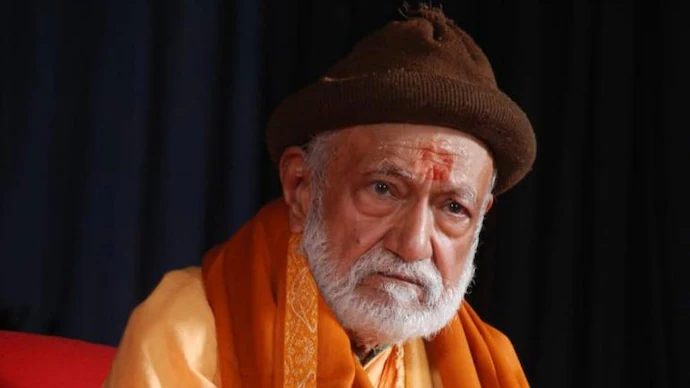
G.D. Agarwal, the Ganga and the Moral Limits of Peaceful Protest’
Venkat Mani Tripathi
Delhi : On 22 June 2018, an elderly environmental engineer began refusing food on the banks of the Ganga.
Professor G.D. Agarwal was not an unfamiliar figure in India’s environmental movement. He had taught at IIT Kanpur, served as member-secretary of the Central Pollution Control Board and spent decades studying water, pollution and river systems. In later life, after embracing the name Swami Gyan Swaroop Sanand, he increasingly combined scientific reasoning with spiritual conviction.
For Agarwal, the Ganga was not merely a sacred symbol. It was a living ecological system.
A river could not be protected only through ceremonial cleaning drives, public slogans or beautification of its banks. It needed sufficient natural flow, functioning ecosystems, protection from untreated waste and restraint in the construction of projects that interrupted its continuity.
His 2018 fast sought stronger legal and ecological protection for the river. Among his principal concerns were the maintenance of an adequate and uninterrupted flow, the regulation of projects affecting the upper Ganga and the creation of a stronger statutory framework for river conservation.
The protest continued for more than one hundred days. In its final stage, Agarwal also stopped taking water. He was taken to the All India Institute of Medical Sciences in Rishikesh, where he died on 11 October 2018.
Some contemporary accounts described it as the 111th day of his fast and others as the 112th. The difference arose from whether the beginning and ending dates were both included in the calculation. The disagreement over the number is less important than the fact that a respected scientist had come to believe that decades of research, correspondence and institutional engagement had failed to produce an adequate response.
His death should not be romanticised. The value of his protest does not lie in the physical suffering he endured. It lies in the question that his protest placed before the country:
Why did a scientist who had worked within India’s environmental institutions conclude that refusing food was his last effective means of communication?
The Scientist and the Ascetic
Agarwal’s public identity was unusual because it brought together two kinds of authority that are often treated separately in modern India.
The first was scientific authority. He understood the Ganga through hydrology, pollution control, environmental flow and river-basin management. He knew that the health of a river could not be measured only by the appearance of the water at a few visible locations.
The second was moral and spiritual authority. To him, the Ganga was not simply a natural resource to be managed. It formed part of India’s civilisational inheritance and demanded a corresponding ethical responsibility.
This combination gave his protest unusual depth. He was neither merely opposing development nor simply appealing to religious sentiment. He was asking whether India could reconcile economic growth with ecological survival.
That question remains difficult because the decline of a river rarely has a single cause. Sewage, industrial discharge, dams, hydropower projects, sand mining, construction, urban expansion and weak enforcement interact across different regions and institutions. Responsibility is divided among the Union government, State governments, municipalities, pollution-control bodies, industries and local communities.
There was therefore no single order that could “save the Ganga”. Nor was there one official, department or political party against whom responsibility could conveniently be fixed.
This complexity strengthened the scientific basis of Agarwal’s campaign but weakened its political communication. A demand for a new State or a new anti-corruption law can be expressed in a short slogan. A programme involving ecological flows, tributaries, barrages, sewage treatment, biodiversity and river-basin governance requires explanation.
Modern political attention does not always reward complexity.
What the Government Did – and Why Agarwal Remained Dissatisfied
It would be inaccurate to say that the government took no action during Agarwal’s protest.
On 9 October 2018, two days before his death, the Union government issued a notification prescribing minimum environmental-flow requirements at specified locations and projects along stretches of the Ganga. The government maintained that it had acted upon almost all of his demands.
Agarwal and those associated with his campaign did not accept that claim. They questioned whether the prescribed flow levels were supported by sufficiently comprehensive scientific study and whether the notification covered the river system in the manner they considered necessary.
The dispute was therefore more complicated than a confrontation between an inactive government and an activist demanding that something – anything – be done.
Action had been taken. The disagreement concerned whether that action was scientifically adequate, geographically comprehensive and legally capable of protecting the ecological integrity of the river.
The notification should neither be dismissed as meaningless nor described as a complete acceptance of Agarwal’s programme. It represented a limited administrative response that did not satisfy his broader vision.
There is also reason to believe that the moral pressure created by his fast contributed to the urgency surrounding the notification. Yet it would be difficult to prove that the measure resulted from the fast alone. Environmental policy is shaped by litigation, administrative discussions, scientific reports, political priorities and earlier campaigns as well as immediate public pressure.
A responsible assessment must therefore avoid both extremes: the claim that his protest achieved nothing and the claim that it secured everything he demanded.
Why Fasting Has Such Power in India
Fasting occupies a distinctive place in Indian political history.
A march demonstrates collective numbers. A strike interrupts economic activity. An election seeks to change those who govern. Litigation asks a court to enforce legal obligations. A fast operates differently: it places the protester’s personal suffering at the centre of a moral appeal.
The protester effectively says that the issue is so serious that ordinary comfort has become secondary.
Because a fast does not ordinarily attack another person or destroy property, it can be a peaceful form of political expression. It may reduce the risk of direct confrontation and compel citizens to confront an issue they might otherwise ignore.
But fasting is not free from democratic difficulty.
An indefinite fast can place intense pressure on governments, officials and the public. As the health of the protester deteriorates, the issue may cease to be discussed only on its merits. The possibility of death can itself become a form of political pressure.
This creates a moral paradox. The protest is non-violent towards others, but it may still attempt to compel a public decision through danger to the protester’s own life.
For that reason, fasting is most defensible when it supports democratic engagement rather than replacing it. Moral protest should be accompanied by clear demands, scientific evidence, public participation, legal action, negotiation and institutional reform.
A democracy should not respond to serious questions only after a citizen places his or her health at risk. At the same time, public policy cannot be determined solely by whoever is prepared to suffer the longest.
Potti Sriramulu: A Fast Joined to a Mass Movement
The political impact of a fast depends not only on the determination of the individual but also on the movement surrounding that person.
Potti Sriramulu began a fast in 1952 in support of a separate State for Telugu-speaking people. He died after 58 days. His death triggered widespread unrest and sharply increased political pressure on the Union government.
However, it would be too simplistic to say that one fast alone created Andhra State.
The demand for Telugu linguistic statehood had existed for years and was supported by an organised political and social movement. Sriramulu’s death became a decisive turning point within that larger struggle. Parliament subsequently enacted the Andhra State Act, 1953, and Andhra State formally came into existence on 1 October 1953.
The fast was politically powerful because the demand was focused, widely understood and supported by a large community capable of continuing the agitation.
Agarwal’s position was very different. His demands addressed a river system crossing administrative boundaries and involving competing claims concerning energy, infrastructure, employment, agriculture, religious practice and environmental protection. There was no single legislative or administrative step that could resolve every element of the problem.
Irom Sharmila: Endurance Without Immediate Repeal
Irom Sharmila began fasting in November 2000 after the Malom incident in Manipur. Her central demand was the repeal of the Armed Forces (Special Powers) Act.
Her protest continued for approximately sixteen years. During that period, she was repeatedly detained and medically fed. She ended the fast in August 2016.
The law was not repealed as a direct result of her protest.
Her experience demonstrates one of the limits of moral endurance. Personal sacrifice, however extraordinary, does not automatically produce policy change. A government may resist moral pressure when it considers the disputed policy essential to national security, territorial stability or administration.
Like Sharmila, Agarwal possessed considerable personal credibility. But moral authority by itself was not enough to generate immediate institutional transformation. Neither campaign was supported by the kind of sustained nationwide political organisation capable of making the issue unavoidable in electoral politics.
Anna Hazare: Moral Protest Amplified by Organisation
Anna Hazare’s anti-corruption fast in 2011 had a different political environment.
The campaign presented a simple and widely understood message. It was supported by civil-society organisers, urban volunteers, public demonstrations, continuous television coverage and extensive social-media activity. The fast became the visible centre of a much larger communication and mobilisation network.
In August 2011, Parliament recorded a non-binding “sense of the House” expressing in-principle agreement on three issues associated with the movement: a citizens’ charter, the inclusion of lower-level public servants through an appropriate mechanism and the establishment of Lokayuktas in the States. The matter was then referred to the relevant parliamentary committee.
This was not the same as Parliament immediately enacting Hazare’s proposed version of the law. The Lokpal and Lokayuktas Act was eventually enacted in 2013, and it did not reproduce every demand made by the movement.
Nevertheless, Hazare’s campaign influenced national politics because the fast was supported by organisation, messaging, media visibility and mass participation.
Agarwal had scientific credibility and spiritual commitment, but he did not possess a comparable nationwide structure. His campaign remained largely associated with environmental specialists, religious institutions and activists concerned with the Ganga. It received media coverage, particularly during its final phase and after his death, but it did not dominate national political discussion for a sustained period.
Why the Ganga Did Not Become a Continuous National Protest
The Ganga has immense religious, cultural and historical importance. Yet symbolic devotion does not always produce support for difficult environmental choices.
Protecting a river may require restrictions on industrial discharge, construction, hydropower projects, sand mining and urban expansion. It may require higher public expenditure, stricter enforcement and changes in the behaviour of industries, municipalities, pilgrims and residents.
Almost every meaningful intervention imposes costs on someone.
Governments may publicly support conservation while also promoting roads, dams, electricity generation, tourism and urban development. The political debate is therefore rarely presented as protection against destruction. It is more often described as a conflict between ecological protection and development, employment, infrastructure or energy security.
Environmental decline is also gradual. A corruption scandal can erupt in a single news cycle. A territorial demand can be placed on a map. The deterioration of a river occurs over years and may be less visible to citizens living far from the affected areas.
Agarwal’s language was scientific and moral rather than electoral. He was not building a political party, seeking office or cultivating a voting constituency. This strengthened his independence but limited his bargaining power.
He became the conscience of a cause without becoming the leader of a mass political organisation.
The Constitutional and Legal Position
Agarwal’s environmental objectives were consistent with important constitutional principles.
Article 48A of the Constitution directs the State to protect and improve the environment and safeguard forests and wildlife. Article 51A(g) places a fundamental duty upon citizens to protect and improve the natural environment, including rivers.
Peaceful protest is also connected with the freedoms of speech and peaceful assembly guaranteed under Article 19. These freedoms, however, are not absolute. They remain subject to constitutionally permitted restrictions, including those concerning public order.
The legal position becomes more complicated when a fast threatens the protester’s life or is intended to compel a public official.
Under the present Bharatiya Nyaya Sanhita, an attempt to take one’s life for the purpose of compelling or restraining a public servant in the exercise of lawful power may attract criminal consequences. This provision came into force years after Agarwal’s death and must not be applied retrospectively to characterise his 2018 protest as an offence.
The Mental Healthcare Act, 2017 also requires the State to approach attempts to take one’s life primarily through care, treatment and rehabilitation, based on a presumption of severe stress. That humane approach does not create an unrestricted legal right to use a life-threatening fast as an instrument of political compulsion.
Indian constitutional law similarly does not recognise a general right to end one’s life. Judicial decisions dealing with withdrawal of medical treatment in narrowly defined end-of-life circumstances belong to a different legal category and should not be confused with political fasting.
The appropriate conclusion is therefore balanced: peaceful fasting may constitute political expression, but an indefinite fast that places life in danger is not legally or democratically neutral.
Shared Responsibility
Agarwal’s fast should not be interpreted only as an accusation against the government.
The condition of the Ganga is the product of failures distributed across institutions and society. Governments must enforce pollution laws, regulate environmentally damaging projects, improve sewage infrastructure and ensure that conservation programmes are scientifically evaluated.
Industries must not treat penalties as an ordinary cost of doing business. Municipal bodies must prevent untreated sewage from entering the river. Religious and social organisations must ensure that reverence for the Ganga is reflected in environmentally responsible practice. Citizens must recognise that a river cannot be protected through worship alone.
Activists, too, carry responsibilities.
A movement should not depend entirely upon the suffering of one individual. It must develop leadership beyond a single figure, communicate scientific issues in accessible language, engage affected communities, use litigation and legislative processes, monitor implementation and maintain transparent dialogue with public authorities.
The moral authority of a fast may open a door. It cannot build the institutions needed on the other side.
A Protest That Was Powerful but Isolated
Agarwal’s fast was morally powerful but strategically isolated.
It demonstrated personal integrity and forced attention upon the ecological condition of the Ganga. It may also have added pressure to the administrative process that produced the October 2018 environmental-flow notification.
Yet it did not generate the sustained mass participation necessary to make river protection an immediate national political priority.
That outcome should not be treated as a failure of his character or commitment. It reflected the structural weakness of environmental politics. Ecological problems are technically complex, their effects are gradual and the economic interests resisting reform may be politically influential.
His protest also revealed an inequality in democratic attention.
A campaign supported by celebrities, political organisations and continuous television coverage may secure rapid negotiation. A scientifically informed environmental campaign may remain marginal even when the issue ultimately affects millions of people.
Public attention often responds more strongly to the drama of a protest than to the evidence that made the protest necessary.
The Question He Left Behind
G.D. Agarwal’s fast should be remembered neither as an act to be blindly glorified nor as an unsuccessful protest to be forgotten.
It should be understood as a warning about the distance between scientific knowledge, public concern and governmental action.
Potti Sriramulu’s fast became politically decisive because it was joined to a powerful linguistic movement and followed by parliamentary legislation. Anna Hazare’s campaign influenced national politics because moral protest was amplified by organisation, media visibility and mass participation. Irom Sharmila’s experience showed that extraordinary endurance does not guarantee immediate policy change.
Agarwal’s fast revealed something different: an environmental cause may possess immense scientific and moral importance and still remain politically weak when it lacks sustained organisation and broad public ownership.
Peaceful protest can awaken a democracy, but it cannot substitute for democratic institutions. Fasting can attract attention, but lasting reform requires legislation, scientific accountability, administrative coordination, independent monitoring and public participation.
Agarwal asked India to move beyond praising the Ganga in speeches and worshipping it in ritual.
He asked whether the country was prepared to protect the river as a living ecological system – even when doing so required difficult choices.
His fast ended on 11 October 2018.
The question did not.